Showing posts with label EU. Show all posts

Tuesday, December 13, 2016

Poul Thomsen and the IMF's "pro growth" policies for Greece


The IMF's Poul (the Ghoul) Thomsen has written about taxes and pensions in Greece in the context of the Fund's contribution in assisting to "Make the Greek Budget More Growth Friendly". This is part of the IMF's newly discovered anti-austerity mission for Greece. Although seemingly relatively sane compared to the rest of Greece's EU "partners'" demands - and especially our colonial overlords in Berlin - of 3,5% budget surpluses for as far in the future as anyone can see, the Fund is in fact helping drive the ongoing negotiations to the rocks. This because in order for the IMF to concede the fiscally obvious regarding surpluses, it demands in return draconian measures against sections of the poor and a further dismantling of labor relations, which is considered, rightly, politically unfeasible, impossible for the current government to even contemplate. (I should note however that as recently as two years ago the IMF was skeptical but approving of 4% + fiscal surpluses for Greece (p.10 and fwd), every year, all the way to the mid 20s)

Simply put, PT's report consists of fallacies, half-truths and misrepresentations piled one on top of the other, the sort of which, when this Austerity Disaster first started, I delighted in shredding apart point by point. As it seems increasingly pointless I'll stick to some basic highlights.

1. IMF as a growth friendly institution: this is the baseline by which all numbers provided by the IMF should be measured.

2. Average salary / tax burden on average salary in Greece (p.9)

3. Disposable income collapsed as a result of the policies that the IMF led the pack of "lenders" in inflicting. So now the IMF laments the "steadily declining tax collections", as if they didn't cause this income collapse, and as if the GDP (as shown in 1, above) didn't plummet at rates reminiscent of wartime. Similarly, as incomes and revenues collapsed and taxes rose, "accumulating tax and social security debt to the state" was a natural consequence, again, of the IMF's own prescriptions

4. I'm not sure how Chart 2, on declining tax collection rate in Greece, jibes with Eurostat statistics showing total tax revenue almost monotonically increasing during the same period

5. Also interesting to note that Greece will have beat the fiscal bailout targets for two consecutive years, basically by improving the collection rate, through, among other factors, exactly the sort of installment and deferral schemes the PT is lamenting. 

6. Public healthcare is in a disastrous condition in Greece, although public expenditure in healthcare has been more or less stable across the past two budgets. However the murderous initial reduction in healthcare spending imposed by the IMF and the EU between 2010 and 2014, is not even mentioned. These reductions were dictated by the troika. PT sounds like he just heard of all this.

7. Greek pensions, the true story. This is from last year, public contributions have since been slashed by 1% GDP, so assume things are worse, and already over 50% of Greek pensioners are around the poverty line

8. The IMF wants to further "liberalize" mass layoffs, in a society that is straining under a 23% unemployment rate, and the Ghoul actually makes the case for this by pointing out that if we dropped even more pensioners below the poverty threshold, then the Greek state could afford better unemployment benefits - and thus I assume it would be cool with the laid off to lose their jobs. Order of magnitude calculations, combined with the dismal - in both remuneration and duration - existing unemployment benefits (i.e Unemployment Benefit Replacement Rates 5y), show that this would offer negligible improvement, provided mass pensioner euthanasia wasn't a prerequisite. How easing layoff laws can possibly help lower the unemployment rate, is one of those things only the IMF executive and similar neoliberal market faith-healers understand, and certainly the IMF's own research teams reject.

9. The Ghoul also fails to mention that the new, improved IMF anti-austerity platform includes refusing to reinstate collective bargaining agreements, which were discontinued originally at the IMF's insistence earlier during this crisis. It also wants to make going on strike more difficult, further hamper unions' already severely diminished capabilities, and allow employer lockouts. This is surely not a step in making anything more fair.

10, Poul Thomsen: "Greece pays an average nominal public pension similar to Germany’s". This is an updated version of an obsession of his.
Wikipedia: The average pension in 2012 [in Germany] €1263.15 per month
Eurostat: Pensioners in Greece receive an average 882 euros per month, 713 euros from basic pension and 169 euros from supplementary pensions (2013). 
Eurostat II: Expenditure on pensions in Greece was lower as % GDP than Germany's until 2007. Then the crisis came and all periphery countries saw the expenditure percentage of pensions explode proportionally to the degree of damage austerity (did I say IMF imposed austerity?) inflicted on their economies.

11. Chart 6, makes little sense until you realize that poverty rates are at 60% of median income, and median income has plummeted in Greece as we saw. So despite the fact that all pensioners in Greece are significantly poorer than what they were in 2007, they haven't lost as much as the economy on average. That's why the working poor in Greece appear by that graph to have increased over the period by just 1%. As pointed out:
The risk-of-poverty rate is even higher when current income is compared to the poverty threshold set in 2005. When measured that way, the deterioration of living standards is startling as 42.2 percent of Greeks have dropped below the poverty threshold of 2005, from just 16.3 percent in 2010. That amounts to an almost threefold increase in just five years.

But finally, as I reconfirm my utter contempt for the IMF and its Murder of Ghouls and Minions, I have in all fairness to point out that compared to the German government they are outright enlightened.
Which is why Europe is doomed.

Saturday, March 17, 2012

The anality of evil

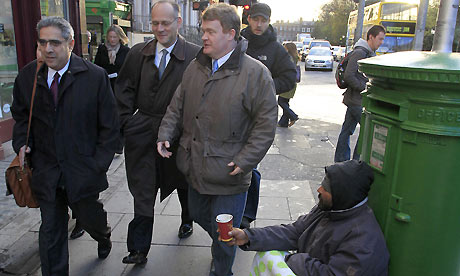
Dark lords of the IMF over Dublin, one of their other lairs

EU Commission President Barroso said: 
"Greece's future passes through restoring both financial stability and growth potential. The support provided by the Commission's Task Force is a key instrument to support growth and jobs in Greece. The solidarity shown by many Member States, the Commission, and other international institutions is a very encouraging signal for this country. Let's build a future for Greece together".
The Daily Mail responded:
Is Greece becoming a third world country? HIV, Malaria and TB rates soar as health services are slashed by savage cuts:
Prostitution and heroin addiction on rise as hospital budgets cut by 40%. Malaria levels reaching near endemic levels in some areas. 'The entire health system is deteriorating'

The Guardian chimed in:
Greece is on the breadline: newborn testing is under threat... a health worker warns that children will die from disorders that are easily detected and treated
"Whatever are you talking about, these sub-humans deserve more austerity" responded the Commission and the Greek government eagerly assented:

...in preparation for the new cuts the government was reviewing public spending programmes, focusing on savings in social transfers, defense and the restructuring of central and local administration.
There would be job cuts in the public sector according to a redundancy and recruitment rule of 1 entry for 5 exits. Athens is to further cut pharmaceutical spending and operational spending of hospitals as well as welfare cash benefits.
“The continuation of the very comprehensive international financial assistance can only be expected if policy implementation improves,” the Commission report said...
"Defending the equitable state, the welfare state, is the top priority, a sine qua non condition for our survival as a civilized people" countered Nikos Xydakis.

"The European social model has already gone" said Mario Draghi dismissively."Yes" agreed the local bankers happily, busy chewing the pound of flesh they stole from the hospitals and the schools.

"While our policies may be unpopular, profligate states are finally starting to reform" added Angela, the demented ordoliberal, pointing at the breadlines and the homeless in Greece with some satisfaction... We have these sort of people here at home too, we do keep them to their station...
Cross posted at the European Tribune

Wednesday, February 22, 2012

A warning to austerian eurocrats

SYRIZA, the Greek Coalition of the Radical Left, has notified through an open letter signed by its president Alexis Tsipras and addressed to heads of Eurogroup member-states, the head of the European Commission Jose Barroso, the President of the European Council Herman Van Rompuy, and Martin Schulz head of the European Parliament, that it does not consider the signature of the politically illegitimate government of Greece binding for future Greek governments. Although SYRIZA is at 10-12% at the polls currently, there is a dynamic testified not only internally but by a recent character-assassination piece in Bild and a less rabid but if anything more vitriolic and selective in its narrative piece in Der Spiegel. SYRIZA is now the first Greek party to publicly commit itself to repudiating the terms of the latest loan agreement, as stated in the letter, translated below. Should SYRIZA continue rising in the polls expect the regime to postpone elections:
Hon. Sirs / Mms
I am sending this letter to alert you to a matter of democratic order of urgent importance for Greece. This has to do with the commitments undertaken over the past two days by the Papademos government, headed by Mr. Loukas Papademos. Allow me to remind you that this is an unelected government, which does not enjoy popular support and has consistently and consciously acted against the will of the people of Greece. This government does not have the democratic legitimacy to bind this country and its people for the coming years, the coming generations. This legitimization deficit is in conflict with the rich democratic tradition of your own country. If this continues therefore, it will become a bad precedent for Greece and Europe as a whole, which above all, have a common inheritance of political and democratic traditions, which must be respected. However great the seriousness of the current circumstances might be - over which there is room for a divergence of opinion - they should not in any way cancel democracy.
The lack of democratic legitimacy of the Papademos government arises from the following facts:
  1. The two political parties, which support the government and participate in it do not have a popular mandate to bind Greece to treaties and agreements of this nature. Their representatives were elected in the last national elections on October 2009, based on political programmes at complete odds with the policies that were followed by the previous Papandreou government as well as those being negotiated today with the EU, the troika and the IIF, by the current government. The two parties which constitute the current government have a recorded history of plundering public resources and are responsible for the current economic situation
  2. The people of Greece have been systematically misinformed and deceived about the intensity and the duration of the austerity measures, ever since their first implementation in 2010. Consequently they have withdrawn their confidence in the Greek political establishment. Furthermore, the widely admitted - inside our country and abroad - obvious failure of these measures to successfully face the fiscal problems they were supposed to solve these past two years and the five-year period of  continuously deepening recession, has further legitimated the demand for a change in policy, so as to restore a socially just growth and therefore the prospect of a fiscal rationalization.
  3. More specifically: the unelected Papademos government provides but a minimum of information, sometimes even deceitful, regarding the agreements it is secretly negotiating. It has not initiated nor has it allowed to initiate any public, informational discussion about the extremely serious long term commitments that follow. Greek Democracy has thus been deprived of the constitutionally protected right of a detailed evaluation of the consequences of the signed agreement. The so-called "second rescue" was voted through an emergency ultra fast-track procedure, in the time-frame of one parliamentary session on a Sunday. The main object of this session was the demand by the government of a carte-blanche authorization on almost blank documents, which are supposed to bind the country for years to come
  4. To the degree that there has been no information on these agreements, their content seems to be such as to commit the Greek people for generations to come. For such commitments any government should at least demand a clear and renewed mandate.
  5. To the degree that there has been no information on the government's movements, the will of the Greek people as expressed in a multitude and a variety of ways, is almost unanimous in opposition to them. Specifically, during the last two years the people of Greece, throughout the country are expressing their opposition to government policies through, among other means, repeated general strikes and demonstrations, occupations, letter writing, electronic messages and other forms of personal communication with members of Parliament. The Greek government, not only chose to ignore the voice of its people, but tried indeed to stifle it, at times even violently, so as to continue in a antidemocratic way, the policies that have been proven disastrous for the Greek economy and society.
For all of the above reasons, I  am notifying you that the Greek people, as soon as they restore their right to democratically express their will and regain control of their democratic institutions, will in all likelihood reserve recognition or compliance with these agreements that the current government is planning to assent to. Specifically the Greek people will not accept any loss of sovereignty, foreign involvement in internal matters of Greece or large-scale sale of public companies, land and other assets that the current government is preparing to accept...

Alexis Tsipras
President of the SYRIZA parliamentary team

Thursday, February 16, 2012

Debts, promises and coups

Schäuble tyrannus

Master and servant
“In Greece the realisation that something has to change, and dramatically, still has to take place among many,” said Schäuble yesterday.
This gem of wisdom, comes from someone who supposedly is in charge of the Greek experiment, the chief of the German economy. I'm not sure how he forms an opinion on what is occurring in Greece, the effects his austerity programmes have on society and the population as a whole, nor do I understand what sort of people advise him on the mindset of the Greek population as a whole. But this didactic tone, coming from someone who obviously, from the effects of the policy he supervises, has not the faintest clue of either the society, or the economy he is helping to demolish and on which he is imposing a developing humanitarian disaster, is colonial in its contempt for the natives.

The Irish Times article linked to in the quotation above, describes Schäuble as one of the negotiators of Germany’s unification treaty, a process which he apparently considers a success and a model for Greece. I leave aside the astonishing idea that the Greek economy is anything like the East German economy was and how terrifying it is that the man running Greece, for all practical purposes, considers it to be a similar project in any meaningful way. I have no first-hand opinion on the matter of course, but it does strike me as odd that the net result is a region which seems to overwhelmingly prefer life under one of the most repressive, intrusive and harsh dictatorships in the Eastern Block, to what Schäuble achieved. So that is what the man calls success: creating mass yearning for dictatorship. I have no doubt that the corrupt and inefficient Third Greek Democracy, ending now, will be remembered with similar nostalgia should current plans persist.

The German leaders' uninformed, yet unabashed shows of contempt, bordering on the racist against Greece and the southerners are, most likely, political theater aimed to please the unthinking Bild readership,vile in its arrogance, but with a broader political aim of enforcing austerity and destroying social Europe as we know it well beyond the Greek borders. Yet one wonders: can they be as cynical as all that? Might the need to make a moralizing argument make them blind and selective as to the sort of "news" and ideas they have about what is happening in the south? I'm not sure... Could it be that it's not just that this is a policy aimed primarily at consolidating the Bild readership, but also a policy informed by Bild?

Meaningless promises burn meaningfully

I have chronicled as best as I could the trials and tribulations of Greek society and its economy, both at Histologion and the European Tribune over the past two disastrous years, and noted the disconnect of the persons in charge of "fixing" the Greek economy with its reality. This whole disaster is turning into a disgusting farce, a farce with real human casualties, but a farce nonetheless. "Greece" is being blamed for failing to meet the programme goals and "lying" to the EU officials. The programme itself cannot be at fault (although it is failing everywhere) so it must be it's lax implementation. This is something that apparently is sold as a fact to northern Europeans, along with the idea that this new package is mainly about "reform" and not about abolishing collective bargaining in Greece, forcefully decreasing private sector salaries to well under official poverty levels and reducing labor law to Burmese levels of worker protection - along with the fire sale of important infrastructure such as the Athens and Thessaloniki water companies and valuable assets such as the state lottery and football pools.

The list of "complaints" about Greece's "broken promises" is impressively ridiculous:
Taxes go uncollected, deficit targets are routinely missed, job cuts from the state payroll are postponed, privatisations have barely begun and pharmacies still shut in the middle of the day. Nearly two years into Greece's bailout, so many promises have been broken that international lenders have largely lost faith in the country's will to reform itself and are torn between imposing stricter outside control and cutting Athens loose.
Let's see how valid the complaints mentioned are:
  • Taxes go uncollected:  This is a ridiculous statement. Taxes - flat taxes, and consumption taxes almost all of them- weighed heavily on the poorer and middle class segments of society, have been vastly increased at a time of total economic implosion. You can't collect taxes now, because the capacity of citizens and most businesses is either diminished or non-existent. As household incomes have fallen by ~50% over the past few months, paying last year's taxes for most households becomes an unbearable weight, and for most small businesses an impossibility. The new tax on property including residences, which was supposed to be paid through the electricity bill (or have your electricity cut-off, I kid you not) - has been met with widespread resentment and refusal of payment from an apparently huge percentage of the population, most of which cannot afford to pay the tax, either because they don't have the money (six out of ten households can't afford to even pay the utility bills, much less the extra tax ), or they're not sure that they won't need the money for pressing and basic needs in a climate of total work insecurity, or because they refuse to be blackmailed by an extortionist state. As even the Telegraph rightly notes:
    Greece’s tax revenue from VAT collapsed by 18.7pc in January from a year earlier.
    Nobody can seriously blame tax evasion for this. It has happened because 60,000 small firms and family businesses have gone bankrupt since the summer.
    The VAT rate for food and drink rose from 13pc to 23pc in September to comply with EU-IMF Troika demands. The revenue effect has been overwhelmed by the contraction of the economy.
    Overall tax receipts fell 7pc year-on-year.
    This is a damning indictment of the EU-imposed strategy. Greece is chasing its tail. The budget deficit is stuck near 8pc to 9pc of GDP because the economic base is shrinking so fast.
  •  Deficit targets are routinely missed: They are. Of course. The targets are unrealistic to begin with, they are imposed based on political aims and not on some plan for the Greek economy, and then the austerity prescribed causes a much greater slump than originally calculated, which makes meeting the deficit target impossible without further cuts, which then cause a deeper recession which cause even greater divergences from the set goal, and so on in an infinite vicious circle... This forecasting error is not limited to Greece alone, but rather a feature of all IMF analyses, which are tools of political coercion and not objective technocratic estimates:
    The fact is that the optimistic 2012 forecasts presented in September 2011 whenever realistic. It was quite clear that the fiscal austerity being imposed upon the Eurozone was always going to result in sharp contractions in real growth.
    The IMF has a history of providing overly optimistic growth forecasts at a time when it is bullying national governments to impose fiscal austerity. The opposite is also the case, their growth estimates that typically conservative when governments are introducing fiscal stimulus packages
    Thus deficit targets are routinely missed, because they are set up that way, in an imploding economy that has lost 15% of GDP in 18 months...
  • Job cuts form the state payroll are postponed: This is hogwash. There is a constitutional ban on firing public sector workers so this can't be done legally as easily as the troika pretends it can. A loophole has been invented in that they can be fired if the position they occupy is canceled. Since 2009, the number of public employees has declined from ~700 thousand to ~500.000. Is this bloated? Well no not even in 2008 it wasn't, according to the OECD:
    Greece has one of the lowest rates of public employment among OECD countries, with general government employing just 7.9% of the total labour force in 2008. This is a slight increase from 2000, when the rate was 6.8%.
    The situation remains significantly unchanged as far as the irrelevance of the size of the public sector employment in Greece to its problems is concerned, even if one adds the broader public sector - quasi-privatized, most of it - which is immediately affected by the troika decisions even though it has no immediate budgetary impact. Now this already low number is to be reduced a further 25%, with promises of firing an extra 150 thousand public employees by 2015. This has literally dissolved the public sector, increased corruption, demotivated the public sector workers and has caused all sort of problems, not least of which is the harm inflicted on the health system, corrupt and inefficient to begin with, which now produces higher mortality rates and superbugs.
  •  privatisations have barely begun: This is true. The reason is that interest in privatized enterprises is close to zero, and the goals set were way too ambitious and unrealistic even last year... Now that the Greek economy has tanked they bring diminishing returns. This is aside of any discussion of the social and long-term economic sense and effects of selling-off things such as the water companies. Demanding immediate privatizations now is a demand for allowing the plunder of public resources. That the privatisation plans were not realistic, was noted very early on by many commentators...
  • pharmacies still shut in the middle of the day: This doesn't merit a response. The reason Greece is in an unprecedented depression is certainly not the traditional arrangements on the work schedule of pharmacies. If they mean the liberalization of professions, it is now in effect in Greece in such a drastic and idiotic way in most cases, that it has destroyed the livelyhoods of thousands of people while creating practically no jobs for anybody else.
This is the sort of propaganda that promotes that idea that the reason for this whole Greek disaster, is not the actual policies imposed by the troika, which came to Greece with general blueprints and no idea about the reality of Greece's economy, vindicating Joseph Stiglitz's views on the IMF missions to various part of the world - but now with a local, ECB flavor of ineptitude:

When the IMF decides to assist a country, it dispatches a "mission" of economists. These economists frequently lack extensive experience in the country; they are more likely to have firsthand knowledge of its five-star hotels than of the villages that dot its countryside. They work hard, poring over numbers deep into the night. But their task is impossible. In a period of days or, at most, weeks, they are charged with developing a coherent program sensitive to the needs of the country. Needless to say, a little number-crunching rarely provides adequate insights into the development strategy for an entire nation. Even worse, the number-crunching isn't always that good. The mathematical models the IMF uses are frequently flawed or out-of-date. Critics accuse the institution of taking a cookie-cutter approach to economics, and they're right. Country teams have been known to compose draft reports before visiting. I heard stories of one unfortunate incident when team members copied large parts of the text for one country's report and transferred them wholesale to another. They might have gotten away with it, except the "search and replace" function on the word processor didn't work properly, leaving the original country's name in a few places. Oops.
There is no doubt, in short, that the Greek government, a most obedient group of creditors' overseers, lacks credibility. First and foremost it lacks credibility among its population. All polls show, and Sunday's demos proved, that this is a government that has lost all real political legitimacy, and the two parties that support it are in free fall. But the reason it lacks this legitimacy, the reason that they are ineffective tools for the implementation of the IMF/ECB programme is exactly because they are trying to implement a political project of mass pauperization and destruction of the minimal social state that existed in Greece before the arrival of the troika. This is not only an unjust and violent plan, but also a plan fraught with contradictions, misdiagnoses, and ideological fixations that apart from destructive also make it unworkable. It is, I admit, a display of evil political genius, that this impossibility is used to reinforce its brutality, at least as far as the other suckers in this mass bank bailout that is sold under the guise of Greece's bankruptcy, are concerned, namely the taxpayers of the loaning countries. Money given to "Greece" in fact will end up a. feeding Greek banks, already bailed out lavishly on taxpayer money, though their ownership structure will be preserved, with sums that are two orders of magnitude larger than their current market evaluation b. To the PSI participants c. To pay of already existing debt. There is no d. It bodes ill for the future of Greece that the memorandum (which parliament approved in a few hours, in a draft version that had blanks on actual sums of money involved, to be filled after its approval!) is a straight jacket that in practice commandeers the Greek economy for the benefit of bankers and other creditors, to the detriment of its population. That is why the Greek government lacks credibility even to lenders: a democratically  illegitimate government facing elections soon, is not credible because it is not stable. Which brings us to recent developments


An EU coup?

The severity of the measures and the blatant breach of any sort of national sovereignty by the new loan deal, coupled with the growing strength of the actual left in Greece, has created a climate of insecurity for the powers that be in the EU - powers, I should add that are already seen as enemies by much of the Greek population. Thus the German Finance Minister and the EPP axis of austerity around him are apparently considering an ultimatum, or is it blackmail? call it what you will:
There were signs a group of triple A-rated governments, including Germany, Finland and the Netherlands, were hardening their stance towards Athens. During a conference call among eurozone finance minsters, the three countries suggested they may want additional letters from other smaller Greek parties and openly discussed the possibility of postponing Greek elections.
Ahead of the call, Wolfgang Schäuble, the German finance minister, said in a radio interview Greece might delay its polls and install a technocratic government that does not include politicians like Mr Venizelos and Mr Samaras, similar to the model currently in place in Italy.
So elections should be put off, according to the debtors wishes, despite the fact that Samaras has guaranteed elections will be held in April and that it is blatantly obvious that the current government is totally at odds with the popular sentiment, as is the parliament. This is not a democratic union anymore. This is a tyranny where political leaders are extorted into signing letters of submission and adherence to a dead-end policy, that has failed in multiple parts of the world. This is the neoliberal cancellation of democracy, the emergence of the European Central Bank as an instrument of transformation of the European Project to some sort of market-driven dystopia. This is not tolerable, and it's not just about Greece anymore.

It seems that the Greek debacle, the realisation of the extent to which European elites are ready to use the debt crisis as an instrument for the neoliberal transformation of the EU has stirred popular forces around the world. From England, to France, to Spain, , Belgium, Italy, even as far away as San Francisco, a lot of people realize that the fight in Greece is more than about fiscal rectitude and balancing budgets, it is the first in a series of battles that will decide the way the debt crises will unfold in Europe and beyond, whether the EU will become another labor wasteland and whether Social Europe as we have known it will continue to exist and develop.

That is the battle we're fighting here, not just for our own skins, although we're trying to avert a descent to a humanitarian disaster, but also the first battle in a world-wide social war over the debt, over who controls the economy and whom it should benefit...
[A briefer and more focused version of this story can be found at the European Tribune]

Wednesday, October 19, 2011

Greece on the Brink of Emergency: A Matter of Days

As Greece prepares for a 48 hour general strike, promising to be the largest ever in a series of far from insignificant mobilizations over the past year and a half, there is a sense here that the coming week will be historical, fateful. The success of the strike over the following two days will be hard to measure, though it seems that there is an unutterable goal of toppling the government, which acts as a quasi colonial regime, pressured to surrender the last vestiges of sovereignty, imposing a catastrophic austerity in full knowledge that it is catastrophic.

The situation is reaching a critical point and I reproduce below, as a general intro, a brief analysis on the current situation that Aris Leonas has been kind enough to send me, with minor edits:


Greece on the Brink of Emergency: A Matter of Days

by Aris Leonas

[Note: This text is part of a longer article about the global crisis and resistance that is being written by Kolya Abramsky, and will explore questions of the emerging worldwide political struggle which is the latest stage of the crisis’ development; the limits of political reformism; control of key means of production and reproduction; and the question of force. It was hoped that this longer article could be finished already by now, but this has not been possible. However, due to the urgency of the situation in Greece, and the fact that the situation can change radically in the next few days, he has decided, together with Aris Leonas, who is the main author of this text on Greece, to send this part out separately].

In Greece a number of factors stand out, suggesting that Greece is on the verge of some major changes. The disruption of basic operations of the state in conjunction with the widespread certainty that the Greek debt cannot be controlled (constant rumours of default in the coming period) compose a picture of political instability and crisis which seems to be the precursor of a more generalized political crisis to be spread to the rest of the south European regimes first and possibly to the heart of the Eurozone given the accelerated tensions of the financial crisis and the disagreements among current leaderships in the Eurozone. The remaining days leading up to the summit of the EU leaders, on the 23rd October, and the G20 summit in the first week of November are considered crucial. Something has to give, and soon. And, it could go in many different directions, for better, or for worse. Rumours, which may or may not be true, are circulating regarding possible deployment of the EU EuroGendFor (Euro Gendamerie Force) military personell being called to Greece in the days ahead...

On the one hand, there has been an incredible level of political activity and mobilization from very broad layers of society. This has continued to intensify, bringing in ever greater numbers and becoming more and more continuous as the crisis has deepened much further since 2009. The sequence of movements follows this general scheme: broad student movement and riots during 2006-07 before the official announcement of the Greek debt crisis; weeks of urban rioting that took place in December 2008 as young people responded to the police killing of a teenager; mass demonstrations; 13 general strikes since the IMF deal; most political form of the movement of indignados (compared to the similar movement in Spain); the last step in this series of resistances is expressed through occupations of public spaces and buildings, and strikes in key industries such as transport or railways.

On the other hand, this high level of mobilization has not stopped or even slowed down the pace of austerity measures, nor the plans for mass privatizations, and repression has been growing. Protests have been met with extreme police violence, and increasingly strikes are being declared illegal.

Despite high levels of organizing, people report a profound sense of despair, and no clear sense of alternatives being built by people. There is widespread panic and a general sense of economic, political and mainly social collapse. Increasingly the reproduction of massive parts of the society is becoming more and more difficult, as society’s functioning grinds to a halt. Nothing is working, neither public services nor private deals.

Political organisations, such as parties on the left side of the spectrum to groups in the anti-authoritarian or autonomous spectrum, are under enormous pressure. The acceleration of the economic crisis has resulted in a serious political crisis and the complete lack of a concrete alternative is obvious. Voices on the left spectrum have begun whispering about the need to form a left government constituted by a broad coalition of the left parties and smaller groupings. However, they have been unable to articulate this idea in such a way as to inspire the broad movements and struggles which have appeared in a very sudden and decentralized way. This, despite the fact that these parties are actually potentially very strong, as they account for 26% in the polls, while the party in government accounts for only 15%, with almost 50% of the voters having declared that they will abstain from voting in any future elections. The range of left parties includes: Syriza, a left coalition born after the decade of Social Forums; the Communist Party – a traditional communist party with its own unions, that are widely criticized for being reluctant to join with the rest of the left in some type of coalition; Antarsia, a small coalition of anti-capitalist groups; and the Ecologists-Greens, a relatively new party linked to the European Greens).

People are under huge pressure. Increasing sections of the population are unable to pay taxes, pay back loans or even ensure the satisfaction of their basic subsistence needs, such as electricity, health services, housing etc.

Unemployment is increasing fast, and is expected to reach an average of 25% in the first semester of 2012. High taxes are being imposed through electricity bills, and the economy has contracted fast, and fear, or even panic, reigns among large parts of the active population. All of this has created a fluid mass of ex-workers, as well as over-exploited and insecure employees. These people are not connected to the traditional trade unions (these are the unions which have traditionally been, for the most part, attached to the two main political parties, i.e. the ruling PASOK party, and Nea Dimokratia, which was in power until it lost the elections in 2009). Unemployment and insecurity mainly affect the younger generations, which are forced to emigrate (mostly to North and Central Europe, and also Australia and Canada). This is especially so for high-skilled workers and those with with university degrees.

Current situation:

The level and intensity of struggles has grown rapidly since the summer and during the first weeks of October. The Greek version of the indignados movement (“Aganaktismenoi” in Greek), which ended with riots in June to mid July, seems to have completed its first cycle of existence, leaving behind a space for a broad basis for interaction among different movements and groups across the country. This has expressed itself in the form of many decentralized and spontaneous activities such as strikes and occupations in the public sector, as well as mass demonstrations and rioting. During this period, new forms of committees of struggle have emerged, increasing the number of participants and showing a willingness to unite behind the call for a 48-hour strike which was issued by the General Confederation of Workers (GSEE) and the Confederation of public servants (ADEDY) for the 19th-20th October. Although these committees are still very new, they have already shown themselves to be highly stable. They vary both in the form and place of struggle, ranging from low level unions in workplaces, to assemblies that organize occupations and neighbourhood assemblies that organize local struggles and unite during major calls, such as calls for demonstrations in the centre of Athens.

Several new forms of struggle have been born during this period. This includes occupations of (8) ministries and government offices, disruption of operations at different levels of the state, from local authorities all the way to state services such as tax offices and courts etc., the occupation of productive infrastructure (means of public transport, railways, occupations from the powerful union of workers in the Public Power Corporation). Every day smaller protests also disrupt the regular functioning of commercial, economic and social life. However, this high level of mobilization has, until now, as we mentioned, not managed to stop or slow down the pace of austerity measures, nor derail mass privatizations. Furthermore, the efforts at creating a concrete and broad organizing umbrella of all these movements has, so far, not given rise to any kind of new institutional form. Left parties, activists and workers meet during these struggles in a rather chaotic way. It is becoming increasingly important to try to ensure that these committees which have emerged become legitimate focal points for building and defending mass based popular power through struggle.

Until now the government has been trying to avoid any uncontrollable explosion from below (such as the ongoing occupations in the public power corporation, strike of workers in the cleaning sectors of the local authorities). Repression has been growing. Street protests are met with increasing levels of violence from the police. More and more strikes are declared illegal, and private companies are being hired by the government to take over tasks that are not being carried out due to occupations and strikes in the public sector etc. The army has even been called in to clean city streets, as cleaners are on strike.

Things are now coming to crisis point, and it is matter of days. In the run up to the summits mentioned above, the movement from below is intensifying its actions through strikes and demonstrations across the country. At the same time as mass activities are increasing, the government is also making moves from above, apparently in preparation for what will follow should the current government resign, and these plans are taking the antidemocratic measures to new levels, based around a state of emergency.

Certain moves from within the government show that this week is probably the most crucial of the crisis period in Greece. Especially important in this regard is a long article signed by three important ministers on Sunday the 16th October, and supported by the assistant PM and Minister of Finance E. Venizelos. This article asks people to loyally follow the policies agreed with the IMF, and to establish the consent of the silent majority against, the so-called vocal minorities who are disrupting the country’s political functioning. This is full of incredibly antidemocratic and authoritarian overtones, suggesting the urgency of the situation. Another important factor that adds to the image of a collapsing government is that increasing numbers of important trade unions and very large numbers of party members have been withdrawing from the ruling PASOK party, as well as one member of parliament. Rumours are rife about what scenarios might develop in the next-days, and it is virtually impossible to know which have their basis in fact and which do not. This includes the rumour that some kind of new antidemocratic social and political compromise will be established among the different centre-right parties, in the form of a national unity government, or the installation of a government of technocrats, or the installation of a state of emergency etc., in order to pre-empt the threat of an even worse scenario unfolding, a threat which remains unspoken from all sides. Presumably, this unspoken threat, which established political authorities understand all to well, is the threat of revolution from below. The question of political power in on the table, and the political crisis will be resolved in the struggles in the days and weeks ahead, in one way or the other.

This is a call for people in Europe, and other parts of the world, to watch closely the developments in Greece, and to be ready for the next stages in the development of this political crisis, which will soon spread, in all probability first to other parts of Southern Europe, and later to the European Union as a whole. The political crisis in Greece has taken approximately two years to reach its climax, and this time frame is likely to be greatly reduced in other countries as the European and global crisis accelerates. There is no time to lose.

Thursday, April 2, 2009

Wednesday, March 4, 2009

Would you bank on them?


/ who hired these guys again? /
If you follow a disastrous path and not only fail miserably at your job but drag the whole Earth along with you, shouldn't you get another chance to implement the exact same philosophy that caused the disaster? Well yes, if the persons hiring you are the European Commission and you are among the elite economists that were proven so spectacularly wrong on anything they said prior to the crash. I paste from the executive summary of the Corporate Europe Observatory report "Would you bank on them?":

The financial crisis has unleashed a huge debate on the state of the global financial system.
As politicians examine fiscal solutions and regulatory reforms, the big question is how supervision and regulation should be changed to avoid a repetition of the present meltdown. In the EU, the Commission and the Council has set up a High Level Group of eight experts to advise them on how to reform the financial system in terms of supervision and regulation. Given the now obvious failings of the current system and individual financial sector
institutions, it would seem prudent to seek advice from a diversity of sources, including from independent experts who had expressed concern about the flaws in the current financial architecture.
However, the group - named the de Larosière Group after its chairman - is comprised of people closely linked to the financial industry, or to institutions that, to a greater or lesser extent, have been implicated in the crisis. Four members of the group are closely linked to giant financial corporations that have all played a major role in the current financial crisis, a fifth was the head of the UK Financial Services Authority that completely failed in its supervision of bust bank Northern Rock, a sixth is a fierce enemy of regulation and a seventh works for a company whose clients include major banks.
Beyond this, some members of the Group failed to warn of the impending financial crisis and lately they have even played down its extent and severity. The majority have expressed strong support for a deregulated financial sector and can be deemed to have supported hard-line, neo-liberal policies that arguably created the financial crisis. They are the very kind of people who got us in to the mess. The eight members are:

Jacques de Larosière: Co-chair of the financial sector lobby organization, Eurofi and until recently, adviser to the French bank BNP Paribas for a decade
Rainer Masera: Former Managing Director of a European branch of Lehman Brothers, which went bankrupt after heavy losses on subprime loans
Onno Ruding: An adviser to Citigroup, owners of Citibank that received billions of US dollars in a bail-out
Otmar Issing: Adviser to the financial giant Goldman Sachs
Callum McCarthy: Former head of the UK Financial Services Authority, accused of systematically failing in its duty over bust British bank, Northern Rock
Leszek Balcerowicz: A strident advocate of deregulation
José Pérez Fernández: Works for a financial market intelligence company, which counts big banks as clients
Lars Nyberg: A career banker, now vice chair of the Swedish National Bank.

That such a group has been selected to play a key role in the EU debate on the response to the crisis is deeply worrying. It is unlikely to open up any debate on real alternatives to the present financial architecture.
Policy capture by vested interests results in flawed policies and regulations. Europe’s leaders must end the privileged access to decision makers enjoyed by the powerful finance sector lobby. At the same time, they must also curb the power that the private sector holds over the political process in the EU and make decision-making democratically accountable.

Tuesday, June 24, 2008

Going privately postal


/ letters to nowhere /
The EU commission warns over "ploys" to protect public postal services, meaning attempts to minimize public cost. These ploys include apparently wildly unreasonable demands:

...Finland has in theory opened its market to full competition but insists on a fee from new entrants if they won't offer their service across all the territory, the official said.

"That, for us, is a freedom of establishment issue," the official added, referring to a plank of EU law that can be mobilised to stop a country hindering competition.

Brussels is also concerned about "protectionist thoughts" in Belgium where a plan is mooted to make all new entrants offer a service across the entire country, a costly undertaking...


Any attempts to "impose" universal service, are thus deemed unacceptable by the folks in the EU commission (the sensitivity of whom to public sentiment and common sense in the EU will virtually guarantee that any EU related issue put to referendum will fail). As the Apostate Windbag has explained some while ago:

So if the directive supposedly guarantees universal service provision, how exactly will the market provide?

The answer is it won’t, as, again, the Commission admits. In order to ensure universal service provision member states ‘may choose’ from a range of different options: state aid (subsidizing private businesses), public procurement, compensation funds or cost-sharing. In other words, recognizing that private providers will be extremely reluctant to provide loss-making services, the Commission has concluded that to continue to ensure universal service provision, governments will still have to pay for it.

Essentially, we are selling the goose that lays the golden egg. While still having to fund universal provision of service, governments will no longer have the subsidy for this service that business-originated and parcel post previously provided.


But what's the empirical evidence regarding the mythical beast called "benefits to the consumer" the appearance of which precedes but rarely follows privatisations the world over? In the British case, a recent report is rather unequivocal, and I'll let the impeccably unsocialist Telegraph, summarize it as "'No benefit' to opening up mail market":

Opening up the postal market to competition has undermined the future of the Royal Mail and provided “no significant benefit” to consumers or small businesses, a report has said.

It found that since liberalisation individual customers had no more choice in who delivered their letter, but were now faced with a complicated sizing and pricing system.

The review, by a Government-appointed panel, also warned that ending the Royal Mail’s monopoly posed a “substantial threat” to the financial stability of the company and the universal postal service in general.


The Telegraph puts it even more explicitly in a related article eloquently titled "Royal Mail privatisation 'hurts customers'":

Posting a letter has become more expensive and more difficult since the market was opened to competition, a government-backed report said yesterday.

Individual Royal Mail customers now have to contend with higher stamp prices and a complicated sizing system as a result of liberalisation, which has provided them with "no significant benefit".


Seumas Milne notes in the Guardian that:

"...The farce of [Labour's] claims [about the effectiveness of its policies] couldn't have been more clearly demonstrated than in the liberalisation and creeping privatisation of Britain's postal service. Far from "working" or delivering the goods, the corporate-skewed opening up of the market is progressively destroying a publicly owned network at the heart of Britain's social and business life. When New Labour came to power, the Post Office was an effective public monopoly handing over more than £100m profit a year to the public purse. Public and political support saw off successive attempts by the Tories and, more tentatively, Tony Blair to privatise what had become Royal Mail.

But eight years after New Labour began exposing the network to private competition and two years after Royal Mail's 350-year-old monopoly was finally abandoned, the postal service is in crisis and the universal service which guarantees delivery of mail anywhere in the country at a single price is in peril..."


Failures however can always be explained by arguing that reforms haven't been deep enough, or that any shortcomings are temporary etc - while governments are advised to leave the services up for privatisation to rot for a while, so that a demand for reform will make privatisation seem sensible. Local developments of course couldn't be allowed to trail behind.

Friday, November 2, 2007

Secession: beyond economics


/ is breaking up so hard to do? /
I was following, a month ago, the whole brouhaha surrounding the Belgian government crisis. Possibly the best summary of what was and is at stake in Belgium was written by Ingrid Robeyns, at Crooked Timber, a post that offers coprehensively both background and analysis of the current crisis' main events. Today, as the issue of Belgium's political impasse moved past record-breaking territory, into a major crisis, previous claims that the country quite probably is not heading towards a break-up, although quite possibly accurate, might seem less than 100% convincing. Everybody seems to agree that the financial imbalance between Flanders and Wallonia, which led to the Flemish having to subsidize the Walloons through their taxes, is a factor in the Belgian equation. It quite probably is, but the interesting thing here is that in the event of secession, both countries will remain partners within the EU, with some sort of transfers certainly flowing again from the State of Flanders to the State of (Rump) Belgium, through the Union's many funds and subsidies!

The question of independence and secession from a country, within the EU, is a novel twist to the "subnational" issue, that enhances the viability of the secessionist project and the vision of secession advocates, in many parts of Europe. To name but a few cases, this prospect has been part of the rhetoric of the Catalans, the Basques, the Scots, the Welsh, the "Padanians" and of course the Flemish. The EU offers a "safe haven" of sorts to various independence movements, a guarantee that "much will remain the same" even in the event of secession, especially regarding the economic viability of such a project. Thus, economic motives for secession can be reasonably seen as enhanced by the prospect of EU participation. Indeed, given the current ideological climate and raw economism, the concept of nation-building as an exercise in revenue maximizing state-branding, isn't beyond contemplation at all.

Economic motives for secession, or market-driven "ethnogenesis", seem very "contemporary". But is economics the driving factor (instead of a driving factor) in secessionist movements? Can states be built on economic considerations alone? Does the Flemish secession movement exist principally because of taxation issues?

I think not.

First of all it is far from obvious that the EU itself is comfortable with the idea of internally multiplying its member states. As the Economist has pointed out:

The EU is also unlikely to support moves leading to any disintegration of member states. Regional movements often point to the EU as a trans-national safeguard, allowing them more easily to dispense with their nation-state affiliation. But the EU may be more concerned about any process that upsets its own delicate institutional balance, to say nothing of making it harder to gain a consensus for a new EU constitution. Having put the brakes on further external enlargement, the EU will not welcome a form of internally-generated expansion.


In fact Prodi had warned explicitly (Scotland in that instance), as President of the EC that EU membership is not a given for any wannabe breakaway republics:

Three years ago... Romano Prodi, the President of the European Commission, warned that if Scotland... breaks away from the United Kingdom, Edinburgh would have to reapply for membership of the European Union (EU). "A newly-independent region would, by the fact of its independence, become a third country with respect to the (European) Union and the treaties would not apply any more in its territory," Mr. Prodi said.


One might also add that the regionalisation of Europe (as intent for the time being and not as actual pervasive policy) and the role that regions seem to be playing in EU development strategy, can act as a counterweight to separatism, as they deliver plenty of self-government to local entities, circumventing (up to a point) the hold of the national government. The prospect of a purely regional Europe however is a non-starter, among other reasons because of scaling problems. I quote from a highly relevant interview with Nicolas Levrat, the director of the Institute of European Studies at the University of Geneva, questioned by eurotopics:

Q: Could you imagine a European Union made up of regions and not of nation states?

NL: A Europe of the Regions wouldn't work. We see that the Committee of the Regions is quite inefficient. We are talking about 200 or 300 entities trying to make decisions. Imagine the procedures necessary to reach a qualifying majority in a decision making body with 300 members! It's not like your average parliament, it would be much more difficult as is already the case in the present European council with 27 members.


Then there is the issue that, apart from problematic parts of the world such as Africa and the (Western) Balkans, there is little that suggests that independence or autonomy movements are directly tied to solely economic considerations - see for example the paper by Elliot D. Green On the Endogeneity of Ethnic Secessionist Groups, which presents the theoretical context of the debate and evidence that shows that the relation between economic opportunity and secessionist power is not linear at all.

Ethnogenesis is a complex process and certainly not one that can be reduced to a purely economic cost-benefit analysis. If this is the case for well established secessionist movements, it is even more so for ad hoc potential entities constructed on economic considerations alone. In fact the only case of a country built on principally economic considerations in Europe that I can think of is Montenegro. Whether that was a wise move, is another discussion, as it isn't at all that obvious that Montenegro is more independent now (under any meaningful definition of the term "independent") than it was when it was federated with Serbia. Anyway, the post-Yugoslav Balkans, home of the smuggler-state, doesn't lend itself towider generalizations.

Note also that were regional economic inequalities a driving force for "nation building" alone (either through the logic of "liberation" from paying for the "backwards" regions, or through the aspiration of a better economic future for disadvantaged regions), the phenomenon would be vastly more widespread than it is now. The economic gaps that exist in almost countries between certain regions are often quite larger than the corresponding gaps between secessionist regions and other regions within the same country, yet not all regional income gaps lead to demands for autonomy or secession. Thus Nicholas Levrat's assertion (in the abovementioned interview) that "Contrary to what is commonly said - that the rise of regionalism is linked to the funding structure and federal EU policy - the facts suggest that it is not the regions that are heavily subsidized by the EU that are pushing for independence but rather the rich regions", is a generalization that is not even statistically valid: Not all, not even most, but just a handful of "rich regions" are pushing for independence. The ones that do are riding on and succeed because of a preexisting national identity.

Thus, the sort of mechanistic reductionism that sees national or regional aspirations of independence as a result of solely, or even principally, economic forces and motives, isn't convincing. The EU separatist movements in fact are, if anything less prevalent today than they were in the past, because political issues such as minority rights, language issues and local government are guaranteed inside the EU. There is a political primacy here that cannot be generated at whim, and is dependent on factors such as local history and past grievances. Countries are not corporations. They presuppose (and impose) a vastly deeper loyalty than any brand-name ever could. History cannot be fast forwarded nor reduced simply to the pursuit of profit.

Tuesday, September 25, 2007

The draft reform treaty for the EU, in plain English


/ daft or draft /
Given that the new EU draft reform treaty was deliberately made unreadable, in order to avoid the nuisance of public acceptance through national referenda, and some hold that it is 96% the same as the European Constitution document that was rejected by French and Dutch voters a couple of years ago (although the BBC insists that there are some important differences), there is a rather pressing need to figure out what the damn thing says.

To this end, the kind folks over at Statewatch, a European State and Civil Liberties watchdog group, were kind enough to wade through the mire of existing treaties and present us with an analysis of the draft treaty which, while not exactly constituting easy reading by any means, makes it possible to see what the changes are about. As they put it:

...the text of the Reform Treaty is completely unintelligible unless it is read alongside the existing Treaties. Furthermore, the full impact of many of the amendments to the Treaties set out in the draft Reform Treaty needs further explanation. Finally, there has been much public discussion of whether or not the draft Reform Treaty is essentially identical to the EU's Constitutional Treaty of 2004.

In order to further public understanding of and debate upon the draft Reform Treaty, the following Statewatch analyses make the text of the draft Treaty comprehensible, by setting out the entire texts of the existing TEU and TEC and showing precisely how those texts would be amended by the draft Treaty. There are explanatory notes on the impact of each substantive amendment to the Treaties, and each analysis includes general comments, giving an overview of the changes and pointing out exactly which provisions of the draft Reform Treaty were taken from the Constitutional Treaty, and which provisions are different from the Constitutional Treaty.

There are 3 analyses, divided into ten parts.


Se also an ongoing series of articles on the proposed treaty by Francis Wurtz (part 1, 2, 3, 4, 5), who is President of the Group of the United European Left/Nordic Green Left (GUE/NGL) in the European Parliament and a member of the French Communist Party. Further installments of Wurtz's analysis will appear (I assume) on Spectrezine, the Dutch Socialist Party's online magazine.

Tuesday, February 1, 2005

The European Project: Dismantling Social Democracy, Globalising Neoliberalism, by Andy Storey

The European Project: Dismantling Social Democracy, Globalising Neoliberalism, by Andy Storey: "Leaving aside for now obvious questions of how exclusively European are the citizenship and social models discussed above, to what extent does European regionalism in the form of the EU currently promote these models? We may conclude with little argument that it does promote a certain version of post-national citizenship (though increasingly restrictive asylum and immigration policies render that rather less inclusive than its adherents might claim - Beatty, 2004). However, does it promote the social model? In the view of some observers, including Anthony McGrew (see above), it most certainly does not.

Van Appeldoorn (2001) provides some useful historical perspective on these questions. He identifies three different visions of European order: neoliberalism; neo-mercantilism; and social democracy. The neo-mercantilist vision, it is argued, underpinned the initial drive towards the creation of the European single market and Economic and Monetary Union (EMU). For neo-mercantilists, a European competitiveness gap vis-a-vis the rest of the world was attributed to fragmented markets, a related inability to fully exploit economies of scale in production, and insufficient investment in research and technology. (For neoliberals, the problems were - and still are - more likely to be attributed to factors such as inflexible labour markets, and unsustainable and work-discouraging welfare states)."