Showing posts with label economy. Show all posts

Thursday, February 16, 2012

Debts, promises and coups

Schäuble tyrannus

Master and servant
“In Greece the realisation that something has to change, and dramatically, still has to take place among many,” said Schäuble yesterday.
This gem of wisdom, comes from someone who supposedly is in charge of the Greek experiment, the chief of the German economy. I'm not sure how he forms an opinion on what is occurring in Greece, the effects his austerity programmes have on society and the population as a whole, nor do I understand what sort of people advise him on the mindset of the Greek population as a whole. But this didactic tone, coming from someone who obviously, from the effects of the policy he supervises, has not the faintest clue of either the society, or the economy he is helping to demolish and on which he is imposing a developing humanitarian disaster, is colonial in its contempt for the natives.

The Irish Times article linked to in the quotation above, describes Schäuble as one of the negotiators of Germany’s unification treaty, a process which he apparently considers a success and a model for Greece. I leave aside the astonishing idea that the Greek economy is anything like the East German economy was and how terrifying it is that the man running Greece, for all practical purposes, considers it to be a similar project in any meaningful way. I have no first-hand opinion on the matter of course, but it does strike me as odd that the net result is a region which seems to overwhelmingly prefer life under one of the most repressive, intrusive and harsh dictatorships in the Eastern Block, to what Schäuble achieved. So that is what the man calls success: creating mass yearning for dictatorship. I have no doubt that the corrupt and inefficient Third Greek Democracy, ending now, will be remembered with similar nostalgia should current plans persist.

The German leaders' uninformed, yet unabashed shows of contempt, bordering on the racist against Greece and the southerners are, most likely, political theater aimed to please the unthinking Bild readership,vile in its arrogance, but with a broader political aim of enforcing austerity and destroying social Europe as we know it well beyond the Greek borders. Yet one wonders: can they be as cynical as all that? Might the need to make a moralizing argument make them blind and selective as to the sort of "news" and ideas they have about what is happening in the south? I'm not sure... Could it be that it's not just that this is a policy aimed primarily at consolidating the Bild readership, but also a policy informed by Bild?

Meaningless promises burn meaningfully

I have chronicled as best as I could the trials and tribulations of Greek society and its economy, both at Histologion and the European Tribune over the past two disastrous years, and noted the disconnect of the persons in charge of "fixing" the Greek economy with its reality. This whole disaster is turning into a disgusting farce, a farce with real human casualties, but a farce nonetheless. "Greece" is being blamed for failing to meet the programme goals and "lying" to the EU officials. The programme itself cannot be at fault (although it is failing everywhere) so it must be it's lax implementation. This is something that apparently is sold as a fact to northern Europeans, along with the idea that this new package is mainly about "reform" and not about abolishing collective bargaining in Greece, forcefully decreasing private sector salaries to well under official poverty levels and reducing labor law to Burmese levels of worker protection - along with the fire sale of important infrastructure such as the Athens and Thessaloniki water companies and valuable assets such as the state lottery and football pools.

The list of "complaints" about Greece's "broken promises" is impressively ridiculous:
Taxes go uncollected, deficit targets are routinely missed, job cuts from the state payroll are postponed, privatisations have barely begun and pharmacies still shut in the middle of the day. Nearly two years into Greece's bailout, so many promises have been broken that international lenders have largely lost faith in the country's will to reform itself and are torn between imposing stricter outside control and cutting Athens loose.
Let's see how valid the complaints mentioned are:
  • Taxes go uncollected:  This is a ridiculous statement. Taxes - flat taxes, and consumption taxes almost all of them- weighed heavily on the poorer and middle class segments of society, have been vastly increased at a time of total economic implosion. You can't collect taxes now, because the capacity of citizens and most businesses is either diminished or non-existent. As household incomes have fallen by ~50% over the past few months, paying last year's taxes for most households becomes an unbearable weight, and for most small businesses an impossibility. The new tax on property including residences, which was supposed to be paid through the electricity bill (or have your electricity cut-off, I kid you not) - has been met with widespread resentment and refusal of payment from an apparently huge percentage of the population, most of which cannot afford to pay the tax, either because they don't have the money (six out of ten households can't afford to even pay the utility bills, much less the extra tax ), or they're not sure that they won't need the money for pressing and basic needs in a climate of total work insecurity, or because they refuse to be blackmailed by an extortionist state. As even the Telegraph rightly notes:
    Greece’s tax revenue from VAT collapsed by 18.7pc in January from a year earlier.
    Nobody can seriously blame tax evasion for this. It has happened because 60,000 small firms and family businesses have gone bankrupt since the summer.
    The VAT rate for food and drink rose from 13pc to 23pc in September to comply with EU-IMF Troika demands. The revenue effect has been overwhelmed by the contraction of the economy.
    Overall tax receipts fell 7pc year-on-year.
    This is a damning indictment of the EU-imposed strategy. Greece is chasing its tail. The budget deficit is stuck near 8pc to 9pc of GDP because the economic base is shrinking so fast.
  •  Deficit targets are routinely missed: They are. Of course. The targets are unrealistic to begin with, they are imposed based on political aims and not on some plan for the Greek economy, and then the austerity prescribed causes a much greater slump than originally calculated, which makes meeting the deficit target impossible without further cuts, which then cause a deeper recession which cause even greater divergences from the set goal, and so on in an infinite vicious circle... This forecasting error is not limited to Greece alone, but rather a feature of all IMF analyses, which are tools of political coercion and not objective technocratic estimates:
    The fact is that the optimistic 2012 forecasts presented in September 2011 whenever realistic. It was quite clear that the fiscal austerity being imposed upon the Eurozone was always going to result in sharp contractions in real growth.
    The IMF has a history of providing overly optimistic growth forecasts at a time when it is bullying national governments to impose fiscal austerity. The opposite is also the case, their growth estimates that typically conservative when governments are introducing fiscal stimulus packages
    Thus deficit targets are routinely missed, because they are set up that way, in an imploding economy that has lost 15% of GDP in 18 months...
  • Job cuts form the state payroll are postponed: This is hogwash. There is a constitutional ban on firing public sector workers so this can't be done legally as easily as the troika pretends it can. A loophole has been invented in that they can be fired if the position they occupy is canceled. Since 2009, the number of public employees has declined from ~700 thousand to ~500.000. Is this bloated? Well no not even in 2008 it wasn't, according to the OECD:
    Greece has one of the lowest rates of public employment among OECD countries, with general government employing just 7.9% of the total labour force in 2008. This is a slight increase from 2000, when the rate was 6.8%.
    The situation remains significantly unchanged as far as the irrelevance of the size of the public sector employment in Greece to its problems is concerned, even if one adds the broader public sector - quasi-privatized, most of it - which is immediately affected by the troika decisions even though it has no immediate budgetary impact. Now this already low number is to be reduced a further 25%, with promises of firing an extra 150 thousand public employees by 2015. This has literally dissolved the public sector, increased corruption, demotivated the public sector workers and has caused all sort of problems, not least of which is the harm inflicted on the health system, corrupt and inefficient to begin with, which now produces higher mortality rates and superbugs.
  •  privatisations have barely begun: This is true. The reason is that interest in privatized enterprises is close to zero, and the goals set were way too ambitious and unrealistic even last year... Now that the Greek economy has tanked they bring diminishing returns. This is aside of any discussion of the social and long-term economic sense and effects of selling-off things such as the water companies. Demanding immediate privatizations now is a demand for allowing the plunder of public resources. That the privatisation plans were not realistic, was noted very early on by many commentators...
  • pharmacies still shut in the middle of the day: This doesn't merit a response. The reason Greece is in an unprecedented depression is certainly not the traditional arrangements on the work schedule of pharmacies. If they mean the liberalization of professions, it is now in effect in Greece in such a drastic and idiotic way in most cases, that it has destroyed the livelyhoods of thousands of people while creating practically no jobs for anybody else.
This is the sort of propaganda that promotes that idea that the reason for this whole Greek disaster, is not the actual policies imposed by the troika, which came to Greece with general blueprints and no idea about the reality of Greece's economy, vindicating Joseph Stiglitz's views on the IMF missions to various part of the world - but now with a local, ECB flavor of ineptitude:

When the IMF decides to assist a country, it dispatches a "mission" of economists. These economists frequently lack extensive experience in the country; they are more likely to have firsthand knowledge of its five-star hotels than of the villages that dot its countryside. They work hard, poring over numbers deep into the night. But their task is impossible. In a period of days or, at most, weeks, they are charged with developing a coherent program sensitive to the needs of the country. Needless to say, a little number-crunching rarely provides adequate insights into the development strategy for an entire nation. Even worse, the number-crunching isn't always that good. The mathematical models the IMF uses are frequently flawed or out-of-date. Critics accuse the institution of taking a cookie-cutter approach to economics, and they're right. Country teams have been known to compose draft reports before visiting. I heard stories of one unfortunate incident when team members copied large parts of the text for one country's report and transferred them wholesale to another. They might have gotten away with it, except the "search and replace" function on the word processor didn't work properly, leaving the original country's name in a few places. Oops.
There is no doubt, in short, that the Greek government, a most obedient group of creditors' overseers, lacks credibility. First and foremost it lacks credibility among its population. All polls show, and Sunday's demos proved, that this is a government that has lost all real political legitimacy, and the two parties that support it are in free fall. But the reason it lacks this legitimacy, the reason that they are ineffective tools for the implementation of the IMF/ECB programme is exactly because they are trying to implement a political project of mass pauperization and destruction of the minimal social state that existed in Greece before the arrival of the troika. This is not only an unjust and violent plan, but also a plan fraught with contradictions, misdiagnoses, and ideological fixations that apart from destructive also make it unworkable. It is, I admit, a display of evil political genius, that this impossibility is used to reinforce its brutality, at least as far as the other suckers in this mass bank bailout that is sold under the guise of Greece's bankruptcy, are concerned, namely the taxpayers of the loaning countries. Money given to "Greece" in fact will end up a. feeding Greek banks, already bailed out lavishly on taxpayer money, though their ownership structure will be preserved, with sums that are two orders of magnitude larger than their current market evaluation b. To the PSI participants c. To pay of already existing debt. There is no d. It bodes ill for the future of Greece that the memorandum (which parliament approved in a few hours, in a draft version that had blanks on actual sums of money involved, to be filled after its approval!) is a straight jacket that in practice commandeers the Greek economy for the benefit of bankers and other creditors, to the detriment of its population. That is why the Greek government lacks credibility even to lenders: a democratically  illegitimate government facing elections soon, is not credible because it is not stable. Which brings us to recent developments


An EU coup?

The severity of the measures and the blatant breach of any sort of national sovereignty by the new loan deal, coupled with the growing strength of the actual left in Greece, has created a climate of insecurity for the powers that be in the EU - powers, I should add that are already seen as enemies by much of the Greek population. Thus the German Finance Minister and the EPP axis of austerity around him are apparently considering an ultimatum, or is it blackmail? call it what you will:
There were signs a group of triple A-rated governments, including Germany, Finland and the Netherlands, were hardening their stance towards Athens. During a conference call among eurozone finance minsters, the three countries suggested they may want additional letters from other smaller Greek parties and openly discussed the possibility of postponing Greek elections.
Ahead of the call, Wolfgang Schäuble, the German finance minister, said in a radio interview Greece might delay its polls and install a technocratic government that does not include politicians like Mr Venizelos and Mr Samaras, similar to the model currently in place in Italy.
So elections should be put off, according to the debtors wishes, despite the fact that Samaras has guaranteed elections will be held in April and that it is blatantly obvious that the current government is totally at odds with the popular sentiment, as is the parliament. This is not a democratic union anymore. This is a tyranny where political leaders are extorted into signing letters of submission and adherence to a dead-end policy, that has failed in multiple parts of the world. This is the neoliberal cancellation of democracy, the emergence of the European Central Bank as an instrument of transformation of the European Project to some sort of market-driven dystopia. This is not tolerable, and it's not just about Greece anymore.

It seems that the Greek debacle, the realisation of the extent to which European elites are ready to use the debt crisis as an instrument for the neoliberal transformation of the EU has stirred popular forces around the world. From England, to France, to Spain, , Belgium, Italy, even as far away as San Francisco, a lot of people realize that the fight in Greece is more than about fiscal rectitude and balancing budgets, it is the first in a series of battles that will decide the way the debt crises will unfold in Europe and beyond, whether the EU will become another labor wasteland and whether Social Europe as we have known it will continue to exist and develop.

That is the battle we're fighting here, not just for our own skins, although we're trying to avert a descent to a humanitarian disaster, but also the first battle in a world-wide social war over the debt, over who controls the economy and whom it should benefit...
[A briefer and more focused version of this story can be found at the European Tribune]

Sunday, February 12, 2012

Greece: They must not pass...

"Martial law has to be imposed for these measures to be implemented"
This loan shark says, make them pay, beat them until they pay everything, but don't beat them so hard that they can't keep paying.  That loan shark says, if you don't make an example of this one, the others won't respect you.  Beat them to death.  And it is between these two poles that the bankers, ratings agencies, and EU leaders oscillate...
How is Greece taking the new loan deal that accompanies the PSI? Most compare it to a dictatorship, a foreign occupation, the kind of terms a victor imposes on a defeated country. No wonder: Two years of the most grinding austerity, has caused a destruction of the Greek economy that has no precedent, in peacetime, as official nominal wages dropped 15%, unemployment passed the 20% mark and, according to polling company VPRC, the bottom 90% of Greek households, suffered in 2011 alone loss of income on average ~45% of their incomes. Greece is already a "labor wasteland" where jobs are near impossible to find and when they materialize they are more likely to be "black", uninsured, well below the poverty threshold.Yet the new loan deals mandate among other things:
- The dismantling of collective bargaining and the annulment of the current collective agreement. "Labor law" in Greece will not be a meaningful subject any more
- Across the board cuts in nearly all of private sector wages and salaries to the tune of 22%. This includes the minimum wage (which will be now around 580 euros net, and under 500 euros if you are a new entrant into the job market). This affects all sort of benefits i.e. the unemployment benefit which is reduced to 369 from 461 euros. This in a country where the cost of living in its capital is still higher than that of Berlin
- Immediate elimination of rent subsidies for the poorer, cuts in pensions, mass privatization at fire sale prices (including the Athens and Thessaloniki water companies, and the lottery/football pool company, whose market price right now is at two years profits) etc. This on top of galloping social destruction, a health system that is going to the dogs (the decay of which is producing even stronger superbugs) and public services being destroyed or annihilated.
- At the same time whatever debt will remain - and it will be huge and unsustainable anyway - will now be under English law, and not Greek law, meaning that the terms of the loans will be draconian.

And much, much more: 650 pages of it that Greek MPs were required to read in 24 hours since they received the package, Saturday, to vote on it on Sunday. The process is illegitimate, and constitutionally questionable yet the two government coalition partners (socialists and conservatives - the far right LAOS rightly figured that this will destroy it electorally and removed its ministers from the government), are extorting their MPs: "pain or destruction" they warned, along with the PM. Everything will be rationed, Greece will leave the euro and remain a third world country for ever. Sane people disagree. But they are not in government.

Τhe political system is shaken: MP after MP from the ruling coalition either resigns (at least 5 now, but probably more, I've lost count) or announces that they will vote against the new plan. These include among others the former economy minister Louka Katseli, and notably Socialist MP and former World Bank and IMF economist Elena Panaritis, who was close to tears in the Parliament commission today, stating that in her 16 year experience of drafting similar deals (and she worked with the World bank in Peru, for chrissakes), she has not seen anything quite as disastrous as the troika's offer.

It is unsurprising then that despite being hammered by the media and the Papademos government (the Prime Minister being the sort of economist that argues in parliament that if workers don't accept huge wage cuts  the unemployed will stay unemployed - this as real wages are collapsing anyway,) most Greeks prefer immediate bankruptcy to this. The colonial attitude of Ollie Rehn and Jean Claude Junker only inflamed public opinion. What seeps through the media from EU and especially establishment opinion on how this is all the Greeks fault and they should suck it up because they are overpaid, lazy etc. has already caused the first instance of German flag-burning and has resulted in the first time ever that the EU as an institution has a negative reception according to a latest poll.

And so Greece strikes and fights back:

The Law school in Athens under occupation by students, the health ministry by mental health doctors who protest the near-total defunding of mental care, the ministry of Labor by workers belonging to the communist union, the electric grid authority in the ministry of environment and energy by the power company workers' union (a couple of days ago they held the minister hostage for a few hours, until he was released by riot police)... also occupied: the Holargos(a suburb of Athens) City Hall, in Larissa, Chania, Veria, Ermoupolis and Corfu the Regional Governor's building, in Rethymnon the City Hall, in Chania and Trikala the prefecture offices.

I'm not sure how many of these occupations are still in effect, and it is likely that they have multiplied. They will serve as a launch pad all over Greece for what promises to be the largest protests ever (despite the weather) outside the parliament building in Athens and in major squares all over Greece. People are angry, no longer "indignant" but "outraged". If this government proceeds to pass this memorandum, all hell will break loose, on a social and a political level. The political system is destabilized, all options are on the table and theoretically elections are less then a couple of months ahead. And despite the rhetoric of this government's apologists, today's demonstrations are in reality the true pro-european demonstrations. In Greece today there will be the first of a series of big battles in defense of the European social contract, of labor. A test case, a guinea pig, because it is obvious that in one form or another this austeritarian disaster will be unleashed around the EU, and the core should not feel safe from harm. Already labor conditions and real wages in the EU southern periphery are converging downwards towards the poorest members of the union.

Today, after three days of huge demonstrations and general strikes, Athens will be filled with rage. A police officer's union has declared that it will refuse to attack its brothers, and threatened the troika members with arrest... People are prepared for the worse anyway though. I'm heading down to Syntagma to topple a foreign imposed bankers' government, gas mask in my pocket and mad as hell. They must not pass. They will not pass...

[The Greek Left Review has said it will have live coverage of demonstrations today]

Wednesday, July 13, 2011

Greek crisis, #imfgr @eurotrib


If it seems that I'm not posting enough here lately, it's because I've been mostly doing that on the European Tribune, where some of the last remnants of various threads of the European Left blog together as neoliberal doom is already upon us. I'm posting the links here (diaries and major comments together with related stuff I have posted on this blog) for completeness sake, since I realized that they are forming a corpus of commentaries on the Greek Crisis and its reality, that might conceivably be considered useful, by someone, somewhere, somehow (posts/diaries in bold):

- 10.12.09(comment): Doom and gloom: The way it looks from the ground (in thread "Potential Greek default - how doomed is the euro?")
- 10.02.10 (comment): Pigs on parade + pig irony
- 27.04.10 (comment) Re: Resisting the Neoliberal Empire? (in thread: Resisting the Neoliberal Empire?)
- 06.05.10 (comment) Re: Getting ugly in Greece (1) and Re: Getting ugly in Greece (2 - the 5/5 demo) (in thread: Getting ugly in Greece)
- 14.05.10: Some sort of semi-coherent collage of notes on the Greek situation (1)
- 25.05.10 Some somewhat more coherent notes on the Greek crisis: debunking IMF propaganda (2)
- 29.06.10 (comment) Re: Is this it? (In thread: Is this it?)
- 02.11.10 (comment) Re: Europe
- 08.11.10 Greece: The unlocal elections
- 15.11.10 (comment) Re: Europe
- 19.11.10 (expanded comment): A comment on the alleged lack of productivity of Greek workers
- 25.11.10 (comment) Re: The Banksters (In thread: Relief)
- 26.11.10 Vampire policy makers of the IMF (and the ECB)
- 26.11.10 (comment) Re: The word from the Serious People (In thread: The word from the Serious People)
- 15.12.10 Greek general strike today: anger and violence
- 19.12.10 The Greek Economy on a Crucifix: IMF lies and misrepresents yet again
- 02.02.11 (comment): Re: Merkel's New (Old) Two-Speed Europe (In thread: Merkel's New (Old) Two-Speed Europe)
- 04.02.11 (comment): Re: Irish pushback strategy - we get mail (In thread: Irish pushback strategy - we get mail)
- 18.02.11 High Drama: Greece under the "troika"
- 04.04.11 Jake's Greek LTE, questions and discussion
- 14.04.11 (comment) Re: Why 2013 (In thread: Three months that will test the Eurozone)
- 19.04.11 (comment) On the Greek black economy (In thread: What's Happening in the Black Economy?)
- 06.05.11 The revelations of Strauss Kahn
- 11.05.11 (comment) Athens Strike / Demo
- 14.05.11 Kristallnacht in Athens
- 17.05.11 (comment) Re:Europe (about state sector participation etc)
- 18.05.11 Merkel's racist lies
- 20.05.11 (comments) Re: LQD: "Tahrir Virus" comes to Europe, Re: No One Expects the Spanish Revolution? (In thread: No One Expects the Spanish Revolution?
)
- 25.05.11 (comment) Re: Europe (on the indignants 1st day)
- 25.05.11 (comment) Re: Did Greeks wake up? Tina, Tara and other girls (In thread: Did Greeks wake up? Tina, Tara and other girls)
- 25.05.11 Here be dragons: Lies, horror populi and subversion amidst hope and chaos - reposted at Eurotrib and then reposted at Daily Kos as "Greece Shock Therapy update - WSJ lies debunked"
- 30.05.11 The Greek Colony
- 05.06.11 (comment) The Greek crisis explained on TV
- 15.06.11 Greece: if austerity doesn't work... Try more austerity!
- 29.06.11 Flash brief from the #greekrevolution
- 12.07.11 Greece: No other plan but plunder

Sunday, December 19, 2010

The Greek Economy on a Crucifix: IMF lies and misrepresents yet again

This much I have learned from watching the output of various IMF mouthpieces on Greece these past months: Even high level spokespersons lie, are ignorant of and misrepresent the facts, even easily available facts, ideoleptically making the case for the disaster they are imposing not on actual shortcomings or economic problems but, rather, on what the IMF would expect these measures to be in order to implement its (highly ideological and scantily backed by any sort of empirical evidence anyway) shock therapy on the country. This is a "therapy" that was imposed at the behest of the ECB and the Central Wankers in the process (and I'm not sure yet if it was a conscious decision or just massive ineptitude) of creating a Peripheral "Latin" Europe: the EU as a relatively wealthy (but more unequal) core, surrounded by pauperized banana cheap-service republics destroyed by policies that can only be described as "a Versailles treaty without the war".
The other thing that I've learned from our IMF experience, is that the docility of Greek Media Magnates / Public Contractors and their petty little shops towards our new Overlords and our post-quisling government that is assisting them in the most slavish manner, knows no bounds. Only the dissident media actually take the trouble of pointing out these sorts of inconsistencies. But this is a different issue, for a different post... Let us return to the IMF's latest communique...

I will eschew commenting on all of the BS that Thomsen spouts in his latest interview on IMF Survey magazine. I will specifically focus on one of his statements that is so obviously and transparently bogus (and repeated in every IMF communication), that in an ideal world it would automatically disqualify him and the organization he represents from managing having anything to do with the Greek economy:

IMF Survey online: Why is legislation to allow firm-level wage agreements so important? Will this lead to massive wage cuts?
Thomsen: The way the Greek labor market was operating contributed to a disproportionate increase in wages over the last decade and a loss of competitiveness. So wages need to be brought more in line with productivity. Over the medium term, wage developments in Greece will be governed by productivity improvements. A more open and dynamic labor market will offer more and better employment opportunities as the business environment improves, investment increases, and the economy expands.

False premises

The IMF, an organization that has been promoting such sociopathic policies around the world for a third of a century now at least, have indeed forced pretty much a complete dismantling of the collective bargaining system in Greece, in order to make it much more like those of the third world countries that were, until recently, their main victims. This is a deregulation so drastic that, in the real world, it is expected to diminish wages in the private sector by 20% - nominal wages that is, in a country which has been running up a 6% inflation rate this year on top of chronic high prices, and thus combines Swiss prices with Portugese (going on Bulgarian) wages. On top of this, in a previous obscenity the IMF/ECB demanded that lay-off compensation be drastically reduced. On top of all of this, Greek unemployment is at 12,4% this month – the highest in decades, but in reality what people actually call un- or under- employed are close to 20 to 25%.
Already we have seen unilateral action by employers who have no or few profitability problems, reducing their workers salaries by arbitrary amounts. And these “firm-level” wage agreements that the IMF and the WB has had two decades worth of experience imposing on Latin American countries, have been a failure everywhere, as has been this idea that labor flexibility will bring more and better employment. In 2001 the Multinational Monitor noted that:

The theory behind labor flexibility is that, if labor is treated as a commodity like any other, with companies able to hire and fire workers just as they might a piece of machinery, then markets will function efficiently. Efficient functioning markets will then facilitate economic growth.
Critics say the theory does not hold up. Former World Bank chief economist Joseph Stiglitz described the problem to Multinational Monitor: “As part of the doctrine of liberalization, the Washington Consensus said, ‘make labor markets more flexible.’ That greater flexibility was supposed to lead to lower unemployment. A side effect that people didn’t want to talk about was that it would lead to lower wages. But the lower wages would generate more investment, more demand for labor. So there would be two beneficial effects: the unemployment rate would go down and job creation would go up because wages were lower.”
“The evidence in Latin America is not supportive of those conclusions,” Stiglitz told Multinational Monitor. “Wage flexibility has not been associated with lower unemployment. Nor has there been more job creation in general.” Where “labor market flexibility was designed to move people from low productivity jobs to high productivity jobs,” according to Stiglitz, “too often it moved people from low productivity jobs to unemployment, which is even lower productivity.”

Meanwhile in 2004 Eckhard Hein & Thorsten Schulten noted in “Unemployment, wages and collective bargaining in the European Union”:

Analysing the developments in the EU during the last four decades, no strictly inverse relationship between real wage growth and unemployment can be found. On the contrary, persistently high unemployment has had strong adverse effects on nominal wage growth and on the labour income share. Weakened labour union bargaining power and changing collective bargaining strategies have contributed to this result. It is therefore concluded that the current EU economic and employment policies aiming at further wage restraint, wage differentiation and decentralisation of collective bargaining are deeply misguided and have to be replaced by an alternative wage policy in Europe as part of a growth and employment oriented coordination of macro-economic policies

I should add that Greece already had a very flexible job market: between unreported and semi-reported labor, pseudo-apprenticeships and "illegal" immigrant labor, as well as the high proportion of the self-employed in Greece, well over 80% of the workforce had no employee payroll taxes, no job security, no benefits - nothing. Greece's was probably the most flexible job market in the EU, unofficially "liberalized" up till now. And this did not have much of a beneficial effect on anything...

A disproportionate increase in wages?

The first lie is included in the first line of text: the "disproportionate increase in wages over the last decade" is patent nonsense, Greek wages were very much in line with productivity and in purchasing power terms were pretty much stagnant for most of the past decade. I have discussed this in previous posts so I'll just copy & paste here the relevant parts:

@Eurotrib:...Debunking IMF propaganda
It is far from obvious how the IMF measures competitiveness, the FAQ section is not referenced at all, and it's not clear how this quantification arises or what does it mean. Erik Jones, writing in Euro Intelligence, was already debunking part of the competitiveness mythology, as pertains to labor costs, in March:


...What matters in terms of a head-to-head competition is how Greece and Germany compare in the cost of labor per unit of output and not the real compensation of employees.  Moreover, we should look at their performance across the European marketplace as a whole.  By that measure, if we set the year 2000 equal to 100, then by 2009 Greece was at 98 while Germany was at 95.  Germany is still doing better than Greece, but only by a little and both have improved against the rest of Europe.

...Using national accounts data for relative real unit labor costs in manufacturing, Greece goes from 100 in the year 2000 to 87 in 2008.  Over the same period, Germany goes from 100 to 90.  It is hard to see how Germany comes off better in the comparison.

...Even if Greece is not suffering in terms of manufacturing, the high real incomes that Greek employers are doling out must surely be hitting the bottom line in the service sector, shouldn't they?  Again, that's hard to see in the data. Total compensation per employee was 53.8 percent in Greece and 57 per cent in Germany...
Furthermore the "since Euro adoption" part is misleading. Greek productivity was surging until 2007, after that year, influenced of course by the global crisis, and affected by real fiscal imbalances (about which more later) productivity (and competitiveness, however defined) fell faster than the Dow Jones average after a computer glitch, but that was surely not a uniquely Greek phenomenon.
In fact Greece was receiving praise by the IMF itself for its improved competitiveness, singled out as the most successful economy in Southern Europe.


Source: IMF

While in a recent post here a few days ago I mentioned:

Let's kill the meme that somehow in Greece workers were benefiting from unreasonable pay-hikes this past decade:
Here we are: real wages have been growing faster than productivity perhaps between 2007-2009 in Greece. Before they were not:
Based on real wage increases during 2007 (3.9%), pay increases in Greece were the highest of the countries of the EU15. Prior to the 2007 increase, there had been four years during which the average annual increase in Greece was around 3%. These big increases, by international standards, in the average real wage in Greece were fully offset by increases in labour productivity, leaving unit labour costs stable in real terms at 2000 levels.

In the private sector during the 2000-2007 period, there was a cumulative decrease of 1.2% in real unit labour costs. Average real wages increased more slowly than average labour productivity, which left companies with leeway to benefit from higher labour productivity. The effect of this development was that at the end of 2007 real wages in the private sector had increased by 27% over the 2000-2007 period, while productivity increased by 36.5%. Thus, there was a benefit to companies of around 7% in unit labour costs in real terms.

For the year 2007, Greece was in second to last place as regards the level of gross wages in € (net wages plus employee contributions). In Greece, average monthly earnings in 2006 amounted to €1,668 for full-time employees, compared to an average of €2,366 in the other countries of the EU15...

... Whereas monthly labour costs in Greece were 83% of the comparable mean costs in the EU15 (in purchasing power parities), labour productivity in Greece stood at 91% of the European average.

In recent years unit labour cost in Greece has become the lowest in the EU15. This development relates to the fact that in Greece labour productivity increased substantially in 1996-2004 and increased in the range of 1.7%-2.7% a year during the four years from 2005 to 2008.

To make things even clearer, here's a chart that shows the profit per employee in the EU market economy in 2005
[source EU KLEMS, shown here]:


The 2006 numbers for Greece are even higher (~44k, >51k in the banking sector) and these sorts of numbers were typical for the past decade up to the crisis.

Greek wages in the private sector were underperforming compared to profits during the same period. The loss of competitiveness has an insignificant labor cost component, a huge inflation component and a large profit component. Yet wage earners are asked to accept massive cuts de facto, and a general return to the 1950s in terms of worker rights and protections...

Over the medium term

...Over the medium term wages will not follow productivity. Or perhaps they will, if more and more young and skilled younger workers leave the country for abroad, leaving manual and semi-skilled labor to man the sweatshops of a new euromaquilladora economy that seems to be the only visible goal of this exercise in thirdworldization. Over the medium term, farmers' markets garbage heaps will be turned increasingly more into senior-citizen mosh pits, as pauperized pensioners fight over pieces of half-rotten tomatoes. Others, less spritely grampas and granmas, will be heading for their neighbourhood garbage cans - and it ain't just the elderly. One in five children under 17 were in poverty last year, there is no telling what the numbers will be this year...

Reforms

Finally, about those reforms that the IMF will be imposing and are supposed to take us out of the slump and into the promised land of growth, sometime, somehow... Where exactly have they been succesful in doing so Mr. Thomsen? What about the Greek government selling off pretty much everything under public control today - including public parks and water companies it seems? Where was that a success? And in doing what?

I wonder if there is somewhere *one* instance of an IMF bureaucrat daring to give an interview against a team of journalists / economists playing hardball and not acting as de facto cheerleaders for the neoliberal voodoo remedies they are peddling?

Friday, November 19, 2010

A comment on the alleged lack of productivity of Greek workers

[This was originally a comment at Eurotrib, which I repost here, augmented and edited:]

Let's kill the meme that somehow in Greece workers were benefiting from unreasonable pay-hikes this past decade:
Here we are: real wages have been growing faster than productivity perhaps between 2007-2009 in Greece. Before they were not:
Based on real wage increases during 2007 (3.9%), pay increases in Greece were the highest of the countries of the EU15. Prior to the 2007 increase, there had been four years during which the average annual increase in Greece was around 3%. These big increases, by international standards, in the average real wage in Greece were fully offset by increases in labour productivity, leaving unit labour costs stable in real terms at 2000 levels.

In the private sector during the 2000-2007 period, there was a cumulative decrease of 1.2% in real unit labour costs. Average real wages increased more slowly than average labour productivity, which left companies with leeway to benefit from higher labour productivity. The effect of this development was that at the end of 2007 real wages in the private sector had increased by 27% over the 2000-2007 period, while productivity increased by 36.5%. Thus, there was a benefit to companies of around 7% in unit labour costs in real terms.

For the year 2007, Greece was in second to last place as regards the level of gross wages in € (net wages plus employee contributions). In Greece, average monthly earnings in 2006 amounted to €1,668 for full-time employees, compared to an average of €2,366 in the other countries of the EU15...

... Whereas monthly labour costs in Greece were 83% of the comparable mean costs in the EU15 (in purchasing power parities), labour productivity in Greece stood at 91% of the European average.

In recent years unit labour cost in Greece has become the lowest in the EU15. This development relates to the fact that in Greece labour productivity increased substantially in 1996-2004 and increased in the range of 1.7%-2.7% a year during the four years from 2005 to 2008.


AFAICS the problem with this analysis is that it does not take into account the very high (comparatively speaking) inflation during this period, which means that "real" wages in PP were not what counted. What is relevant in terms of "competitiveness", is absolute wage levels in Euros, and (outside the Eurozone the relative price of the Euro). However high inflation in Greece was due to vast monopolies in many sectors of the economy, that went practically unchecked, hardly the workers' fault. It is unfeasible to have real wages shrink during an expansion. Having said that, since 70% of the GDP was due internal consumption, and speaking of orders of magnitude another 10% was due to tourism and another 10% to shipping, the absolute wages are quite irrelevant. Corporate profits were hugely up during this period, any way you measure them. The OECD data show a huge (>15%) jump in ulc in 2002. The only thing that can possibly explain this (as nothing else spectacular happened at the time during the collective bargaining agreements) is euro adoption. Why this would result in reocketing labour costs is unclear to me... Some sort of data glitch perhaps?


Note also that even during the period 2000-2009 (that is, including the crash in productivity of 2007-2009) unit labor costs in Greece had indeed grown compared to Germany, but in fact fell compared to the EU average, and in manufacturing they were below German ULC as well. I've linked to Erik Jones's article before, but I'll quote him again:


...What matters in terms of a head-to-head competition is how Greece and Germany compare in the cost of labor per unit of output and not the real compensation of employees.  Moreover, we should look at their performance across the European marketplace as a whole... By that measure, if we set the year 2000 equal to 100, then by 2009 Greece was at 98 while Germany was at 95.  Germany is still doing better than Greece, but only by a little and both have improved against the rest of Europe.


...Using national accounts data for relative real unit labor costs in manufacturing, Greece goes from 100 in the year 2000 to 87 in 2008.  Over the same period, Germany goes from 100 to 90. It is hard to see how Germany comes off better in the comparison.

...Even if Greece is not suffering in terms of manufacturing, the high real incomes that Greek employers are doling out must surely be hitting the bottom line in the service sector, shouldn't they? Again, that's hard to see in the data. Total compensation per employee was 53.8 percent in Greece and 57 per cent in Germany...


NB: these alleged pay increases came with increasing hours worked and do not apply to the black or gray economy... And of course the *private* sector was below this average - never mind the precarious workers not included because they were victims of a generalized private and public sector trainee scam to avoid paying social security contributions and allow employers to pay below minimum wage...

However the result of the imposed austerity that is being inflicted with special severity on the lower strata of the working population is to drop wages even further to average purchasing power that Greeks had in 1980 or something (which doesn't describe the depth of the crisis enough: moving from middle to low income, or from low income to poverty is a totally different animal than the steady state, much less improvement. And to push all that through the ECB is demanding inter alia circumvention of collective bargaining and lowering the minimum wage from 700 to 590 Euros (possibly below that in "exceptional cases").


The question on the original thread was about the viability of the Euro. Can Greece leave the Euro: my first reaction was that it would be a disaster. However if this madness is kept up (we're heading for a -4,5% recession at least this year and - -3% next year - and these are a slight negative correction on the IMF's forecast numbers, so they're probably idiotically optimistic - with inflation running at close to 6% this year) such a disaster might turn out to be the lesser evil compared with the ECB / IMF intensive thirdworldization programme.

Saturday, November 14, 2009

The spread of central bank political unaccountability

GLOBALIZATION PRESSURES AND THE STATE: THE WORLDWIDE SPREAD OF CENTRAL BANK INDEPENDENCE [pdf]

"We predict that countries boost the independence of their central bank from the political power as their exposure to foreign trade, investment, and multilateral lending increases. We also model the cross-national dynamic process of diffusion of central bank independence by examining the impact of cohesive and role-equivalent trade relationships between countries. We test our hypotheses with information on 71 countries between 1990 and 2000, using both event-history modeling and fixed-effects panel-corrected regression. Controlling for domestic variables of a macroeconomic and political nature, we find empirical support for each our predictions. We conclude that globalization pressures have the effect of strengthening certain parts of the state at the expense of others, and raise concerns about the degree of democratic oversight of technocratic institutions."

Monday, May 4, 2009

You jail them and they multiply!

A metric of the historical development of the hard, incessant and fucking pointless war against a plant and the criminalization of peace-loving yet fiendish pot-smokers:

Friday, March 20, 2009

Jump You Fuckers!


Dan Hind on the obvious (pdf)

"...we should try to establish exactly what caused the crisis, who is responsible, and how. And that does require a certain amount of finger‐pointing. Not because it is fun, although it is, but because we can’t afford to be magnanimous to the policy‐makers and opinion‐formers who steered us into this. If we do we’ll leave them in place to manage the crisis as confidently and ineptly as its prelude. They will seek to reconstruct a system on the same disastrous lines, they will fail, and they will, with every appearance of regret, resort to ever more desperate measures. You probably found this article online, so I shall say no more."

Monday, March 16, 2009

From the Crisis of Distribution to the Distribution of the Costs of the Crisis

From the Crisis of Distribution to the Distribution of the Costs of the Crisis:
What Can We Learn from Previous Crises about the Effects of the Financial Crisis on Labor Share?

by Özlem Onaran

"The paper analyzes the possible distributional consequences of the global crisis based on the lessons of the past crises experiences. The decline in the labor share across the globe has been a major factor that led to the current global crisis. What we are going through is a crisis of distribution, and similarly the policy reactions to the crisis are part of a distributional struggle. The paper presents the effects of the former crises in the developing countries and in Japan on income distribution, wages, and unemployment. This comparison is important not only because it compares developing vs. developed country cases, but also because it highlights the differences of the currency crises vs. domestic financial crises regarding the distributional consequences. However, despite differences, the cumulative effect is in both cases a dramatic pro-capital redistribution. Building on these lessons, the paper discusses the possible different effects of the current global crisis in the developed countries, Eastern Europe, and developing countries, and concludes with policy alternatives to avoid the socialization of the costs of the crisis."


Selected excerpt from policy alternatives:
In order to fundamentally solve the problems of this crisis, economic policy must most of all solve the distributional crisis. A new socio-economic and political paradigm is required focusing on full-employment, productivity led wage growth, and a shortening of work-time. This process should also decide on critical sectors for the society, in which the ownership rights cannot be left to the private sector and private profit motive. The crisis has indicated that the finance and the housing sectors are clear candidates for public ownership enhanced with democratic and transparent control mechanisms of all the stakeholders. The energy crisis is indicating that the energy sector and alternative energy investments also require public ownership. The problems with the private pension funds as well as private supplies of education, health, and infrastructure are showing that social services are also too critical to be ruled by private profit motives. A creative and participatory public discussion should question, in which other sectors public ownership would produce more egalitarian as well as more efficient outcomes. This does not mean to praise the public sector as such, but calls for the participation and control of the stakeholders (the workers, consumers, regional representatives etc.) in the decision making mechanisms within a public and transparent economic model. Such a shift in decision making also facilitates economy wide coordination of important decisions for a sustainable and planned development based on solidarity.

Wednesday, March 4, 2009

Would you bank on them?


/ who hired these guys again? /
If you follow a disastrous path and not only fail miserably at your job but drag the whole Earth along with you, shouldn't you get another chance to implement the exact same philosophy that caused the disaster? Well yes, if the persons hiring you are the European Commission and you are among the elite economists that were proven so spectacularly wrong on anything they said prior to the crash. I paste from the executive summary of the Corporate Europe Observatory report "Would you bank on them?":

The financial crisis has unleashed a huge debate on the state of the global financial system.
As politicians examine fiscal solutions and regulatory reforms, the big question is how supervision and regulation should be changed to avoid a repetition of the present meltdown. In the EU, the Commission and the Council has set up a High Level Group of eight experts to advise them on how to reform the financial system in terms of supervision and regulation. Given the now obvious failings of the current system and individual financial sector
institutions, it would seem prudent to seek advice from a diversity of sources, including from independent experts who had expressed concern about the flaws in the current financial architecture.
However, the group - named the de Larosière Group after its chairman - is comprised of people closely linked to the financial industry, or to institutions that, to a greater or lesser extent, have been implicated in the crisis. Four members of the group are closely linked to giant financial corporations that have all played a major role in the current financial crisis, a fifth was the head of the UK Financial Services Authority that completely failed in its supervision of bust bank Northern Rock, a sixth is a fierce enemy of regulation and a seventh works for a company whose clients include major banks.
Beyond this, some members of the Group failed to warn of the impending financial crisis and lately they have even played down its extent and severity. The majority have expressed strong support for a deregulated financial sector and can be deemed to have supported hard-line, neo-liberal policies that arguably created the financial crisis. They are the very kind of people who got us in to the mess. The eight members are:

Jacques de Larosière: Co-chair of the financial sector lobby organization, Eurofi and until recently, adviser to the French bank BNP Paribas for a decade
Rainer Masera: Former Managing Director of a European branch of Lehman Brothers, which went bankrupt after heavy losses on subprime loans
Onno Ruding: An adviser to Citigroup, owners of Citibank that received billions of US dollars in a bail-out
Otmar Issing: Adviser to the financial giant Goldman Sachs
Callum McCarthy: Former head of the UK Financial Services Authority, accused of systematically failing in its duty over bust British bank, Northern Rock
Leszek Balcerowicz: A strident advocate of deregulation
José Pérez Fernández: Works for a financial market intelligence company, which counts big banks as clients
Lars Nyberg: A career banker, now vice chair of the Swedish National Bank.

That such a group has been selected to play a key role in the EU debate on the response to the crisis is deeply worrying. It is unlikely to open up any debate on real alternatives to the present financial architecture.
Policy capture by vested interests results in flawed policies and regulations. Europe’s leaders must end the privileged access to decision makers enjoyed by the powerful finance sector lobby. At the same time, they must also curb the power that the private sector holds over the political process in the EU and make decision-making democratically accountable.

Monday, February 23, 2009

The disease of privatization

Shawn Hattingh on Cholera in South Africa:
Cholera outbreaks in South Africa are due to the ANC-led state's failure to address the inequalities of apartheid. In fact, both national and local governments in South Africa have promoted the idea that water should be sold as a commodity. Consequently, millions of people, even where the infrastructure exists, don't have access to clean water because they can't afford the high prices charged for it. Over 40% of South Africans are unemployed and simply don't have the money to pay for clean water. Unfortunately, there is little hope that free water for all will be rolled out across the country. All of the parties involved in the upcoming election, including the ANC,26 COPE,27 and the DA,28 remain committed to neo-liberalism and the commercialization of services -- in other words, committed to selling water as a commodity and cutting off people's water if they don't pay for it. This, in turn, is going to force people to reuse the water they do manage to get or access water from other sources such as streams. Therefore, cholera is set to break out again and again in South Africa. Only by organizing themselves and winning free water for all through their own actions can people put an end to this disease of privatization. Water is essential for life -- it mustn't be turned into a commodity to be sold and bought.

Wednesday, February 11, 2009

Get to their homes


Mortgage Madness: Protest targets 'predator':
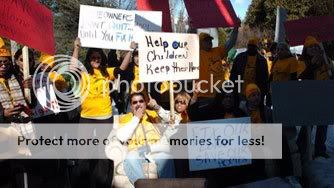
Stamford and Greenwich became the stomping grounds of a grassroots campaign against corporate greed Sunday as part of a three day homeowners' workshop sponsored by the Neighborhood Assistance Corporation of America. Between 350 and 400 people, most of them members, staff or volunteers for the Boston-based nonprofit organization, converged outside the Greenwich home of William Frey, manager of Greenwich Financial Services, at around 1 p.m.

Wearing bright yellow hats and t-shirts with pictures of sharks and the words "Stop Loan Sharks," protesters had already targeted the home of John Mack, CEO of Morgan Stanley, at 6 Club Road, Rye, N.Y. earlier in the day.

At Frey's house, 10 Glenville Road, Greenwich, they chanted slogans such as "Fix our loans, save our homes." They placed furniture on the lawn to symbolize the dislocation felt by people who have had their homes foreclosed upon and been evicted, their belongings tossed outside by state marshals.

"We did it to make them feel what it must be like for someone to have their home foreclosed upon," NACA mortgage counselor Carmen Orta said.

Called the "Predators Tour" these actions were the start of NACA's "accountability campaign," an aggressive, confrontational protest aimed at several top executives of companies that refuse to allow NACA to renegotiate the terms of loans on behalf of members, according to NACA CEO Bruce Marks.

Friday, January 30, 2009

The Numbers Racket

Harper's Magazine, May 2008: Numbers racket | Why the economy is worse than we know:

Transparency is the hallmark of democracy, but we now find ourselves with economic statistics every bit as opaque—and as vulnerable to double- dealing—as a subprime CDO. Of the “big three” statistics, let us start with unemployment. Most of the people tired of looking for work, as mentioned above, are no longer counted in the workforce, though they do still show up in one of the auxiliary unemployment numbers. The BLS has six different regular jobless measurements—U-1, U-2, U-3 (the one routinely cited), U-4, U-5, and U-6. In January 2008, the U-4 to U-6 series produced unemployment numbers ranging from 5.2 percent to 9.0 percent, all above the “official” number. The series nearest to real-world conditions is, not surprisingly, the highest: U-6, which includes part-timers looking for full-time employment as well as other members of the “marginally attached,” a new catchall meaning those not looking for a job but who say they want one. Yet this does not even include the Americans who (as Austan Goolsbee puts it) have been “bought off the unemployment rolls” by government programs such as Social Security disability, whose recipients are classified as outside the labor force.


Second is the Gross Domestic Product, which in itself represents something of a fudge: federal economists used the Gross National Product until 1991, when rising U.S. international debt costs made the narrower GDP assessment more palatable. The GDP has been subject to many further fiddles, the most manipulatable of which are the adjustments made for the presumed starting up and ending of businesses (the “birth/death of businesses” equation) and the amounts that the Bureau of Economic Analysis “imputes” to nationwide personal income data (known as phantom income boosters, or imputations; for example, the imputed income from living in one’s own home, or the benefit one receives from a free checking account, or the value of employer-paid health- and life-insurance premiums). During 2007, believe it or not, imputed income accounted for some 15 percent of GDP. John Williams, the economic statistician, is briskly contemptuous of GDP numbers over the past quarter century. “Upward growth biases built into GDP modeling since the early 1980s have rendered this important series nearly worthless,” he wrote in 2004. “[T]he recessions of 1990/1991 and 2001 were much longer and deeper than currently reported [and] lesser downturns in 1986 and 1995 were missed completely.”


Nothing, however, can match the tortured evolution of the third key number, the somewhat misnamed Consumer Price Index. Government economists themselves admit that the revisions during the Clinton years worked to reduce the current inflation figures by more than a percentage point, but the overall distortion has been considerably more severe. Just the 1983 manipulation, which substituted “owner equivalent rent” for home-ownership costs, served to understate or reduce inflation during the recent housing boom by 3 to 4 percentage points. Moreover, since the 1990s, the CPI has been subjected to three other adjustments, all downward and all dubious: product substitution (if flank steak gets too expensive, people are assumed to shift to hamburger, but nobody is assumed to move up to filet mignon), geometric weighting (goods and services in which costs are rising most rapidly get a lower weighting for a presumed reduction in consumption), and, most bizarrely, hedonic adjustment, an unusual computation by which additional quality is attributed to a product or service.

Thursday, August 7, 2008

On drug resistant bacteria and the invisible hand


/ deadly efficiency /

From the New Yorker, Superbugs:

In the past, large pharmaceutical companies were the primary sources of antibiotic research. But many of these companies have abandoned the field. “Eli Lilly and Company developed the first cephalosporins,” Moellering told me, referring to familiar drugs like Keflex. “They developed a huge number of important anti-microbial agents. They had incredible chemistry and incredible research facilities, and, unfortunately, they have completely pulled out of it now. After Squibb merged with Bristol-Myers, they closed their antibacterial program,” he said, as did Abbott, which developed key agents in the past treatment of gram-negative bacteria. A recent assessment of progress in the field, from U.C.L.A., concluded, “FDA approval of new antibacterial agents decreased by 56 per cent over the past 20 years (1998-2002 vs. 1983-1987),” noting that, in the researchers’ projection of future development only six of the five hundred and six drugs currently being developed were new antibacterial agents. Drug companies are looking for blockbuster therapies that must be taken daily for decades, drugs like Lipitor, for high cholesterol, or Zyprexa, for psychiatric disorders, used by millions of people and generating many billions of dollars each year. Antibiotics are used to treat infections, and are therefore prescribed only for days or weeks. (The exception is the use of antibiotics in livestock, which is both a profit-driver and a potential cause of antibiotic resistance.)


Beyond this, the article is rather unsettling; we're overusing antibiotics to ineffectiveness it seems, and there doesn't seem to be an easy way out, maggot saliva notwithstanding. Vaccines might help in the not so near future, or then again maybe not that much. Their lethal impact is however terrifying.

Thursday, May 22, 2008

"Give me more oil or I'll hold my breath", a new school of American foreign policy is growing


/ how to generate Onionnesque headlines - for real /
On the heels of US presidential candidate Clinton's pledges to smash OPEC in a confident if utterly vague and unspecified way, reaching the "hollow threat" concept to unprecedented heights, the US congress has one-upped her, passing a bill to sue OPEC over oil prices, under US law, a move that even the hypertrophic jurisdiction cheerleaders in the current White House think is a bad idea. Ignore that in the current price range most oil producers are producing at near capacity. Notice however that the implementation of their proposals can only be established militarily and would certainly destroy supply along with demand (demand destruction in the form of mountains dead people, I mean to imply), to reach an uncertain final balance.

Meanwhile, back in reality, the International Energy Agency (hardly an alarmist institution, one is obliged to notice), flinches, as it is...:

...preparing a sharp downward revision of its oil-supply forecast, a shift that reflects deepening pessimism over whether oil companies can keep abreast of booming demand.

The Paris-based International Energy Agency is in the middle of its first attempt to comprehensively assess the condition of the world's top 400 oil fields. Its findings won't be released until November, but the bottom line is already clear: Future crude supplies could be far tighter than previously thought...


We're heading to a broad acknowledgment of the reality of Peak Oil, it seems, albeit obliquely, and a wide range of experts are predicting rough but promising to scary times, the last link being about the latest predictions of the man who wrote the Hirsch Report. Our world is about to be not very subtly transformed it seems.

This post came about through the utilization of this Eurotrib Diary, a website where peak-oilers (and other commie pinkos such as myself) abound. For a more dedicated peak-oil hub, check out The Oil Drum.

Wednesday, January 9, 2008

New Left Review - Qin Hui: Dividing the Big Family Assets


/ uncommon analysis /


This is an interview with Qin Hui, almost four years old now (brought to my attention via metafilter, triggered in turn by this recent piece), in which the historian discusses a broad range of issues:

Where is the PRC heading? One of its leading intellectual iconoclasts, after describing his origins in the Cultural Revolution, offers a long-range comparative perspective on the Chinese state’s strategy for land and industry today. The divisions in the intelligentsia and the fate of the peasantry, the overwhelming majority of the country, as China enters the WTO.


This is a treasure trove of information and insight for those (like me) who have a superficial knowledge of current China. It offers glimpses of the Cultural Revolution from within (a very different and more nuanced situation than that usually found in western publications), the situation of the peasantry and the problems facing today's China. He also points out the implications of China's current situation for the West:

Obviously, in the manufacturing sector no labour force—either under the welfare system of developed countries, or backed by trade unions in Third World or East European democracies—can ‘compete’ with a Chinese working class that has no right to unions or to labour negotiations. So too, Western farmers who rely on state subsidies may find it difficult to compete with Chinese exporters who can rely on peasant producers who have never enjoyed any protection, only strict control—causes underlying many of the ‘miracles’ in today’s China that often seem equally baffling to Right and Left in the West. In fact, though no one in the contemporary world will say so, such a situation is not without historical precedent. Around the sixteenth century, some East European countries became highly competitive in commercial agriculture by establishing a ‘second serfdom’. You can find people in today’s Chinese think-tanks who understand this very well. In some internal discussions they bluntly state that, as China has no comparative advantages in either resources or technology in today’s world, and cannot advance either to a real socialism or a real capitalism, its competitive edge can only come from its unique system of dependent labour.

Factually, I admit they are to a great extent right. Without this labour system China wouldn’t have been able to pull off the ‘miracle of competitiveness’, which attracts such interest from the West, the former Soviet bloc and many Third World democracies—but which they will never be able to emulate. The question I would ask, however, is whether a ‘miracle’ of this kind is sustainable? We might want to look at the long-term consequences of the ‘second serfdom’ in Eastern Europe. Nowadays there is a lot of talk in the US about a ‘China threat’. Actually, as no big power emerged out of the sixteenth-century East European experience, it is highly doubtful whether the current Chinese miracle could continue to a point where it really did threaten the West. But even if economic magic of this sort, that does not treat people as human beings, did take China to the top of the world, what would be its value? Such a development would first of all threaten the existence of the Chinese people themselves.


I would also highlight this insightful comment:

…The merit of general ‘isms’ lies in the universal values that inform them; yet the specific theory of a given ‘ism’ is usually constructed in response to particular historical questions, not universal ones. Therefore, when we advocate universal values we should be careful not to confuse them with universal questions. My slogan is: ‘isms’ can be imported; ‘questions’ must be generated locally; and theories should always be constructed independently…

Friday, November 2, 2007

Secession: beyond economics


/ is breaking up so hard to do? /
I was following, a month ago, the whole brouhaha surrounding the Belgian government crisis. Possibly the best summary of what was and is at stake in Belgium was written by Ingrid Robeyns, at Crooked Timber, a post that offers coprehensively both background and analysis of the current crisis' main events. Today, as the issue of Belgium's political impasse moved past record-breaking territory, into a major crisis, previous claims that the country quite probably is not heading towards a break-up, although quite possibly accurate, might seem less than 100% convincing. Everybody seems to agree that the financial imbalance between Flanders and Wallonia, which led to the Flemish having to subsidize the Walloons through their taxes, is a factor in the Belgian equation. It quite probably is, but the interesting thing here is that in the event of secession, both countries will remain partners within the EU, with some sort of transfers certainly flowing again from the State of Flanders to the State of (Rump) Belgium, through the Union's many funds and subsidies!

The question of independence and secession from a country, within the EU, is a novel twist to the "subnational" issue, that enhances the viability of the secessionist project and the vision of secession advocates, in many parts of Europe. To name but a few cases, this prospect has been part of the rhetoric of the Catalans, the Basques, the Scots, the Welsh, the "Padanians" and of course the Flemish. The EU offers a "safe haven" of sorts to various independence movements, a guarantee that "much will remain the same" even in the event of secession, especially regarding the economic viability of such a project. Thus, economic motives for secession can be reasonably seen as enhanced by the prospect of EU participation. Indeed, given the current ideological climate and raw economism, the concept of nation-building as an exercise in revenue maximizing state-branding, isn't beyond contemplation at all.

Economic motives for secession, or market-driven "ethnogenesis", seem very "contemporary". But is economics the driving factor (instead of a driving factor) in secessionist movements? Can states be built on economic considerations alone? Does the Flemish secession movement exist principally because of taxation issues?

I think not.

First of all it is far from obvious that the EU itself is comfortable with the idea of internally multiplying its member states. As the Economist has pointed out:

The EU is also unlikely to support moves leading to any disintegration of member states. Regional movements often point to the EU as a trans-national safeguard, allowing them more easily to dispense with their nation-state affiliation. But the EU may be more concerned about any process that upsets its own delicate institutional balance, to say nothing of making it harder to gain a consensus for a new EU constitution. Having put the brakes on further external enlargement, the EU will not welcome a form of internally-generated expansion.


In fact Prodi had warned explicitly (Scotland in that instance), as President of the EC that EU membership is not a given for any wannabe breakaway republics:

Three years ago... Romano Prodi, the President of the European Commission, warned that if Scotland... breaks away from the United Kingdom, Edinburgh would have to reapply for membership of the European Union (EU). "A newly-independent region would, by the fact of its independence, become a third country with respect to the (European) Union and the treaties would not apply any more in its territory," Mr. Prodi said.


One might also add that the regionalisation of Europe (as intent for the time being and not as actual pervasive policy) and the role that regions seem to be playing in EU development strategy, can act as a counterweight to separatism, as they deliver plenty of self-government to local entities, circumventing (up to a point) the hold of the national government. The prospect of a purely regional Europe however is a non-starter, among other reasons because of scaling problems. I quote from a highly relevant interview with Nicolas Levrat, the director of the Institute of European Studies at the University of Geneva, questioned by eurotopics:

Q: Could you imagine a European Union made up of regions and not of nation states?

NL: A Europe of the Regions wouldn't work. We see that the Committee of the Regions is quite inefficient. We are talking about 200 or 300 entities trying to make decisions. Imagine the procedures necessary to reach a qualifying majority in a decision making body with 300 members! It's not like your average parliament, it would be much more difficult as is already the case in the present European council with 27 members.


Then there is the issue that, apart from problematic parts of the world such as Africa and the (Western) Balkans, there is little that suggests that independence or autonomy movements are directly tied to solely economic considerations - see for example the paper by Elliot D. Green On the Endogeneity of Ethnic Secessionist Groups, which presents the theoretical context of the debate and evidence that shows that the relation between economic opportunity and secessionist power is not linear at all.

Ethnogenesis is a complex process and certainly not one that can be reduced to a purely economic cost-benefit analysis. If this is the case for well established secessionist movements, it is even more so for ad hoc potential entities constructed on economic considerations alone. In fact the only case of a country built on principally economic considerations in Europe that I can think of is Montenegro. Whether that was a wise move, is another discussion, as it isn't at all that obvious that Montenegro is more independent now (under any meaningful definition of the term "independent") than it was when it was federated with Serbia. Anyway, the post-Yugoslav Balkans, home of the smuggler-state, doesn't lend itself towider generalizations.

Note also that were regional economic inequalities a driving force for "nation building" alone (either through the logic of "liberation" from paying for the "backwards" regions, or through the aspiration of a better economic future for disadvantaged regions), the phenomenon would be vastly more widespread than it is now. The economic gaps that exist in almost countries between certain regions are often quite larger than the corresponding gaps between secessionist regions and other regions within the same country, yet not all regional income gaps lead to demands for autonomy or secession. Thus Nicholas Levrat's assertion (in the abovementioned interview) that "Contrary to what is commonly said - that the rise of regionalism is linked to the funding structure and federal EU policy - the facts suggest that it is not the regions that are heavily subsidized by the EU that are pushing for independence but rather the rich regions", is a generalization that is not even statistically valid: Not all, not even most, but just a handful of "rich regions" are pushing for independence. The ones that do are riding on and succeed because of a preexisting national identity.

Thus, the sort of mechanistic reductionism that sees national or regional aspirations of independence as a result of solely, or even principally, economic forces and motives, isn't convincing. The EU separatist movements in fact are, if anything less prevalent today than they were in the past, because political issues such as minority rights, language issues and local government are guaranteed inside the EU. There is a political primacy here that cannot be generated at whim, and is dependent on factors such as local history and past grievances. Countries are not corporations. They presuppose (and impose) a vastly deeper loyalty than any brand-name ever could. History cannot be fast forwarded nor reduced simply to the pursuit of profit.