Showing posts with label imfgr. Show all posts

Tuesday, December 13, 2016

Poul Thomsen and the IMF's "pro growth" policies for Greece


The IMF's Poul (the Ghoul) Thomsen has written about taxes and pensions in Greece in the context of the Fund's contribution in assisting to "Make the Greek Budget More Growth Friendly". This is part of the IMF's newly discovered anti-austerity mission for Greece. Although seemingly relatively sane compared to the rest of Greece's EU "partners'" demands - and especially our colonial overlords in Berlin - of 3,5% budget surpluses for as far in the future as anyone can see, the Fund is in fact helping drive the ongoing negotiations to the rocks. This because in order for the IMF to concede the fiscally obvious regarding surpluses, it demands in return draconian measures against sections of the poor and a further dismantling of labor relations, which is considered, rightly, politically unfeasible, impossible for the current government to even contemplate. (I should note however that as recently as two years ago the IMF was skeptical but approving of 4% + fiscal surpluses for Greece (p.10 and fwd), every year, all the way to the mid 20s)

Simply put, PT's report consists of fallacies, half-truths and misrepresentations piled one on top of the other, the sort of which, when this Austerity Disaster first started, I delighted in shredding apart point by point. As it seems increasingly pointless I'll stick to some basic highlights.

1. IMF as a growth friendly institution: this is the baseline by which all numbers provided by the IMF should be measured.

2. Average salary / tax burden on average salary in Greece (p.9)

3. Disposable income collapsed as a result of the policies that the IMF led the pack of "lenders" in inflicting. So now the IMF laments the "steadily declining tax collections", as if they didn't cause this income collapse, and as if the GDP (as shown in 1, above) didn't plummet at rates reminiscent of wartime. Similarly, as incomes and revenues collapsed and taxes rose, "accumulating tax and social security debt to the state" was a natural consequence, again, of the IMF's own prescriptions

4. I'm not sure how Chart 2, on declining tax collection rate in Greece, jibes with Eurostat statistics showing total tax revenue almost monotonically increasing during the same period

5. Also interesting to note that Greece will have beat the fiscal bailout targets for two consecutive years, basically by improving the collection rate, through, among other factors, exactly the sort of installment and deferral schemes the PT is lamenting. 

6. Public healthcare is in a disastrous condition in Greece, although public expenditure in healthcare has been more or less stable across the past two budgets. However the murderous initial reduction in healthcare spending imposed by the IMF and the EU between 2010 and 2014, is not even mentioned. These reductions were dictated by the troika. PT sounds like he just heard of all this.

7. Greek pensions, the true story. This is from last year, public contributions have since been slashed by 1% GDP, so assume things are worse, and already over 50% of Greek pensioners are around the poverty line

8. The IMF wants to further "liberalize" mass layoffs, in a society that is straining under a 23% unemployment rate, and the Ghoul actually makes the case for this by pointing out that if we dropped even more pensioners below the poverty threshold, then the Greek state could afford better unemployment benefits - and thus I assume it would be cool with the laid off to lose their jobs. Order of magnitude calculations, combined with the dismal - in both remuneration and duration - existing unemployment benefits (i.e Unemployment Benefit Replacement Rates 5y), show that this would offer negligible improvement, provided mass pensioner euthanasia wasn't a prerequisite. How easing layoff laws can possibly help lower the unemployment rate, is one of those things only the IMF executive and similar neoliberal market faith-healers understand, and certainly the IMF's own research teams reject.

9. The Ghoul also fails to mention that the new, improved IMF anti-austerity platform includes refusing to reinstate collective bargaining agreements, which were discontinued originally at the IMF's insistence earlier during this crisis. It also wants to make going on strike more difficult, further hamper unions' already severely diminished capabilities, and allow employer lockouts. This is surely not a step in making anything more fair.

10, Poul Thomsen: "Greece pays an average nominal public pension similar to Germany’s". This is an updated version of an obsession of his.
Wikipedia: The average pension in 2012 [in Germany] €1263.15 per month
Eurostat: Pensioners in Greece receive an average 882 euros per month, 713 euros from basic pension and 169 euros from supplementary pensions (2013). 
Eurostat II: Expenditure on pensions in Greece was lower as % GDP than Germany's until 2007. Then the crisis came and all periphery countries saw the expenditure percentage of pensions explode proportionally to the degree of damage austerity (did I say IMF imposed austerity?) inflicted on their economies.

11. Chart 6, makes little sense until you realize that poverty rates are at 60% of median income, and median income has plummeted in Greece as we saw. So despite the fact that all pensioners in Greece are significantly poorer than what they were in 2007, they haven't lost as much as the economy on average. That's why the working poor in Greece appear by that graph to have increased over the period by just 1%. As pointed out:
The risk-of-poverty rate is even higher when current income is compared to the poverty threshold set in 2005. When measured that way, the deterioration of living standards is startling as 42.2 percent of Greeks have dropped below the poverty threshold of 2005, from just 16.3 percent in 2010. That amounts to an almost threefold increase in just five years.

But finally, as I reconfirm my utter contempt for the IMF and its Murder of Ghouls and Minions, I have in all fairness to point out that compared to the German government they are outright enlightened.
Which is why Europe is doomed.

Saturday, March 17, 2012

The anality of evil

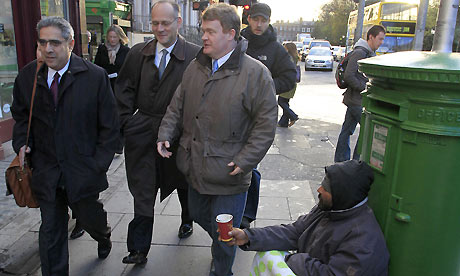
Dark lords of the IMF over Dublin, one of their other lairs

EU Commission President Barroso said: 
"Greece's future passes through restoring both financial stability and growth potential. The support provided by the Commission's Task Force is a key instrument to support growth and jobs in Greece. The solidarity shown by many Member States, the Commission, and other international institutions is a very encouraging signal for this country. Let's build a future for Greece together".
The Daily Mail responded:
Is Greece becoming a third world country? HIV, Malaria and TB rates soar as health services are slashed by savage cuts:
Prostitution and heroin addiction on rise as hospital budgets cut by 40%. Malaria levels reaching near endemic levels in some areas. 'The entire health system is deteriorating'

The Guardian chimed in:
Greece is on the breadline: newborn testing is under threat... a health worker warns that children will die from disorders that are easily detected and treated
"Whatever are you talking about, these sub-humans deserve more austerity" responded the Commission and the Greek government eagerly assented:

...in preparation for the new cuts the government was reviewing public spending programmes, focusing on savings in social transfers, defense and the restructuring of central and local administration.
There would be job cuts in the public sector according to a redundancy and recruitment rule of 1 entry for 5 exits. Athens is to further cut pharmaceutical spending and operational spending of hospitals as well as welfare cash benefits.
“The continuation of the very comprehensive international financial assistance can only be expected if policy implementation improves,” the Commission report said...
"Defending the equitable state, the welfare state, is the top priority, a sine qua non condition for our survival as a civilized people" countered Nikos Xydakis.

"The European social model has already gone" said Mario Draghi dismissively."Yes" agreed the local bankers happily, busy chewing the pound of flesh they stole from the hospitals and the schools.

"While our policies may be unpopular, profligate states are finally starting to reform" added Angela, the demented ordoliberal, pointing at the breadlines and the homeless in Greece with some satisfaction... We have these sort of people here at home too, we do keep them to their station...
Cross posted at the European Tribune

Wednesday, February 22, 2012

A warning to austerian eurocrats

SYRIZA, the Greek Coalition of the Radical Left, has notified through an open letter signed by its president Alexis Tsipras and addressed to heads of Eurogroup member-states, the head of the European Commission Jose Barroso, the President of the European Council Herman Van Rompuy, and Martin Schulz head of the European Parliament, that it does not consider the signature of the politically illegitimate government of Greece binding for future Greek governments. Although SYRIZA is at 10-12% at the polls currently, there is a dynamic testified not only internally but by a recent character-assassination piece in Bild and a less rabid but if anything more vitriolic and selective in its narrative piece in Der Spiegel. SYRIZA is now the first Greek party to publicly commit itself to repudiating the terms of the latest loan agreement, as stated in the letter, translated below. Should SYRIZA continue rising in the polls expect the regime to postpone elections:
Hon. Sirs / Mms
I am sending this letter to alert you to a matter of democratic order of urgent importance for Greece. This has to do with the commitments undertaken over the past two days by the Papademos government, headed by Mr. Loukas Papademos. Allow me to remind you that this is an unelected government, which does not enjoy popular support and has consistently and consciously acted against the will of the people of Greece. This government does not have the democratic legitimacy to bind this country and its people for the coming years, the coming generations. This legitimization deficit is in conflict with the rich democratic tradition of your own country. If this continues therefore, it will become a bad precedent for Greece and Europe as a whole, which above all, have a common inheritance of political and democratic traditions, which must be respected. However great the seriousness of the current circumstances might be - over which there is room for a divergence of opinion - they should not in any way cancel democracy.
The lack of democratic legitimacy of the Papademos government arises from the following facts:
  1. The two political parties, which support the government and participate in it do not have a popular mandate to bind Greece to treaties and agreements of this nature. Their representatives were elected in the last national elections on October 2009, based on political programmes at complete odds with the policies that were followed by the previous Papandreou government as well as those being negotiated today with the EU, the troika and the IIF, by the current government. The two parties which constitute the current government have a recorded history of plundering public resources and are responsible for the current economic situation
  2. The people of Greece have been systematically misinformed and deceived about the intensity and the duration of the austerity measures, ever since their first implementation in 2010. Consequently they have withdrawn their confidence in the Greek political establishment. Furthermore, the widely admitted - inside our country and abroad - obvious failure of these measures to successfully face the fiscal problems they were supposed to solve these past two years and the five-year period of  continuously deepening recession, has further legitimated the demand for a change in policy, so as to restore a socially just growth and therefore the prospect of a fiscal rationalization.
  3. More specifically: the unelected Papademos government provides but a minimum of information, sometimes even deceitful, regarding the agreements it is secretly negotiating. It has not initiated nor has it allowed to initiate any public, informational discussion about the extremely serious long term commitments that follow. Greek Democracy has thus been deprived of the constitutionally protected right of a detailed evaluation of the consequences of the signed agreement. The so-called "second rescue" was voted through an emergency ultra fast-track procedure, in the time-frame of one parliamentary session on a Sunday. The main object of this session was the demand by the government of a carte-blanche authorization on almost blank documents, which are supposed to bind the country for years to come
  4. To the degree that there has been no information on these agreements, their content seems to be such as to commit the Greek people for generations to come. For such commitments any government should at least demand a clear and renewed mandate.
  5. To the degree that there has been no information on the government's movements, the will of the Greek people as expressed in a multitude and a variety of ways, is almost unanimous in opposition to them. Specifically, during the last two years the people of Greece, throughout the country are expressing their opposition to government policies through, among other means, repeated general strikes and demonstrations, occupations, letter writing, electronic messages and other forms of personal communication with members of Parliament. The Greek government, not only chose to ignore the voice of its people, but tried indeed to stifle it, at times even violently, so as to continue in a antidemocratic way, the policies that have been proven disastrous for the Greek economy and society.
For all of the above reasons, I  am notifying you that the Greek people, as soon as they restore their right to democratically express their will and regain control of their democratic institutions, will in all likelihood reserve recognition or compliance with these agreements that the current government is planning to assent to. Specifically the Greek people will not accept any loss of sovereignty, foreign involvement in internal matters of Greece or large-scale sale of public companies, land and other assets that the current government is preparing to accept...

Alexis Tsipras
President of the SYRIZA parliamentary team

Monday, February 13, 2012

The battle around Syntagma square


Around 11, I tried to return to the protests. I had to turn back. It was impossible to reach down-town. ~50 buildings have been set on fire and the smell of tear gas is overpowering. A few minutes ago a police precinct was attacked. A bank in Volos was burned to the ground, while MPs offices were attacked in Corfu, Western Greece and Crete...

The mobilization was unprecedented. By 5 o'clock Syntagma was full, so was Omonia square, and almost all of the surrounding streets - but it's difficult to gauge participation though because as soon as the square started to fill up the police attacked the protesters with large amounts of teargas... There is an estimate around the tweetosphere of 500.000, this is not unrealistic. Bear in mind though that after the first chemicals people, especially older people,  decided not to show up, or attempt to approach Syntagma.

Even the orderly and robust communist union's block didn't make it to Syntagma although they attempted an approach from three different directions. The Syriza block attempted many times to reach parliament. They were pushed back, and the block was attacked around 10 - 10:30.

The cops were throwing tear gas canisters in the middle of huge but peaceful crowds. The number of people injured and taken to the hospital tonight officially is 75, but in reality it's much more, the makeshift first aid stations around Syntagma (some of which I hear were attacked by the police) treated scores of people....


Among the first to be hit were Greek resistance icon Manolis Glezos and music composer Mikis Theodorakis (89 and 91 years old respectively), giving a signal that the police was not about to spare anyone. It was obvious that they had orders to keep Syntagma square clear and they did it with extreme brutality.

After that, things got wild, either through some sort of concerted black-block action, or whatever, one after the other buildings were set on fire, banks initially but then other buildings: coffee shops, and cinemas among them - grand old buildings of great contemporary historical significance sadly.
As I write this Athens is still ablaze, and I fear this might be the start of a trend, not just an explosion. Certainly the number of people despising both the police and the current government skyrocketed today and as the state is reduced more and more to shows of police brutality anti-authoritarian or even just blind violence will grow more frequent.

About the vote: As expected. The two leaders, the political and electoral nullity (8% approval rate) of George Papandreou and Antonis Samaras (soon to follow him in disrepute) threw out a total of 41 MPs from their parties. The two teams of expelled MPs are strong enough to create two new parties: one at PASOK's left perhaps (although most of them are also in disrepute exactly for following the PASOK leadership's orders for so long) and one at ND's populist right. Panos Kammenos, an economic populist (and virulent nationalist , it has to be said) is said to be preparing such a party, though not all of the MPs who were expelled would feel comfortable in such a political environment.

The left will gain: Democratic Left as a more "moderate" left is receiving a huge inflow of moderate PASOK voters, looking for a less damaged political roof, but also SYRIZA and KKE have stabilized at very high numbers and the current climate of popular unrest will probably strengthen them. All three of these parties voted against the memorandum and SYRIZA and KKE have promised to undo all of its measures one by one, on constitutional grounds...

There is talk of a continuous general strike planned for most of the country's public enterprises, and a continuous series of strikes in the rest of the public and private sector. I think it is labor now, more than any other part of the Greek population that will carry the torch of the popular battle...

I would also like to point out that those who are building a Europe of solidarity, a real European Union? well it's not Merkel...

Sunday, February 12, 2012

Greece: They must not pass...

"Martial law has to be imposed for these measures to be implemented"
This loan shark says, make them pay, beat them until they pay everything, but don't beat them so hard that they can't keep paying.  That loan shark says, if you don't make an example of this one, the others won't respect you.  Beat them to death.  And it is between these two poles that the bankers, ratings agencies, and EU leaders oscillate...
How is Greece taking the new loan deal that accompanies the PSI? Most compare it to a dictatorship, a foreign occupation, the kind of terms a victor imposes on a defeated country. No wonder: Two years of the most grinding austerity, has caused a destruction of the Greek economy that has no precedent, in peacetime, as official nominal wages dropped 15%, unemployment passed the 20% mark and, according to polling company VPRC, the bottom 90% of Greek households, suffered in 2011 alone loss of income on average ~45% of their incomes. Greece is already a "labor wasteland" where jobs are near impossible to find and when they materialize they are more likely to be "black", uninsured, well below the poverty threshold.Yet the new loan deals mandate among other things:
- The dismantling of collective bargaining and the annulment of the current collective agreement. "Labor law" in Greece will not be a meaningful subject any more
- Across the board cuts in nearly all of private sector wages and salaries to the tune of 22%. This includes the minimum wage (which will be now around 580 euros net, and under 500 euros if you are a new entrant into the job market). This affects all sort of benefits i.e. the unemployment benefit which is reduced to 369 from 461 euros. This in a country where the cost of living in its capital is still higher than that of Berlin
- Immediate elimination of rent subsidies for the poorer, cuts in pensions, mass privatization at fire sale prices (including the Athens and Thessaloniki water companies, and the lottery/football pool company, whose market price right now is at two years profits) etc. This on top of galloping social destruction, a health system that is going to the dogs (the decay of which is producing even stronger superbugs) and public services being destroyed or annihilated.
- At the same time whatever debt will remain - and it will be huge and unsustainable anyway - will now be under English law, and not Greek law, meaning that the terms of the loans will be draconian.

And much, much more: 650 pages of it that Greek MPs were required to read in 24 hours since they received the package, Saturday, to vote on it on Sunday. The process is illegitimate, and constitutionally questionable yet the two government coalition partners (socialists and conservatives - the far right LAOS rightly figured that this will destroy it electorally and removed its ministers from the government), are extorting their MPs: "pain or destruction" they warned, along with the PM. Everything will be rationed, Greece will leave the euro and remain a third world country for ever. Sane people disagree. But they are not in government.

Τhe political system is shaken: MP after MP from the ruling coalition either resigns (at least 5 now, but probably more, I've lost count) or announces that they will vote against the new plan. These include among others the former economy minister Louka Katseli, and notably Socialist MP and former World Bank and IMF economist Elena Panaritis, who was close to tears in the Parliament commission today, stating that in her 16 year experience of drafting similar deals (and she worked with the World bank in Peru, for chrissakes), she has not seen anything quite as disastrous as the troika's offer.

It is unsurprising then that despite being hammered by the media and the Papademos government (the Prime Minister being the sort of economist that argues in parliament that if workers don't accept huge wage cuts  the unemployed will stay unemployed - this as real wages are collapsing anyway,) most Greeks prefer immediate bankruptcy to this. The colonial attitude of Ollie Rehn and Jean Claude Junker only inflamed public opinion. What seeps through the media from EU and especially establishment opinion on how this is all the Greeks fault and they should suck it up because they are overpaid, lazy etc. has already caused the first instance of German flag-burning and has resulted in the first time ever that the EU as an institution has a negative reception according to a latest poll.

And so Greece strikes and fights back:

The Law school in Athens under occupation by students, the health ministry by mental health doctors who protest the near-total defunding of mental care, the ministry of Labor by workers belonging to the communist union, the electric grid authority in the ministry of environment and energy by the power company workers' union (a couple of days ago they held the minister hostage for a few hours, until he was released by riot police)... also occupied: the Holargos(a suburb of Athens) City Hall, in Larissa, Chania, Veria, Ermoupolis and Corfu the Regional Governor's building, in Rethymnon the City Hall, in Chania and Trikala the prefecture offices.

I'm not sure how many of these occupations are still in effect, and it is likely that they have multiplied. They will serve as a launch pad all over Greece for what promises to be the largest protests ever (despite the weather) outside the parliament building in Athens and in major squares all over Greece. People are angry, no longer "indignant" but "outraged". If this government proceeds to pass this memorandum, all hell will break loose, on a social and a political level. The political system is destabilized, all options are on the table and theoretically elections are less then a couple of months ahead. And despite the rhetoric of this government's apologists, today's demonstrations are in reality the true pro-european demonstrations. In Greece today there will be the first of a series of big battles in defense of the European social contract, of labor. A test case, a guinea pig, because it is obvious that in one form or another this austeritarian disaster will be unleashed around the EU, and the core should not feel safe from harm. Already labor conditions and real wages in the EU southern periphery are converging downwards towards the poorest members of the union.

Today, after three days of huge demonstrations and general strikes, Athens will be filled with rage. A police officer's union has declared that it will refuse to attack its brothers, and threatened the troika members with arrest... People are prepared for the worse anyway though. I'm heading down to Syntagma to topple a foreign imposed bankers' government, gas mask in my pocket and mad as hell. They must not pass. They will not pass...

[The Greek Left Review has said it will have live coverage of demonstrations today]

Friday, January 6, 2012

IMF: The gaping abyss of "reform"

...Whenever the IMF tried to take care of countries’ debts, it created more problems than solutions
Former Brazilian President Lula Da Silva


About a month ago, on the 16th of December, IMF mission chief for Greece, Poul Thomsen, told reporters that the country's economy:
“...is continuing to trend downwards, reflecting that the hoped for improvement in market sentiment and in the investment climate is not materializing,”
Having finally recognized, after two years of producing an unmitigated societal and economic disaster, the failure of its plans, its estimates and its projections, one would expect the IMF to backtrack from its pro-depression policies, and start proposing something less catastrophic for Greece and the rest of the EU periphery (and eventually the whole of the EU and the rest of the world). Well one wouldn't really, if they knew the history of the IMF and the recent history of the EU debt debacle, but that would be the rational thing to do. Actually the IMF did the exact opposite: after a treatment that has driven the patient close to death, it is asking to increase the dosage of the same deleterious medicine in line with the Merkozy school of Hooverian economics:
"The numbers show that Greece's budget deficit continued to rise in November, while the recession, spurred on by suffocating austerity measures, has cancelled out a large part of the extra income that the government hoped to gain from emergency taxes. Indeed, provisional figures from the Ministry of Finance show that the state budget's "black hole" broadened by 5.1% in the first 11 months of this year, reaching 20.52 billion euros, compared to a total of 19.5 billion a year ago.

In order drastically to reduce public spending, therefore, the so-called "troika" has asked the Athens government to carry out further severe austerity measures, including the redundancy of a further 150,000 public sector workers by 2015, in addition to the 30,000 who will be released by the end of this month. The demands of the "troika"... were announced by the Minister for Administrative Reform, Dimitris Reppas, following a meeting with representatives of the international creditors: Matthias Mors, Mark Flanagan and Bob Traa. Reppas explained to the officials that the redundancy of surplus state employees has not had the desired effect because the measure was applied hurriedly and without correct assessment..."
IMF eparch for Greece P.Thomsen
Along with all that, and a barrage of new taxes on the already buckling shoulders of employees and pensioners who cannot evade taxes, add the customarily sadistic and destructive extortions accompanying every installment of the "loan package" Greece has been receiving from the troika: demands for lowering or abolishing the minimum wage (it's ~8400 Euros/year net, theoretically, around 7000 Euros for youth entering the work force, and less than that for all the tens of thousands now forced into part-time jobs, usually with full-time schedules, and no overtime, and those who are months behind in salaries probably never to be received) and cancelling the 13th and 14th monthly salaries (misrepresented as bonuses when they are part of a workers' yearly compensation, cut into 14 installments for historical and practical reasons) - and that's for the private sector. Public sector workers having had their (mostly) meager salaries slashed by anything from 30 to 60% over the past two years, and having been fired at random for months now, are planned to be drastically reduced in number (they were no more than 14% of the workforce to begin with note, near the OECD average) while most teachers, and quite a few doctors etc will be among the working poor.
Note that there is still one area in which Greek public spending outperforms most of the healthier economies of the world: defence spending. This is apparently, actively encouraged by both Merkel and Sarkozy.

Is it a Greek thing?

The disaster that has befallen Greece, according to the various fiscal occupation authorities, is entirely of its own making, the reasons the IMF's predictions have failed is because of insufficient political support or not enough reforms. But is that  true? How successful have the policies of uber-hooverism been in less rowdy patients?

IrelandTroika warns of future welfare cuts
The Coalition will have difficulty in keeping to its promise not to adjust tax bands and credits in Government and will also need to rely on cuts in social protection to provide the “bulk of savings”, troika officials monitoring Ireland’s bailout programme have determined.
Two separate analyses by the EU Commission and the International Monetary Fund published before Christmas have disclosed details of proposed measures for the 2013 budget, which is unprecedented for Ireland. A total of €3.5 billion in savings are planned; €1.25 billion in new taxes and €2.25 billion in cuts.

The analysis has also criticised aspects of Government policy, including its decision to make larger than expected reductions in the capital budget as well as the lack of punitive sanctions for unemployed people who refuse to seek work.
...All of which lead to the obvious question: Ireland has done what the IMF wanted, but where is the reward?
Despite 'exceptional' efforts to meet IMF targets, Ireland has a rising deficit, sustained emigration and 15% unemployment... The fiscal adjustment, according to economist Karl Whelan, is the equivalent of "€4,600 per person… the largest budgetary adjustments seen in the advanced economic world in recent times". With annual "adjustments" of €3-4bn flagged until 2015, the euphemism of "purposeful austerity" cannot long camouflage the concerted assault on the – already minimalist – social contract...
...Costas Douzinas recently documented how the IMF blames the failure of its growth predictions, and austerity measures, on the impact of Greek public resistance. Yet in well-behaved not-Greece, the same bad medicine has resulted in a rising deficit, stagnant growth, sustained emigration, and unemployment at about 15%. In its latest quarterly report, the IMF praised Ireland's "exceptional" efforts to meet its targets, but this praise comes at a time when the fiction of a reward for good behaviour is falling apart.
Portugal: Income inequality EU15 champion, is heading towards even greater income disparity, as are apparently all the already highly unequal "restructured" peripheral countries - this being of course not a side effect but an aim of the IMF / ECB/ EU programmes. Meanwhile, this year's logistic trick that reined in the Portuguese deficit can't be repeated next year:
The government had set a goal to trim the deficit from 9.8 percent of GDP in 2010 to 5.9 percent in 2011 and to 4.5 percent next year. The 2012 budget includes a plan to eliminate the summer and Christmas salary payments for state workers earning more than 1,100 euros ($1,443) a month. Tax deductions will be reduced and the government plans to increase the value- added tax rate on some goods.
 Or as the IIF has put it:
Portugal, which has “experienced serious fiscal slippages,” is trying to meet a deficit target of 4.5% of GDP. Doing so would require a fiscal contraction valued at 6.1% of GDP, in a year in which growth is expected to drop by 3%. “This represents a very demanding objective and lack of progress could heighten market concern.”

Spain:  The new conservative government has already reneged on its promises as a result of troika pressure and missed targets:
Spain's new government said on Friday that this year's budget deficit would be much larger than expected and announced a slew of surprise tax hikes and wage freezes that could drag the country back to the centre of the euro zone debt crisis. In its first decrees since sweeping to victory in November, the centre-right government said the public deficit for 2011 would come in at 8 percent of gross domestic product, well above an official target of 6 percent. It announced initial public spending cuts of 8.9 billion euros ($11.5 billion) and tax hikes aimed at bringing in an additional 6 billion euros a year to tackle the shortfall.
And things look bleak for the foreseeable future:
Rajoy's government is taking quick action so as to meet a promise to slash the annual public deficit to 4.4 per cent of gross domestic product in 2012, come what may.
The government has acknowledged Spain will miss its goal of reducing the public deficit to 6.0 per cent of GDP in 2011 from 9.3 per cent the year before. The 2011 deficit may even top 8.0 per cent, ministers say.
The Popular Party government says the deficit slippage in 2011 could force it to implement another 20 billion euros in austerity measures for 2012, on top of the originally estimated savings target of 16.5 billion euros.
The government also announced that the social security fund's accounts are worse than had been feared, with a 2011 deficit of 668 million euros. The previous Socialist government had forecast a social security surplus
But it isn't just the unclean PIGS, who are in trouble, austerity (certainly the open-ended, turbo-austerity we're witnessing being implemented around the world) hasn't worked because it never worked in the interests of the societies subjected to it:
Indeed, austerity economics has not worked in one single case in Europe in the last two years. When David Cameron’s government imposed a first round of harsh spending cuts in 2010, it utterly failed to revive the British economy as promised. To the contrary, it probably cut a budding recovery short. Unemployment and the deficit as a percent of GDP remained high. Some pro-Conservative observers I met at the time assured me that the Cameron team, led by George Osborne, the Chancellor of the Exchequer, was pragmatic and would reverse course on austerity if it wasn’t working. Yet when growth basically ground to a halt in late 2011, the Cameron team only doubled down, making further cuts. We need more of the same medicine, they told their citizens, a record number of whom are unemployed. Britian is a hair’s breadth away from outright recession only two years after its last one.

So, no Mr. Thomsen, the IMF / ECB failure was not due to some Greek particularity. It is systemic and ubiquitous. part and parcel of what austerity is supposed to do. Indebted countries in the EU periphery can get an idea about where they will be next year socially, if these policies are not resisted, by looking at Greece now . We're a year ahead as far as social despair is concerned (possibly a couple more years from richer countries). And by just sitting there and doing nothing, dear European reader, you're not helping avert it. Protest, organize, demand. Elect those who are explicitly and adamantly against the destruction of social Europe. Or, as our brothers from across the pond might put it, fight the 1%...
[An extended and slightly rearranged version of this post is cross-posted at the European Tribune]

Friday, December 30, 2011

Austerity: the Greek road to hell

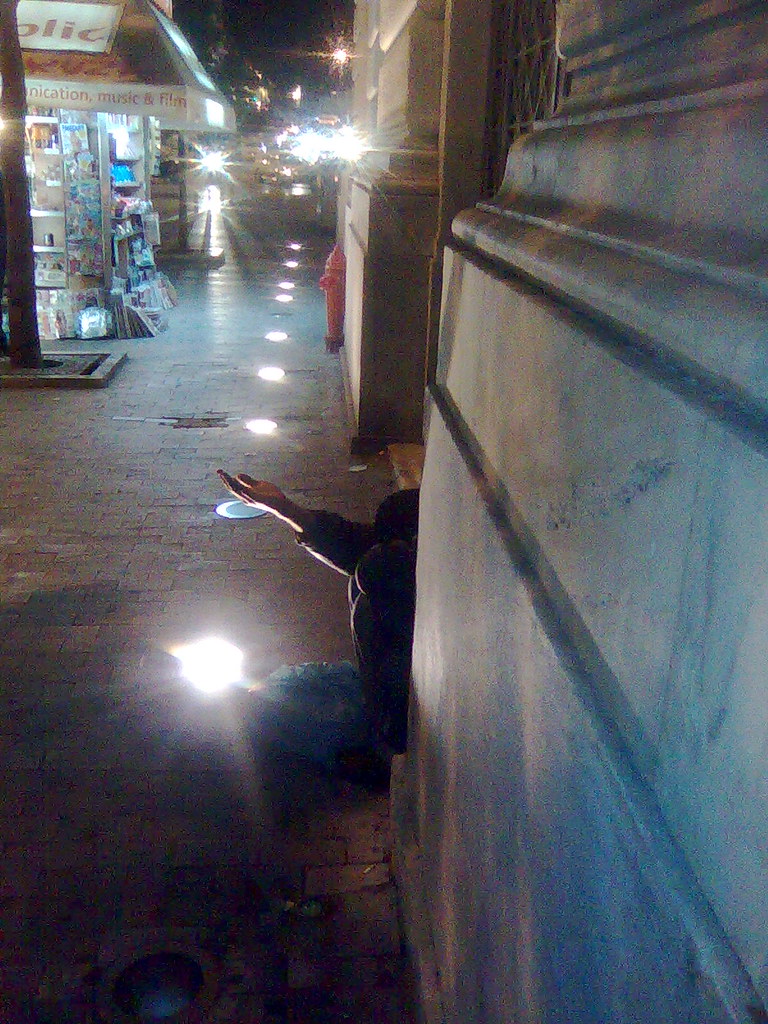
A beggar in Syntagma square, Athens, 27.12.2011
As the Euro crisis unfolds, and the European social model remains under attack by the mindless political armies of orthodox neoliberalism, spread across the continent in positions of power, and the bankers they represent, all is hardly well in Greece. The Greeks, having served as lab-rats for extreme-austerity, have come to realize one thing: Austerity is not a fiscal programme. It is a political project: a project of societal and financial sabotage, aiming at a radical upwards redistribution of wealth in an already very unequal country - indeed a whole continent. This is how the austeritarian disaster zone looks like from the ground:

  • Back to the Caves: "Dozens of homeless people in Athens will spend the Christmas holidays in the sheltering caves of Philopappou Hill, away from the rain and the cold weather.
    According to two reports conducted by the Ministry of Health and the Municipality of Athens and published by Real News, there are many new age homeless, who once were businessmen and traders, and are now penniless, lying on the streets.
    The shocking truth is that among those people there are families as well."
  • Homeless in Athens
    Meet the new homeless: With an average age of 47, 11% of Greece’s homeless have a university degree (!) and 23.5% hold a high school diploma, while only 9.3% are illiterate. The new Greek homeless class members have laptops and iPhones, remnants of their “old” lives. “They come to us in suits with their laptops in hand. These citizens a couple of months ago had ordinary lives. They had a job, a home and car,” says Nikitas Kanakis, the head of Doctors Without Borders in Athens. Counselors from the Department of Homeless Services describe a similar situation. “We even have homeless from suburbs like Kifisia and Voula [upper class suburbs of Athens]! They come  here with their laptops and expensive smart phones they once used for their work, shocked and depressed”.
  • Hunger: Athens Mayor George Kaminis told the daily that the city's homeless had increased by around 20 per cent while queues at soup kitchens organised by municipal and church organisations were up 15 per cent."Care workers no longer meet typical homeless people, they meet a person who likely had a perfectly organised life weeks previously," said Kaminis, who has asked for additional state funding for city welfare services."We have noticed a dramatic increase in our mess halls over the recent period," added Chrysostomos Symeonidis, head of the Athens archdiocese poverty fund. "We distribute over 10,000 meals on a daily basis and 250,000 meals are given out nationwide on a weekly basis," Symeonidis said... [oh and Starvation Recipes are all the rage]
  • ...hunger in the schools:  “Our pupils faint due to starvation. We see our pupils coming to school with holes in their shoes. They don’t even have money to buy food from the school canteen”
  • Which then leads to abandoned children: 'Propelled by poverty, 500 families had recently asked to place children in homes run by the charity SOS Children's Villages, according to the Greek daily Kathimerini. One toddler was left at the nursery she attended with a note that read: "I will not return to get Anna. I don't have any money, I can't bring her up. Sorry. Her mother."'
  • The disabled are also victims of the policies pursued: "In August, a five-year-old program providing deaf people with interpreters was suspended after the government abruptly cut its funding to less than half. Overnight, 15,000 deaf people around Greece were left without help to report a crime to the police, rent a house or go to a job interview. Funding cuts have opened up gaps across welfare services, with slashed services and longer waiting times for vulnerable groups including the blind, recovering organ-transplant patients, autistic children, and paraplegics in need of physiotherapy"

  • At the same time the already decrepit health system is further eroded according to The Lancet: "Overall, the picture of health in Greece is concerning. It reminds us that, in an effort to finance debts, ordinary people are paying the ultimate price: losing access to care and preventive services, facing higher risks of HIV and sexually transmitted diseases, and in the worst cases losing their lives. Greater attention to health and health-care access is needed to ensure that the Greek crisis does not undermine the ultimate source of the country's wealth—its people". Giving birth is now a luxury activity. I suppose women are expected to give birth at home by themselves - a great way to bring infant and maternal mortality to truly third world levels...
  • And, desperate, people kill themselves at an unprecedented rate:  "Greece's suicide rate has reached a pan-European record high, with experts attributing the rise to the country's economic crisis and painful austerity measures. Statistics from the Greek Ministry of Health show a 40 per cent rise in those taking their own lives between January and May this year compared with the same period in 2010"
And the economy? Surely all those wizards of austerity must have improved the flailing Greek economy, raising its productivity etc. No? Well... No:

  • Greece: heavy industry, desperate measures to survive: Heavy industry in Greece, particularly the sectors that produce steel, concrete, aluminium, copper and paper, are desperately trying to find ways to stem some of the negative effects of the economic crisis the country is going though. Some companies even sell up to 70% of their production abroad at cost price, just to be able to keep producing... Energy-intensive industries in Greece fight a daily battle for their survival on a domestic market that has been in recession for four years, with low liquidity, limited financial resources, rising interest rates and a series of austerity measures that seem to ignore their impact on the real economy, like the high taxes on energy
  • Unemployment is rocketing, reaching fearsome heights:


    The jobless rate rose to 17.7 per cent in the third quarter compared to 16.3 per cent in the previous quarter and 12.4 per cent in the corresponding quarter of 2010, the Hellenic statistical authority said... It added that there were over 878,000 people out of work during the three-month period, most of them women and young employees aged under 30

Things are, in other words, tough. Very tough. The kind of tough one associates with a war or a huge natural disaster. And do not think for a minute that all of this is irrelevant to you: if you live anywhere in Europe, periphery or center (but at this point probably anywhere in the Western world), this is in one form or another the future that has been prepared for you. Greece has been the canary in the coal-mine for social Europe in this crisis, a wretched and sorry bird, to begin with, admittedly, yet an indicator of the way things are going in Europe. Regardless of whether austerity is systemically viable in its own terms (it most probably isn't), the news is that the canary, is slowly yet steadily croaking. It is dying. Greek society is taking blows that will transform it for ever, in a path that no one knows where it takes and it is unraveling. So our suicides here, our untended ill, our abandoned children, our middle-class poor, our new homeless and hungry, they are an omen, a sign of things to come, across Europe. Or that seems to be the plan. The good news is that this society is taking it a lot better than some (I too) initially expected it would. Solidarity networks have cropped up all over Greece, while the support to the striking steel-workers (from Greece but not only), two months now in struggle for their livelihoods and lives, is going strong and their struggle is right now the rallying point of resistance to the destruction of all of our collective lives.
High school students, express solidarity with the steel-workers after having gathered a few Euros from pocket change to contribute to the strikers fund


An interesting thing is happening at the political level: the "unserious" Left is gaining. In a recent poll, the "electoral influence" of the three left of the mainstream parties adds up to 37% - 41 percent if one adds up the smaller parties and the Greens, a number that is unprecedented and apparently rising. Whether this will coalesce to a viable government is doubtful: The communists consider everybody else a capitalist stooge, not serious about systemic change, the Democratic Left, the right splinter group from SYRIZA, seems to be more comfortable discussing a collaboration with PASOK (assuming there will be a PASOK left by the time the elections arrive) than with everybody else. However, popular pressure can work wonders, and one still hopes that  Greece will be the first to throw a political wrench in the working of the austeritarian banksters and their political employees in Europe. That is assuming that the ruling Socialist - Conservative - Far Right coalition under a former ECB vice president, actually deigns to hold elections sometime in the near future as originally promised.

The future remains at this point very opaque. The issue is whether the rest of the European peoples will need to arrive at the point of despair that Greeks have reached, before they react.

Wednesday, October 19, 2011

Greece on the Brink of Emergency: A Matter of Days

As Greece prepares for a 48 hour general strike, promising to be the largest ever in a series of far from insignificant mobilizations over the past year and a half, there is a sense here that the coming week will be historical, fateful. The success of the strike over the following two days will be hard to measure, though it seems that there is an unutterable goal of toppling the government, which acts as a quasi colonial regime, pressured to surrender the last vestiges of sovereignty, imposing a catastrophic austerity in full knowledge that it is catastrophic.

The situation is reaching a critical point and I reproduce below, as a general intro, a brief analysis on the current situation that Aris Leonas has been kind enough to send me, with minor edits:


Greece on the Brink of Emergency: A Matter of Days

by Aris Leonas

[Note: This text is part of a longer article about the global crisis and resistance that is being written by Kolya Abramsky, and will explore questions of the emerging worldwide political struggle which is the latest stage of the crisis’ development; the limits of political reformism; control of key means of production and reproduction; and the question of force. It was hoped that this longer article could be finished already by now, but this has not been possible. However, due to the urgency of the situation in Greece, and the fact that the situation can change radically in the next few days, he has decided, together with Aris Leonas, who is the main author of this text on Greece, to send this part out separately].

In Greece a number of factors stand out, suggesting that Greece is on the verge of some major changes. The disruption of basic operations of the state in conjunction with the widespread certainty that the Greek debt cannot be controlled (constant rumours of default in the coming period) compose a picture of political instability and crisis which seems to be the precursor of a more generalized political crisis to be spread to the rest of the south European regimes first and possibly to the heart of the Eurozone given the accelerated tensions of the financial crisis and the disagreements among current leaderships in the Eurozone. The remaining days leading up to the summit of the EU leaders, on the 23rd October, and the G20 summit in the first week of November are considered crucial. Something has to give, and soon. And, it could go in many different directions, for better, or for worse. Rumours, which may or may not be true, are circulating regarding possible deployment of the EU EuroGendFor (Euro Gendamerie Force) military personell being called to Greece in the days ahead...

On the one hand, there has been an incredible level of political activity and mobilization from very broad layers of society. This has continued to intensify, bringing in ever greater numbers and becoming more and more continuous as the crisis has deepened much further since 2009. The sequence of movements follows this general scheme: broad student movement and riots during 2006-07 before the official announcement of the Greek debt crisis; weeks of urban rioting that took place in December 2008 as young people responded to the police killing of a teenager; mass demonstrations; 13 general strikes since the IMF deal; most political form of the movement of indignados (compared to the similar movement in Spain); the last step in this series of resistances is expressed through occupations of public spaces and buildings, and strikes in key industries such as transport or railways.

On the other hand, this high level of mobilization has not stopped or even slowed down the pace of austerity measures, nor the plans for mass privatizations, and repression has been growing. Protests have been met with extreme police violence, and increasingly strikes are being declared illegal.

Despite high levels of organizing, people report a profound sense of despair, and no clear sense of alternatives being built by people. There is widespread panic and a general sense of economic, political and mainly social collapse. Increasingly the reproduction of massive parts of the society is becoming more and more difficult, as society’s functioning grinds to a halt. Nothing is working, neither public services nor private deals.

Political organisations, such as parties on the left side of the spectrum to groups in the anti-authoritarian or autonomous spectrum, are under enormous pressure. The acceleration of the economic crisis has resulted in a serious political crisis and the complete lack of a concrete alternative is obvious. Voices on the left spectrum have begun whispering about the need to form a left government constituted by a broad coalition of the left parties and smaller groupings. However, they have been unable to articulate this idea in such a way as to inspire the broad movements and struggles which have appeared in a very sudden and decentralized way. This, despite the fact that these parties are actually potentially very strong, as they account for 26% in the polls, while the party in government accounts for only 15%, with almost 50% of the voters having declared that they will abstain from voting in any future elections. The range of left parties includes: Syriza, a left coalition born after the decade of Social Forums; the Communist Party – a traditional communist party with its own unions, that are widely criticized for being reluctant to join with the rest of the left in some type of coalition; Antarsia, a small coalition of anti-capitalist groups; and the Ecologists-Greens, a relatively new party linked to the European Greens).

People are under huge pressure. Increasing sections of the population are unable to pay taxes, pay back loans or even ensure the satisfaction of their basic subsistence needs, such as electricity, health services, housing etc.

Unemployment is increasing fast, and is expected to reach an average of 25% in the first semester of 2012. High taxes are being imposed through electricity bills, and the economy has contracted fast, and fear, or even panic, reigns among large parts of the active population. All of this has created a fluid mass of ex-workers, as well as over-exploited and insecure employees. These people are not connected to the traditional trade unions (these are the unions which have traditionally been, for the most part, attached to the two main political parties, i.e. the ruling PASOK party, and Nea Dimokratia, which was in power until it lost the elections in 2009). Unemployment and insecurity mainly affect the younger generations, which are forced to emigrate (mostly to North and Central Europe, and also Australia and Canada). This is especially so for high-skilled workers and those with with university degrees.

Current situation:

The level and intensity of struggles has grown rapidly since the summer and during the first weeks of October. The Greek version of the indignados movement (“Aganaktismenoi” in Greek), which ended with riots in June to mid July, seems to have completed its first cycle of existence, leaving behind a space for a broad basis for interaction among different movements and groups across the country. This has expressed itself in the form of many decentralized and spontaneous activities such as strikes and occupations in the public sector, as well as mass demonstrations and rioting. During this period, new forms of committees of struggle have emerged, increasing the number of participants and showing a willingness to unite behind the call for a 48-hour strike which was issued by the General Confederation of Workers (GSEE) and the Confederation of public servants (ADEDY) for the 19th-20th October. Although these committees are still very new, they have already shown themselves to be highly stable. They vary both in the form and place of struggle, ranging from low level unions in workplaces, to assemblies that organize occupations and neighbourhood assemblies that organize local struggles and unite during major calls, such as calls for demonstrations in the centre of Athens.

Several new forms of struggle have been born during this period. This includes occupations of (8) ministries and government offices, disruption of operations at different levels of the state, from local authorities all the way to state services such as tax offices and courts etc., the occupation of productive infrastructure (means of public transport, railways, occupations from the powerful union of workers in the Public Power Corporation). Every day smaller protests also disrupt the regular functioning of commercial, economic and social life. However, this high level of mobilization has, until now, as we mentioned, not managed to stop or slow down the pace of austerity measures, nor derail mass privatizations. Furthermore, the efforts at creating a concrete and broad organizing umbrella of all these movements has, so far, not given rise to any kind of new institutional form. Left parties, activists and workers meet during these struggles in a rather chaotic way. It is becoming increasingly important to try to ensure that these committees which have emerged become legitimate focal points for building and defending mass based popular power through struggle.

Until now the government has been trying to avoid any uncontrollable explosion from below (such as the ongoing occupations in the public power corporation, strike of workers in the cleaning sectors of the local authorities). Repression has been growing. Street protests are met with increasing levels of violence from the police. More and more strikes are declared illegal, and private companies are being hired by the government to take over tasks that are not being carried out due to occupations and strikes in the public sector etc. The army has even been called in to clean city streets, as cleaners are on strike.

Things are now coming to crisis point, and it is matter of days. In the run up to the summits mentioned above, the movement from below is intensifying its actions through strikes and demonstrations across the country. At the same time as mass activities are increasing, the government is also making moves from above, apparently in preparation for what will follow should the current government resign, and these plans are taking the antidemocratic measures to new levels, based around a state of emergency.

Certain moves from within the government show that this week is probably the most crucial of the crisis period in Greece. Especially important in this regard is a long article signed by three important ministers on Sunday the 16th October, and supported by the assistant PM and Minister of Finance E. Venizelos. This article asks people to loyally follow the policies agreed with the IMF, and to establish the consent of the silent majority against, the so-called vocal minorities who are disrupting the country’s political functioning. This is full of incredibly antidemocratic and authoritarian overtones, suggesting the urgency of the situation. Another important factor that adds to the image of a collapsing government is that increasing numbers of important trade unions and very large numbers of party members have been withdrawing from the ruling PASOK party, as well as one member of parliament. Rumours are rife about what scenarios might develop in the next-days, and it is virtually impossible to know which have their basis in fact and which do not. This includes the rumour that some kind of new antidemocratic social and political compromise will be established among the different centre-right parties, in the form of a national unity government, or the installation of a government of technocrats, or the installation of a state of emergency etc., in order to pre-empt the threat of an even worse scenario unfolding, a threat which remains unspoken from all sides. Presumably, this unspoken threat, which established political authorities understand all to well, is the threat of revolution from below. The question of political power in on the table, and the political crisis will be resolved in the struggles in the days and weeks ahead, in one way or the other.

This is a call for people in Europe, and other parts of the world, to watch closely the developments in Greece, and to be ready for the next stages in the development of this political crisis, which will soon spread, in all probability first to other parts of Southern Europe, and later to the European Union as a whole. The political crisis in Greece has taken approximately two years to reach its climax, and this time frame is likely to be greatly reduced in other countries as the European and global crisis accelerates. There is no time to lose.

Wednesday, July 13, 2011

Greek crisis, #imfgr @eurotrib


If it seems that I'm not posting enough here lately, it's because I've been mostly doing that on the European Tribune, where some of the last remnants of various threads of the European Left blog together as neoliberal doom is already upon us. I'm posting the links here (diaries and major comments together with related stuff I have posted on this blog) for completeness sake, since I realized that they are forming a corpus of commentaries on the Greek Crisis and its reality, that might conceivably be considered useful, by someone, somewhere, somehow (posts/diaries in bold):

- 10.12.09(comment): Doom and gloom: The way it looks from the ground (in thread "Potential Greek default - how doomed is the euro?")
- 10.02.10 (comment): Pigs on parade + pig irony
- 27.04.10 (comment) Re: Resisting the Neoliberal Empire? (in thread: Resisting the Neoliberal Empire?)
- 06.05.10 (comment) Re: Getting ugly in Greece (1) and Re: Getting ugly in Greece (2 - the 5/5 demo) (in thread: Getting ugly in Greece)
- 14.05.10: Some sort of semi-coherent collage of notes on the Greek situation (1)
- 25.05.10 Some somewhat more coherent notes on the Greek crisis: debunking IMF propaganda (2)
- 29.06.10 (comment) Re: Is this it? (In thread: Is this it?)
- 02.11.10 (comment) Re: Europe
- 08.11.10 Greece: The unlocal elections
- 15.11.10 (comment) Re: Europe
- 19.11.10 (expanded comment): A comment on the alleged lack of productivity of Greek workers
- 25.11.10 (comment) Re: The Banksters (In thread: Relief)
- 26.11.10 Vampire policy makers of the IMF (and the ECB)
- 26.11.10 (comment) Re: The word from the Serious People (In thread: The word from the Serious People)
- 15.12.10 Greek general strike today: anger and violence
- 19.12.10 The Greek Economy on a Crucifix: IMF lies and misrepresents yet again
- 02.02.11 (comment): Re: Merkel's New (Old) Two-Speed Europe (In thread: Merkel's New (Old) Two-Speed Europe)
- 04.02.11 (comment): Re: Irish pushback strategy - we get mail (In thread: Irish pushback strategy - we get mail)
- 18.02.11 High Drama: Greece under the "troika"
- 04.04.11 Jake's Greek LTE, questions and discussion
- 14.04.11 (comment) Re: Why 2013 (In thread: Three months that will test the Eurozone)
- 19.04.11 (comment) On the Greek black economy (In thread: What's Happening in the Black Economy?)
- 06.05.11 The revelations of Strauss Kahn
- 11.05.11 (comment) Athens Strike / Demo
- 14.05.11 Kristallnacht in Athens
- 17.05.11 (comment) Re:Europe (about state sector participation etc)
- 18.05.11 Merkel's racist lies
- 20.05.11 (comments) Re: LQD: "Tahrir Virus" comes to Europe, Re: No One Expects the Spanish Revolution? (In thread: No One Expects the Spanish Revolution?
)
- 25.05.11 (comment) Re: Europe (on the indignants 1st day)
- 25.05.11 (comment) Re: Did Greeks wake up? Tina, Tara and other girls (In thread: Did Greeks wake up? Tina, Tara and other girls)
- 25.05.11 Here be dragons: Lies, horror populi and subversion amidst hope and chaos - reposted at Eurotrib and then reposted at Daily Kos as "Greece Shock Therapy update - WSJ lies debunked"
- 30.05.11 The Greek Colony
- 05.06.11 (comment) The Greek crisis explained on TV
- 15.06.11 Greece: if austerity doesn't work... Try more austerity!
- 29.06.11 Flash brief from the #greekrevolution
- 12.07.11 Greece: No other plan but plunder

Wednesday, May 25, 2011

Here be dragons: Lies, horror populi and subversion amidst hope and chaos


Takis Michas' article in the WSJ, written a month ago, about Greece and what he describes as its Descent into Anarchy (full article reproduced here) is a stunning piece of disinformation on the situation in Greece, an outlandish view of the disaster unfolding in the country, tainted by class prejudices and ideolepsy. It is so utterly unrooted in reality, that, were it published in Greece anonymously, it would be unclear whether this was perhaps a parody. This is the pinnacle of a genre of alarmist anti-left writings that seem to pop-up regularly in the local MSM to lecture the restless natives on the vileness of resistance to Authority and its true Prophet, the IMF, and blame the Left as sole instigator of all sorts of violence: A"violence" however, which on closer inspection mostly consists of jeering a corrupt politician or two, staging a protest against the pauperization of this or that social group, peaceful civil disobedience and strikes. In a zoology of militantly conformist, fear-mongering tall tales on display in the government-friendly media (and that's 90% of all MSM media), Michas piece is Godzilla. That's why it was perhaps too tall for the Greek press and required a global newspaper to print it.

The WSJ readership of course, needs this potent injection of fear-mongering anyway, as the plebes in the US are rapidly becoming unruly themselves, faced with shouldering the costs of the banker bailout and this cautionary tale form the exotic Near East, complete with leftist dragons, is perfectly timed for domestic use.

As I said, if this was published in a Greek newspaper, in Greek, it would offer a hilarious peek at the paranoia that the crisis has bread among the country's upper classes, and would not merit a response significantly different from "you should go out more often". Since it is published in English, in a paper as broadly read among ruling elites as the WSJ, and might skew the perception of what is actually happening in Greece, it requires debunking, especially as I have seen the article being referred to on the www as some sort of authoritative picture of Greek "anarchy", since its publication. In the process it will provide an opportunity to relate the true story of the budding, if still incoherent, mass resistance to the ECB/IMF fiscal stormtroopers and their caretaker government in this peripheral ECB province I'm writing from, but also the truly darker side of collapsing neighbourhoods, mindless violence and general despair that is emerging from the deep cracks that the prolonged ECB/IMF induced depression has carved on the already decrepit social body. This panoramic view of civil discontent and societal unrest that answering Michas' article must include, and the true dangers lurking as the crisis deepens will be the major theme of this post, along with a discussion of things that have happened after the publication of this article: it has been a month thick with events.

Austerity? What austerity?

Michas begins by lamenting the demise of "the rule of law" in Greece and chiding the government for its inability to "to maintain order and implement its own legislation". While the debt crisis is briefly mentioned, Michas avoids pointing to a rather crucial piece of background info: the developments he "describes" (and misrepresents) are happening as Greece is plunged into the deepest recession in living memory, as unemployment is skyrocketing along with part-time and uninsured jobs, as even nominal wages are collapsing, as a quarter of small businesses have either gone bankrupt or are preparing to do so, as indirect taxes soar and inflation persists. But all this does not impress Michas
"Many argue that Greece’s disintegration is the unavoidable consequence of the government’s attempt to enforce economic austerity. This seems doubtful".
Now why it seems doubtful to Takis Michas, he won't say. It certainly doesn't seem doubtful to the vast majority of people in the country, as the percentage of Greeks expecting social conflict in the next few months as a result of government policies reached 84% three months ago [poll links in Greek, I'm afraid], while when asked to describe their feelings towards these policies in another poll, 35,5% mentioned "anger", 33% "disappointment", and 21% "fear". Pollsters warn that the Greek political system has "passed the point of no return", and is facing a drastic overhaul...

I don't think there is a country in the world were the population can (or should) be expected to passively accept its own impoverishment and the annihilation of lives and prospects. Society is still paralyzed from the Shock Therapy the German Bankers and their local overseers have imposed and are still, to an extent, under the spell of the neoliberal mantra: There Is No Alternative. There are movements however on the ground, local and nation-wide that resist this destruction, stemming both from a sense of injustice and a practical inability to pay for much more than basic necessities. These movements are widely accepted and approved of by the Greek population. However, for Michas to admit to large scale societal desperation, rage and depression would be to accept that there are valid reasons for this anger. But that would by ideologically problematic for a large part of the neoliberal right that he represents and, anyway, it would stand in the way of red-baiting which is the object of this article. Thus Michas proceeds to a string of accusations against the left that are blatantly outrageous and viciously false. They are the kind of accusations an authoritarian government levels against dissident groups. It is highly unlikely that Michas is so secluded and deluded that he doesn't know this already, so this is IMHO inexcusable disinformation.

All protest is lawlessness?

SYRIZA members harass pro-market politician

Michas starts his description of the Evil Greek Left with an impressive piece of disinformation:

The country is at the mercy of militant activists, who are mostly inspired by various factions of Greece’s hard left. The heaviest hitters are Greece’s Communist Party and the anarcho-Stalinist Coalition of the Radical Left, which is comprised of the Ecosocialists of Greece, the “Roza” Radical Left Group and the Internationalist Workers’ Left, to name a few. Their followers, with total impunity, have taken to harassing citizens and destroying public property, even taking over whole villages.

First if all let's start with this fact: The "militant activists" of these parties are responsible for zero (0) acts of real physical violence against anyone. They have "harassed" no citizens that I'm aware of, unless "harass citizens" means "demonstrate against politicians" perhaps, they have not destroyed public property as far as I'm aware of, and they have certainly not taken over any villages, at least since the Greek Civil War in the 1940s.

Beware of Stalinists bearing flags
The Communist Party is an ossified relic of a sovietophilic old-school stalinist party, whose intransigence and militancy in workers' movements as well as its historic role in the Greek resistance have guaranteed it a permanent place in parliament - and which is growing stronger by the day as the protest party par excellence. Its actions include the usual old-school labor actions, i.e. ship-workers and sailors blocking ports. The party has no loose canons and has a horror of things getting out of control. No police officers worry about attending a KKE demonstration. Ever.


Rabid SYRIZA Members armed with deadly pickets
The description of the Coalition of the Radical Left (SY.RIZ.A in Greek) again is, well, somewhat idiosyncratic. It is indeed a coalition, a block of left and green parties from left social-democracy to post-maoist groups. The three parties Michas chooses to enumerate are however not quite representative of the alliance. It is like saying that "the Italian peninsula is comprised among others of the Vatican and San Marino". The missing elephant, the core political and parliamentary entity around which the alliance was built, is the Coalition of the Left and Ecology (even the similar name sort of gives the deal away) a member of the Party of the European Left (along with Die Linke, Bloco, Sinn Fein, PCF etc.). Interestingly, despite Michas' claims regarding their dastardly final objectives, this party participated in two Greek governments in the late 80s early 90s (along with the Communists - with the Conservatives first and then in a emergency government): there were no gulags built. Kim Il Sung does not seem to feature among the guiding lights of either party... About "Anarchostalinism" I can only say that it is a term that has no proper place outside satire, so I'll leave it at that.

Those evil commies then, have activists who apparently "direct physical attacks primarily at politicians and journalists who support open societies and market economies". Now, the three "attacks" Michas mentions have indeed happened (as have many more like them); in fact politicians and establishment figures are currently feeling rather unsafe walking around in public without heavy escort. But that isn't because they are "for open societies and market economies" but rather because they are part of a corrupt and/or incompetent political two-party system that has thrown Greece into an unsustainable debt maelstorm, through cronyism, clientilism and theft. This opinion about the two governing parties is shared by a vast majority of the population - 93% of Greeks feel that corrupt politicians should go to jail. According to last year's Transparency International survey, Greeks were the people who ranked their political parties with the highest marks for corruption in the world. A recent poll shows that 40% of the population are for (and 56% against) violent heckling of governing politicians. As the Greek economy collapses even the "official" narrative for the crisis makes people who are facing destitution rather angry.

Even so, the conservative politician mentioned was most certainly not attacked by organized leftist activists (of any kind). Kostis Hatzidakis, MP and former transport minister, not involved in any personal scandals, was attacked by a couple of elderly men during a huge union demonstration, one carrying an umbrella which he used against the former minister, as other protesters from the crowd protected the MP.

Hadzidakis attacked
No one credible has, to my knowledge, seriously suggested that the attackers were members of any party. Their photos and the relevant video has travelled around the Greek web and the media many times. Were the perpetrators members of any left party, the MS media, quick to indulge in all sort of wild accusations against those "irresponsible leftists" would no-doubt have unearthed it.  They haven't.


Keratea burning
The same is true for both other cases (and there are many more instances of public, intense disapproval, voiced all over Greece and abroad wherever government members appear in public, on a daily basis by now, most of which have nothing to do with physical violence). In one case Michas mentions, we know for a fact that the person that threw yogurt (yogurt! how deadly can you get?) against the Vice-Premier was a voter of the far-right LAOS party, (and we know this because he gave an interview in a Greek newspaper). He was acting as a citizen of Keratea, a town whose inhabitants have immersed themselves in an insurgency against the creation of a landfill next to their homes. The town was a rather conservative - if anything - electoral municipality. This is the only instance of anything that might be legitimately called an insurrection in Greece, and it is very local in its scope. Theodoros Pangalos, the Vice Premier, elected from that particular electoral periphery, had spoken against the locals and for Law and Order, as is par for the course. Again, since local politicians of all colours and stripes have expressed their sympathies with the locals, and the whole town was behind the demonstrations, the claim that the locals were "supported by anarchist 'freedom fighters'” is ridiculous - not to mention in contradiction with the claim that the village was taken over by leftist activists. Keratea is a case study in state intimidation since from day one the government chose to use sticks - not carrots: the police have shown incredible ferocity against the inhabitants of Keratea, including Gaza-style home invasions and violence against the elderly, on orders to support tooth and claw a project that the citizens of Keratea insist is a contract awarded to politically connected construction companies. This is not the first time in Greece or in Europe, where locals have found being forced to live next to a toxic landfill violently unpalatable. Only previously, no one would have thought it necessary to invoke a conspiracy of anarchostalinists to explain it away. As for Pangalos, who has distinguished himself in heaping scorn against Greek citizens, a recent poll has shown that a full 79% of those questioned agreed with the deprecation and the jeers directed against him. By the way: it seems that these protests might yet have borne fruit... with all that this fact might have to teach us.


Raw terror at the toll booths
Similarly, the "Won't pay" movement, far from being some sort of bloodthirsty extremist group (in fact they are completely non-violent) is a citizens' initiative, mostly, but not solely, from areas where the government has set up toll booths that force the inhabitants of towns to pay in order to be able to leave their towns. At the same time, the toll fee prices had been hiked originally, exactly as general nominal income is steeply declining and inflation is charging on at 4-5%. Frequent commuters find it too much of a drain for their precarious finances to pay extra for driving to and from work, on incomplete roads constructed by the "national" contractors whose contracts are generally believed to be the product of their owners' political "entanglement". The Left certainly supported these movements but hardly initiated them. The movements had managed to win a promise of across the board reduction on toll fees (which it seems now the government has no intention of carrying out). They have also opened up with their actions, both on the road and in the courts, a new area of public inquiry, regarding the enormous costs that Greek roads seem to have incurred, as part of the corrupt relationships between some construction companies' owners and government cadres from both ruling parties...And it's far more than the voters of the Left who are furious with the toll prices: 66% of the public consider that the Minister of Infrastructure is a tool for the contractors. 52% suppport the "Won't pay" activists (vs 33% against). These people are not ideologues of any sort of "hard left" Michas is terrified of. They are people at the edge of bankruptcy and disaster. Even the regional chambers of commerce for Pieria and Thessaloniki are participating actively in these protests. So much for wild-eyed radicals...A similar story pertains to the metro/bus ticket boycott: fares went up by 40% this January, meeting a determined resistance from many commuters who have refused to pay these price hikes. In both cases the government legislated draconian measures to break these movements, and it is rumored that the toll companies are paying police officers and police departments to be present at the toll stations and force payment on anyone who denies payment, while they have tried to scare ticket dodgers with heavy penalties and fines - and even jail for a 1,4 Euro ticket!


Then there is the Marfin Bank incident last May, where, in one of the largest union rallies ever in Athens, a group of hooded "anarchists" threw molotov cocktails inside a bank, a mind-bogglingly criminal act that resulted in the death of three bank employees, who were trapped inside. This was a depraved act, no doubt about it, but the fire-bombers, who were possibly not aware of the fact that there were people inside the shuttered bank, were a small group (3-4 people strong) acting around the main demo, with no connection to Michas' "hard left" at all. Michas' claim, that activists of the main parliamentary leftist parties go after "people who refuse to participate in strikes and demonstrations" stating that: "In May 2010 three employees of the private bank Marfin suffocated to death when a hard-left mob fire-bombed their offices during a riot" is slanderous and dishonest.  


The ghost of Greek liberals past

This tale of nefarious leftists firebombing villages and occupying banks or whatever, is of course par for the course for the socialist government and its supporters in the media as well as the ultra-right wing LAOS party.This is not the only policy area where the "serious" parties converge: This January the government, the conservative opposition and the extreme right were trying to outdo each other in anti-immigrant, xenophobic and racist rhetoric when 300 (mainly North African) "illegal" workers went on a hunger strike to demand that they have the opportunity to employ themselves legally. Seeing this as a rare opportunity to gain popular points, the government rode the xenophobic horse almost until the end when, faced with the prospect of dozens of dead hunger strikers, as one after the other were fading in critical condition in Greek hospitals, they accepted some sort of deal - which after the hunger strike was over they made sure to reinterpret. The compliant government-dependent media moguls and their TV stations went on what can only be described as a week of inciting racist hatred: the intensity of rhetoric was at KKK levels and it was truly scary to realize that one was witnessing what amounted to a immigrant hate-fest in the most mainstream of Greek TV news shows. This was unfolding in an already ominous context of sky-rocketing unemployment and Dublin II, an EU treaty on migration which guarantees that Greece is and will remain a massive EU immigrant detention camp for the forseeable future, with a desperate, unemployed and hopeless detainee population that is now dying to get out of the country on top of dying to get in...   The Democratic Alliance, the party which Mr. Michas writes as a representative of in the WSJ article, was a very vocal part of that broad coalition of xenophobia. Note that as an independent journalist Michas showed a libertarian bend, and it is doubly astonishing to read such calls to authoritarianism by him especially...

The immigrant hunger strike was the most obvious example of the "respectable" part of the political spectrum seeming to have decided that, in the face of mass popular delegitimization of the political system, the proper response is to move ever rightwards on social issues. This is some sort of a collective "Sarkozy strategy", which ignores, among other things, how this is currently playing out in France. The marriage of neoliberal economics with extreme conservative, nationalist and xenophobic currents, seems to be a viable vehicle for preserving elite privilege. This has the effect of further strengthening an already empowered extreme right: the Nazi party (not a metaphor - the actual Nazi party) is polling at 1,5% according to a recent poll, ten times its historical size, and the original xenophobic extreme right-wingers at LAOS have also shown signs of a significant rise in the polls. Since Michas' article, the Nazis and the mainstream apologists for xenophobia who have fanned the flames of the racism that feeds them, have gone on an anti-immigrant rampage, a pogrom of real and horrific criminal violence, illustrating where the danger of blind and mindless destruction and societal dissolution come from and where criminal intent really is indiscernible from the effects of a programmatically antidemocratic platform. These events happened a month after Michas' aricle in the WSJ, and the trend was visible well before then. Strangely Michas' libertarianism was blind to this actual rather than invented rise of political violence. 

What is even more worrying is the fact that these pogroms happened under the indifferent eye of the police, and they were then only peripherally highlighted and lightly condemned by mainstream media. What is more: as the Minister of Public Protection mumbled a few words about dissolving the nuclei of neonazi sympathizers in the police force, "serious" newspapers, the conservative and far-right opposition, members of his own "socialist" party and pundits of every sort, actually protested against "starting witch hunts" in the police force and "hurting an already diminished morale". Thus it is plainly clear that the toleration of the far right is a reasoned choice for sections of the Greek elite.


This will not be the first time the Greek liberal right and center and the elites that run them, will have allied themselves with the extreme right: During the civil war in Greece the "traditional" parties allied themselves with Nazi collaborators, black-marketeers and goons, and proceeded to impose a national security state that, with varying ferocity, continued until 1974, after attempts at democratization were quashed by royalist parliamentary coups and then the brutal military junta of 1967-74. Thus it is truly ironic for Michas to dangle the spectre of an imaginary authoritarian left: in Greece it is the liberal and not too liberal center and conservative parties that have a history of violence, using the extreme right as their "muscle". The parties Michas slanders and their ideological forebears, have been fighting for more not less democracy in Greece over the last 60 years. Kim Il Sung would feel much more comfortable with the government's LAOS allies than he would with the independent (to say the least) minded members of the components of SYRIZA's coalition. much less of course an anarchist of any sort...


Societal Tensions

There are other things happening in Greek society, as well, other ways in which the current increasingly desperate situation expresses itself. Suicide rates have shot up in 2010, and continue unabated in 2011, a quarter of shops in downtown Athens are now empty, people are leaving Athens in panic to become farmers, organized crime is booming, while unemployment almost reached 16% this February, homelessness has become a visible issue, soup kitchens almost cannot serve all the needy...

This collapse has created hopelessness, anger and violence. Criminal violence, racist and nazi violence, police violence and anarchist / protest violence. The events of the past weeks I have described elsewhere, but a day after the brutal and murderous police attack against peaceful demonstrators - a practice so entrenched and widespread that it suggests a permanent strategy of intimidation in order to "discourage" participation -  a gang of anarchists attacked a central police station with molotov cocktails, running through a street market full of people. In the ensuing mess, three bystanders were burned by the fire bombs and one was until yesterday in serious condition, fighting for his life in a hospital...

So this explains somewhat the results that Public Issue, a polling company, published, of a survey that reported that:
- 62% of Greeks think that the memorandum with the troika has harmed the country and the same percentage is against it (13% it benefited the country - 15 support it),
- 16% think that there is no alternative (69% think there are alternatives).
- 77% do not trust the Prime Minister to manage the economy (22% trust him).
- 75% have a negative view of the IMF (69% last year), and 74% of DSK (49% last year).
- 69% believe that the IMF must leave Greece now (up 4% from 6 months ago).
- Only 52% have a negative view of the ECB (vs 33% positive) and 61% of Trichet. 59% have a positive view of the EU (up three points from 6 months ago).
- 53% want to bargain and default on at least a part of the public debt. 17% want to default completely and unilaterally.
- 33% think that the country needs a revolution and 56% deep changes.
- Greeks support strikes (74 - 20) and protests & marches (69 - 25) and are marginally not supportive of electoral abstention (45 - 54) and public deprecation and jeering of politicians (43 - 54)...
- 78% vs 21, believe that a social explosion is impending...
- 29% feel mainly angry, 18% dissapointed, 15% anxious, 11% shamed,  8% sadness and 13% all of the above.

Interestingly 48% believes that the stage is set for a successful far right party to emerge, versus 27% for a far left.

Thus contrary to Michas' assertions this is not about a leftist coup d' etat: The natives are restless and unhappy because of the, probably unprecedented during peacetime, drop of living standards they are suffering, with large swathes of the population being pushed to extremes of poverty that were unimaginable a few years ago, at the same time as prices rise, with incredibly high inflation due to a continuous barrage of indirect taxes and the backbone of state services and companies is being privatized in a gigantic sell out:  Schools are being shut down, hospitals are in jeopardy (while corruption in and around them is still rife), as per yesterday the electric utility, the healthiest bank in the country, the state gambling and betting monopolies (very profitable), the power company (again profitable), petroleum, water services etc - are on sale, a true sell out that will happen at fire-sale prices (the depression has driven the Athens stock market at an all time low, it will be interesting in a morbid way to see how low will the sell out prices go). The sad thing about the left in these circumstances is not that it does to much. But that it is still doing too little to stop the asset stripping and the destruction of a whole generation of Greeks. If only they were as dangerous as Michas claims!

Yet this work of political fiction Michas has concocted must serve a purpose. I fear it is one of creating alibis. "If you see us rolling out the tanks, rescinding a few articles of the constitution, or if you see demonstrators being trampled, beaten like it's Mubarak's Tahrir Square, Manama, or Baniya, Syria", signals Michas to US and global elites, "it's OK": It's only communists and "anarchostalinists" who are being punished for their love of Kim Il Sung. Everybody else just loves being reduced to poverty and insecurity.

P.S: And so it was until the #spanishrevolution. There are as we speak twenty or more facebook groups planning  #greekrevolution gatherings around the country, today 25/5/11. Let's see how succesful and how nonviolent these turn out to be. Unlike the #spanishrevolution however, everybody expects the #greekrevolution right now...