Showing posts with label capitalism. Show all posts

Thursday, February 16, 2012

Debts, promises and coups

Schäuble tyrannus

Master and servant
“In Greece the realisation that something has to change, and dramatically, still has to take place among many,” said Schäuble yesterday.
This gem of wisdom, comes from someone who supposedly is in charge of the Greek experiment, the chief of the German economy. I'm not sure how he forms an opinion on what is occurring in Greece, the effects his austerity programmes have on society and the population as a whole, nor do I understand what sort of people advise him on the mindset of the Greek population as a whole. But this didactic tone, coming from someone who obviously, from the effects of the policy he supervises, has not the faintest clue of either the society, or the economy he is helping to demolish and on which he is imposing a developing humanitarian disaster, is colonial in its contempt for the natives.

The Irish Times article linked to in the quotation above, describes Schäuble as one of the negotiators of Germany’s unification treaty, a process which he apparently considers a success and a model for Greece. I leave aside the astonishing idea that the Greek economy is anything like the East German economy was and how terrifying it is that the man running Greece, for all practical purposes, considers it to be a similar project in any meaningful way. I have no first-hand opinion on the matter of course, but it does strike me as odd that the net result is a region which seems to overwhelmingly prefer life under one of the most repressive, intrusive and harsh dictatorships in the Eastern Block, to what Schäuble achieved. So that is what the man calls success: creating mass yearning for dictatorship. I have no doubt that the corrupt and inefficient Third Greek Democracy, ending now, will be remembered with similar nostalgia should current plans persist.

The German leaders' uninformed, yet unabashed shows of contempt, bordering on the racist against Greece and the southerners are, most likely, political theater aimed to please the unthinking Bild readership,vile in its arrogance, but with a broader political aim of enforcing austerity and destroying social Europe as we know it well beyond the Greek borders. Yet one wonders: can they be as cynical as all that? Might the need to make a moralizing argument make them blind and selective as to the sort of "news" and ideas they have about what is happening in the south? I'm not sure... Could it be that it's not just that this is a policy aimed primarily at consolidating the Bild readership, but also a policy informed by Bild?

Meaningless promises burn meaningfully

I have chronicled as best as I could the trials and tribulations of Greek society and its economy, both at Histologion and the European Tribune over the past two disastrous years, and noted the disconnect of the persons in charge of "fixing" the Greek economy with its reality. This whole disaster is turning into a disgusting farce, a farce with real human casualties, but a farce nonetheless. "Greece" is being blamed for failing to meet the programme goals and "lying" to the EU officials. The programme itself cannot be at fault (although it is failing everywhere) so it must be it's lax implementation. This is something that apparently is sold as a fact to northern Europeans, along with the idea that this new package is mainly about "reform" and not about abolishing collective bargaining in Greece, forcefully decreasing private sector salaries to well under official poverty levels and reducing labor law to Burmese levels of worker protection - along with the fire sale of important infrastructure such as the Athens and Thessaloniki water companies and valuable assets such as the state lottery and football pools.

The list of "complaints" about Greece's "broken promises" is impressively ridiculous:
Taxes go uncollected, deficit targets are routinely missed, job cuts from the state payroll are postponed, privatisations have barely begun and pharmacies still shut in the middle of the day. Nearly two years into Greece's bailout, so many promises have been broken that international lenders have largely lost faith in the country's will to reform itself and are torn between imposing stricter outside control and cutting Athens loose.
Let's see how valid the complaints mentioned are:
  • Taxes go uncollected:  This is a ridiculous statement. Taxes - flat taxes, and consumption taxes almost all of them- weighed heavily on the poorer and middle class segments of society, have been vastly increased at a time of total economic implosion. You can't collect taxes now, because the capacity of citizens and most businesses is either diminished or non-existent. As household incomes have fallen by ~50% over the past few months, paying last year's taxes for most households becomes an unbearable weight, and for most small businesses an impossibility. The new tax on property including residences, which was supposed to be paid through the electricity bill (or have your electricity cut-off, I kid you not) - has been met with widespread resentment and refusal of payment from an apparently huge percentage of the population, most of which cannot afford to pay the tax, either because they don't have the money (six out of ten households can't afford to even pay the utility bills, much less the extra tax ), or they're not sure that they won't need the money for pressing and basic needs in a climate of total work insecurity, or because they refuse to be blackmailed by an extortionist state. As even the Telegraph rightly notes:
    Greece’s tax revenue from VAT collapsed by 18.7pc in January from a year earlier.
    Nobody can seriously blame tax evasion for this. It has happened because 60,000 small firms and family businesses have gone bankrupt since the summer.
    The VAT rate for food and drink rose from 13pc to 23pc in September to comply with EU-IMF Troika demands. The revenue effect has been overwhelmed by the contraction of the economy.
    Overall tax receipts fell 7pc year-on-year.
    This is a damning indictment of the EU-imposed strategy. Greece is chasing its tail. The budget deficit is stuck near 8pc to 9pc of GDP because the economic base is shrinking so fast.
  •  Deficit targets are routinely missed: They are. Of course. The targets are unrealistic to begin with, they are imposed based on political aims and not on some plan for the Greek economy, and then the austerity prescribed causes a much greater slump than originally calculated, which makes meeting the deficit target impossible without further cuts, which then cause a deeper recession which cause even greater divergences from the set goal, and so on in an infinite vicious circle... This forecasting error is not limited to Greece alone, but rather a feature of all IMF analyses, which are tools of political coercion and not objective technocratic estimates:
    The fact is that the optimistic 2012 forecasts presented in September 2011 whenever realistic. It was quite clear that the fiscal austerity being imposed upon the Eurozone was always going to result in sharp contractions in real growth.
    The IMF has a history of providing overly optimistic growth forecasts at a time when it is bullying national governments to impose fiscal austerity. The opposite is also the case, their growth estimates that typically conservative when governments are introducing fiscal stimulus packages
    Thus deficit targets are routinely missed, because they are set up that way, in an imploding economy that has lost 15% of GDP in 18 months...
  • Job cuts form the state payroll are postponed: This is hogwash. There is a constitutional ban on firing public sector workers so this can't be done legally as easily as the troika pretends it can. A loophole has been invented in that they can be fired if the position they occupy is canceled. Since 2009, the number of public employees has declined from ~700 thousand to ~500.000. Is this bloated? Well no not even in 2008 it wasn't, according to the OECD:
    Greece has one of the lowest rates of public employment among OECD countries, with general government employing just 7.9% of the total labour force in 2008. This is a slight increase from 2000, when the rate was 6.8%.
    The situation remains significantly unchanged as far as the irrelevance of the size of the public sector employment in Greece to its problems is concerned, even if one adds the broader public sector - quasi-privatized, most of it - which is immediately affected by the troika decisions even though it has no immediate budgetary impact. Now this already low number is to be reduced a further 25%, with promises of firing an extra 150 thousand public employees by 2015. This has literally dissolved the public sector, increased corruption, demotivated the public sector workers and has caused all sort of problems, not least of which is the harm inflicted on the health system, corrupt and inefficient to begin with, which now produces higher mortality rates and superbugs.
  •  privatisations have barely begun: This is true. The reason is that interest in privatized enterprises is close to zero, and the goals set were way too ambitious and unrealistic even last year... Now that the Greek economy has tanked they bring diminishing returns. This is aside of any discussion of the social and long-term economic sense and effects of selling-off things such as the water companies. Demanding immediate privatizations now is a demand for allowing the plunder of public resources. That the privatisation plans were not realistic, was noted very early on by many commentators...
  • pharmacies still shut in the middle of the day: This doesn't merit a response. The reason Greece is in an unprecedented depression is certainly not the traditional arrangements on the work schedule of pharmacies. If they mean the liberalization of professions, it is now in effect in Greece in such a drastic and idiotic way in most cases, that it has destroyed the livelyhoods of thousands of people while creating practically no jobs for anybody else.
This is the sort of propaganda that promotes that idea that the reason for this whole Greek disaster, is not the actual policies imposed by the troika, which came to Greece with general blueprints and no idea about the reality of Greece's economy, vindicating Joseph Stiglitz's views on the IMF missions to various part of the world - but now with a local, ECB flavor of ineptitude:

When the IMF decides to assist a country, it dispatches a "mission" of economists. These economists frequently lack extensive experience in the country; they are more likely to have firsthand knowledge of its five-star hotels than of the villages that dot its countryside. They work hard, poring over numbers deep into the night. But their task is impossible. In a period of days or, at most, weeks, they are charged with developing a coherent program sensitive to the needs of the country. Needless to say, a little number-crunching rarely provides adequate insights into the development strategy for an entire nation. Even worse, the number-crunching isn't always that good. The mathematical models the IMF uses are frequently flawed or out-of-date. Critics accuse the institution of taking a cookie-cutter approach to economics, and they're right. Country teams have been known to compose draft reports before visiting. I heard stories of one unfortunate incident when team members copied large parts of the text for one country's report and transferred them wholesale to another. They might have gotten away with it, except the "search and replace" function on the word processor didn't work properly, leaving the original country's name in a few places. Oops.
There is no doubt, in short, that the Greek government, a most obedient group of creditors' overseers, lacks credibility. First and foremost it lacks credibility among its population. All polls show, and Sunday's demos proved, that this is a government that has lost all real political legitimacy, and the two parties that support it are in free fall. But the reason it lacks this legitimacy, the reason that they are ineffective tools for the implementation of the IMF/ECB programme is exactly because they are trying to implement a political project of mass pauperization and destruction of the minimal social state that existed in Greece before the arrival of the troika. This is not only an unjust and violent plan, but also a plan fraught with contradictions, misdiagnoses, and ideological fixations that apart from destructive also make it unworkable. It is, I admit, a display of evil political genius, that this impossibility is used to reinforce its brutality, at least as far as the other suckers in this mass bank bailout that is sold under the guise of Greece's bankruptcy, are concerned, namely the taxpayers of the loaning countries. Money given to "Greece" in fact will end up a. feeding Greek banks, already bailed out lavishly on taxpayer money, though their ownership structure will be preserved, with sums that are two orders of magnitude larger than their current market evaluation b. To the PSI participants c. To pay of already existing debt. There is no d. It bodes ill for the future of Greece that the memorandum (which parliament approved in a few hours, in a draft version that had blanks on actual sums of money involved, to be filled after its approval!) is a straight jacket that in practice commandeers the Greek economy for the benefit of bankers and other creditors, to the detriment of its population. That is why the Greek government lacks credibility even to lenders: a democratically  illegitimate government facing elections soon, is not credible because it is not stable. Which brings us to recent developments


An EU coup?

The severity of the measures and the blatant breach of any sort of national sovereignty by the new loan deal, coupled with the growing strength of the actual left in Greece, has created a climate of insecurity for the powers that be in the EU - powers, I should add that are already seen as enemies by much of the Greek population. Thus the German Finance Minister and the EPP axis of austerity around him are apparently considering an ultimatum, or is it blackmail? call it what you will:
There were signs a group of triple A-rated governments, including Germany, Finland and the Netherlands, were hardening their stance towards Athens. During a conference call among eurozone finance minsters, the three countries suggested they may want additional letters from other smaller Greek parties and openly discussed the possibility of postponing Greek elections.
Ahead of the call, Wolfgang Schäuble, the German finance minister, said in a radio interview Greece might delay its polls and install a technocratic government that does not include politicians like Mr Venizelos and Mr Samaras, similar to the model currently in place in Italy.
So elections should be put off, according to the debtors wishes, despite the fact that Samaras has guaranteed elections will be held in April and that it is blatantly obvious that the current government is totally at odds with the popular sentiment, as is the parliament. This is not a democratic union anymore. This is a tyranny where political leaders are extorted into signing letters of submission and adherence to a dead-end policy, that has failed in multiple parts of the world. This is the neoliberal cancellation of democracy, the emergence of the European Central Bank as an instrument of transformation of the European Project to some sort of market-driven dystopia. This is not tolerable, and it's not just about Greece anymore.

It seems that the Greek debacle, the realisation of the extent to which European elites are ready to use the debt crisis as an instrument for the neoliberal transformation of the EU has stirred popular forces around the world. From England, to France, to Spain, , Belgium, Italy, even as far away as San Francisco, a lot of people realize that the fight in Greece is more than about fiscal rectitude and balancing budgets, it is the first in a series of battles that will decide the way the debt crises will unfold in Europe and beyond, whether the EU will become another labor wasteland and whether Social Europe as we have known it will continue to exist and develop.

That is the battle we're fighting here, not just for our own skins, although we're trying to avert a descent to a humanitarian disaster, but also the first battle in a world-wide social war over the debt, over who controls the economy and whom it should benefit...
[A briefer and more focused version of this story can be found at the European Tribune]

Sunday, February 12, 2012

Greece: They must not pass...

"Martial law has to be imposed for these measures to be implemented"
This loan shark says, make them pay, beat them until they pay everything, but don't beat them so hard that they can't keep paying.  That loan shark says, if you don't make an example of this one, the others won't respect you.  Beat them to death.  And it is between these two poles that the bankers, ratings agencies, and EU leaders oscillate...
How is Greece taking the new loan deal that accompanies the PSI? Most compare it to a dictatorship, a foreign occupation, the kind of terms a victor imposes on a defeated country. No wonder: Two years of the most grinding austerity, has caused a destruction of the Greek economy that has no precedent, in peacetime, as official nominal wages dropped 15%, unemployment passed the 20% mark and, according to polling company VPRC, the bottom 90% of Greek households, suffered in 2011 alone loss of income on average ~45% of their incomes. Greece is already a "labor wasteland" where jobs are near impossible to find and when they materialize they are more likely to be "black", uninsured, well below the poverty threshold.Yet the new loan deals mandate among other things:
- The dismantling of collective bargaining and the annulment of the current collective agreement. "Labor law" in Greece will not be a meaningful subject any more
- Across the board cuts in nearly all of private sector wages and salaries to the tune of 22%. This includes the minimum wage (which will be now around 580 euros net, and under 500 euros if you are a new entrant into the job market). This affects all sort of benefits i.e. the unemployment benefit which is reduced to 369 from 461 euros. This in a country where the cost of living in its capital is still higher than that of Berlin
- Immediate elimination of rent subsidies for the poorer, cuts in pensions, mass privatization at fire sale prices (including the Athens and Thessaloniki water companies, and the lottery/football pool company, whose market price right now is at two years profits) etc. This on top of galloping social destruction, a health system that is going to the dogs (the decay of which is producing even stronger superbugs) and public services being destroyed or annihilated.
- At the same time whatever debt will remain - and it will be huge and unsustainable anyway - will now be under English law, and not Greek law, meaning that the terms of the loans will be draconian.

And much, much more: 650 pages of it that Greek MPs were required to read in 24 hours since they received the package, Saturday, to vote on it on Sunday. The process is illegitimate, and constitutionally questionable yet the two government coalition partners (socialists and conservatives - the far right LAOS rightly figured that this will destroy it electorally and removed its ministers from the government), are extorting their MPs: "pain or destruction" they warned, along with the PM. Everything will be rationed, Greece will leave the euro and remain a third world country for ever. Sane people disagree. But they are not in government.

Τhe political system is shaken: MP after MP from the ruling coalition either resigns (at least 5 now, but probably more, I've lost count) or announces that they will vote against the new plan. These include among others the former economy minister Louka Katseli, and notably Socialist MP and former World Bank and IMF economist Elena Panaritis, who was close to tears in the Parliament commission today, stating that in her 16 year experience of drafting similar deals (and she worked with the World bank in Peru, for chrissakes), she has not seen anything quite as disastrous as the troika's offer.

It is unsurprising then that despite being hammered by the media and the Papademos government (the Prime Minister being the sort of economist that argues in parliament that if workers don't accept huge wage cuts  the unemployed will stay unemployed - this as real wages are collapsing anyway,) most Greeks prefer immediate bankruptcy to this. The colonial attitude of Ollie Rehn and Jean Claude Junker only inflamed public opinion. What seeps through the media from EU and especially establishment opinion on how this is all the Greeks fault and they should suck it up because they are overpaid, lazy etc. has already caused the first instance of German flag-burning and has resulted in the first time ever that the EU as an institution has a negative reception according to a latest poll.

And so Greece strikes and fights back:

The Law school in Athens under occupation by students, the health ministry by mental health doctors who protest the near-total defunding of mental care, the ministry of Labor by workers belonging to the communist union, the electric grid authority in the ministry of environment and energy by the power company workers' union (a couple of days ago they held the minister hostage for a few hours, until he was released by riot police)... also occupied: the Holargos(a suburb of Athens) City Hall, in Larissa, Chania, Veria, Ermoupolis and Corfu the Regional Governor's building, in Rethymnon the City Hall, in Chania and Trikala the prefecture offices.

I'm not sure how many of these occupations are still in effect, and it is likely that they have multiplied. They will serve as a launch pad all over Greece for what promises to be the largest protests ever (despite the weather) outside the parliament building in Athens and in major squares all over Greece. People are angry, no longer "indignant" but "outraged". If this government proceeds to pass this memorandum, all hell will break loose, on a social and a political level. The political system is destabilized, all options are on the table and theoretically elections are less then a couple of months ahead. And despite the rhetoric of this government's apologists, today's demonstrations are in reality the true pro-european demonstrations. In Greece today there will be the first of a series of big battles in defense of the European social contract, of labor. A test case, a guinea pig, because it is obvious that in one form or another this austeritarian disaster will be unleashed around the EU, and the core should not feel safe from harm. Already labor conditions and real wages in the EU southern periphery are converging downwards towards the poorest members of the union.

Today, after three days of huge demonstrations and general strikes, Athens will be filled with rage. A police officer's union has declared that it will refuse to attack its brothers, and threatened the troika members with arrest... People are prepared for the worse anyway though. I'm heading down to Syntagma to topple a foreign imposed bankers' government, gas mask in my pocket and mad as hell. They must not pass. They will not pass...

[The Greek Left Review has said it will have live coverage of demonstrations today]

Friday, December 30, 2011

Austerity: the Greek road to hell

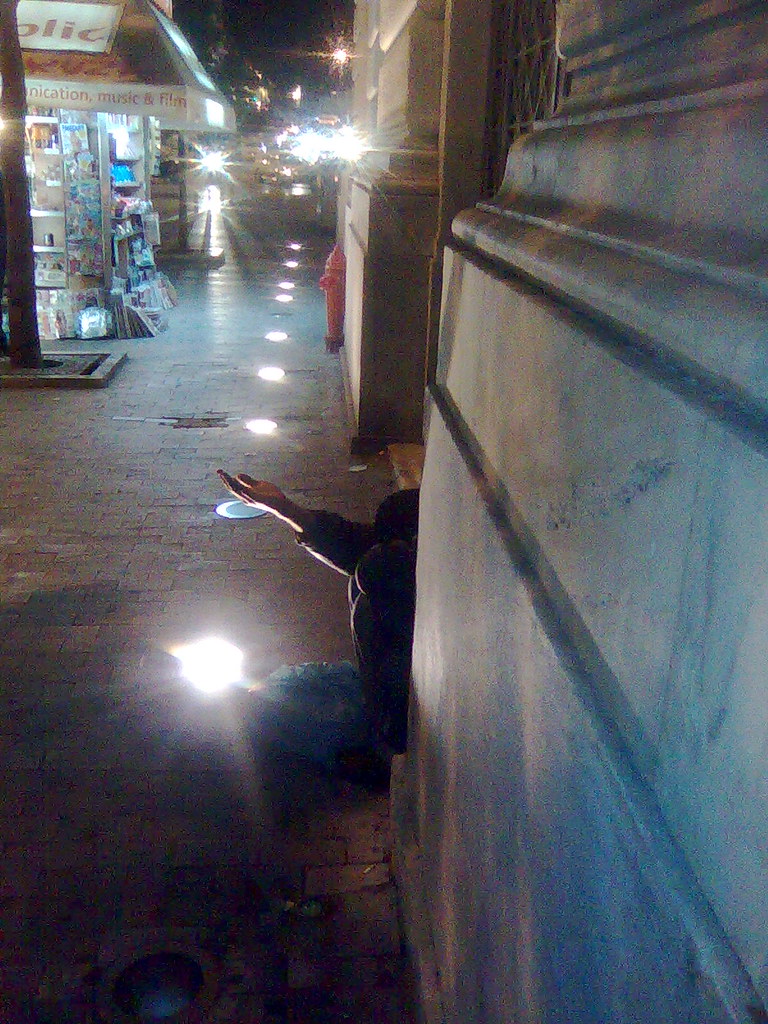
A beggar in Syntagma square, Athens, 27.12.2011
As the Euro crisis unfolds, and the European social model remains under attack by the mindless political armies of orthodox neoliberalism, spread across the continent in positions of power, and the bankers they represent, all is hardly well in Greece. The Greeks, having served as lab-rats for extreme-austerity, have come to realize one thing: Austerity is not a fiscal programme. It is a political project: a project of societal and financial sabotage, aiming at a radical upwards redistribution of wealth in an already very unequal country - indeed a whole continent. This is how the austeritarian disaster zone looks like from the ground:

  • Back to the Caves: "Dozens of homeless people in Athens will spend the Christmas holidays in the sheltering caves of Philopappou Hill, away from the rain and the cold weather.
    According to two reports conducted by the Ministry of Health and the Municipality of Athens and published by Real News, there are many new age homeless, who once were businessmen and traders, and are now penniless, lying on the streets.
    The shocking truth is that among those people there are families as well."
  • Homeless in Athens
    Meet the new homeless: With an average age of 47, 11% of Greece’s homeless have a university degree (!) and 23.5% hold a high school diploma, while only 9.3% are illiterate. The new Greek homeless class members have laptops and iPhones, remnants of their “old” lives. “They come to us in suits with their laptops in hand. These citizens a couple of months ago had ordinary lives. They had a job, a home and car,” says Nikitas Kanakis, the head of Doctors Without Borders in Athens. Counselors from the Department of Homeless Services describe a similar situation. “We even have homeless from suburbs like Kifisia and Voula [upper class suburbs of Athens]! They come  here with their laptops and expensive smart phones they once used for their work, shocked and depressed”.
  • Hunger: Athens Mayor George Kaminis told the daily that the city's homeless had increased by around 20 per cent while queues at soup kitchens organised by municipal and church organisations were up 15 per cent."Care workers no longer meet typical homeless people, they meet a person who likely had a perfectly organised life weeks previously," said Kaminis, who has asked for additional state funding for city welfare services."We have noticed a dramatic increase in our mess halls over the recent period," added Chrysostomos Symeonidis, head of the Athens archdiocese poverty fund. "We distribute over 10,000 meals on a daily basis and 250,000 meals are given out nationwide on a weekly basis," Symeonidis said... [oh and Starvation Recipes are all the rage]
  • ...hunger in the schools:  “Our pupils faint due to starvation. We see our pupils coming to school with holes in their shoes. They don’t even have money to buy food from the school canteen”
  • Which then leads to abandoned children: 'Propelled by poverty, 500 families had recently asked to place children in homes run by the charity SOS Children's Villages, according to the Greek daily Kathimerini. One toddler was left at the nursery she attended with a note that read: "I will not return to get Anna. I don't have any money, I can't bring her up. Sorry. Her mother."'
  • The disabled are also victims of the policies pursued: "In August, a five-year-old program providing deaf people with interpreters was suspended after the government abruptly cut its funding to less than half. Overnight, 15,000 deaf people around Greece were left without help to report a crime to the police, rent a house or go to a job interview. Funding cuts have opened up gaps across welfare services, with slashed services and longer waiting times for vulnerable groups including the blind, recovering organ-transplant patients, autistic children, and paraplegics in need of physiotherapy"

  • At the same time the already decrepit health system is further eroded according to The Lancet: "Overall, the picture of health in Greece is concerning. It reminds us that, in an effort to finance debts, ordinary people are paying the ultimate price: losing access to care and preventive services, facing higher risks of HIV and sexually transmitted diseases, and in the worst cases losing their lives. Greater attention to health and health-care access is needed to ensure that the Greek crisis does not undermine the ultimate source of the country's wealth—its people". Giving birth is now a luxury activity. I suppose women are expected to give birth at home by themselves - a great way to bring infant and maternal mortality to truly third world levels...
  • And, desperate, people kill themselves at an unprecedented rate:  "Greece's suicide rate has reached a pan-European record high, with experts attributing the rise to the country's economic crisis and painful austerity measures. Statistics from the Greek Ministry of Health show a 40 per cent rise in those taking their own lives between January and May this year compared with the same period in 2010"
And the economy? Surely all those wizards of austerity must have improved the flailing Greek economy, raising its productivity etc. No? Well... No:

  • Greece: heavy industry, desperate measures to survive: Heavy industry in Greece, particularly the sectors that produce steel, concrete, aluminium, copper and paper, are desperately trying to find ways to stem some of the negative effects of the economic crisis the country is going though. Some companies even sell up to 70% of their production abroad at cost price, just to be able to keep producing... Energy-intensive industries in Greece fight a daily battle for their survival on a domestic market that has been in recession for four years, with low liquidity, limited financial resources, rising interest rates and a series of austerity measures that seem to ignore their impact on the real economy, like the high taxes on energy
  • Unemployment is rocketing, reaching fearsome heights:


    The jobless rate rose to 17.7 per cent in the third quarter compared to 16.3 per cent in the previous quarter and 12.4 per cent in the corresponding quarter of 2010, the Hellenic statistical authority said... It added that there were over 878,000 people out of work during the three-month period, most of them women and young employees aged under 30

Things are, in other words, tough. Very tough. The kind of tough one associates with a war or a huge natural disaster. And do not think for a minute that all of this is irrelevant to you: if you live anywhere in Europe, periphery or center (but at this point probably anywhere in the Western world), this is in one form or another the future that has been prepared for you. Greece has been the canary in the coal-mine for social Europe in this crisis, a wretched and sorry bird, to begin with, admittedly, yet an indicator of the way things are going in Europe. Regardless of whether austerity is systemically viable in its own terms (it most probably isn't), the news is that the canary, is slowly yet steadily croaking. It is dying. Greek society is taking blows that will transform it for ever, in a path that no one knows where it takes and it is unraveling. So our suicides here, our untended ill, our abandoned children, our middle-class poor, our new homeless and hungry, they are an omen, a sign of things to come, across Europe. Or that seems to be the plan. The good news is that this society is taking it a lot better than some (I too) initially expected it would. Solidarity networks have cropped up all over Greece, while the support to the striking steel-workers (from Greece but not only), two months now in struggle for their livelihoods and lives, is going strong and their struggle is right now the rallying point of resistance to the destruction of all of our collective lives.
High school students, express solidarity with the steel-workers after having gathered a few Euros from pocket change to contribute to the strikers fund


An interesting thing is happening at the political level: the "unserious" Left is gaining. In a recent poll, the "electoral influence" of the three left of the mainstream parties adds up to 37% - 41 percent if one adds up the smaller parties and the Greens, a number that is unprecedented and apparently rising. Whether this will coalesce to a viable government is doubtful: The communists consider everybody else a capitalist stooge, not serious about systemic change, the Democratic Left, the right splinter group from SYRIZA, seems to be more comfortable discussing a collaboration with PASOK (assuming there will be a PASOK left by the time the elections arrive) than with everybody else. However, popular pressure can work wonders, and one still hopes that  Greece will be the first to throw a political wrench in the working of the austeritarian banksters and their political employees in Europe. That is assuming that the ruling Socialist - Conservative - Far Right coalition under a former ECB vice president, actually deigns to hold elections sometime in the near future as originally promised.

The future remains at this point very opaque. The issue is whether the rest of the European peoples will need to arrive at the point of despair that Greeks have reached, before they react.

Saturday, October 8, 2011

Questions From a Worker Who Reads - from an iPad


Questions From a Worker Who Reads, Bertold Brecht, 1935

Who built Thebes of the seven gates?
In the books you will find the names of kings.
Did the kings haul up the lumps of rock?
And Babylon, many times demolished
Who raised it up so many times? In what houses
of gold-glittering Lima did the builders live?
Where, the evening that the Wall of China was finished
Did the masons go? Great Rome
Is full of triumphal arches. Who erected them? Over whom
Did the Caesars triumph? Had Byzantium, much praised in song
Only palaces for its inhabitants? Even in fabled Atlantis
The night the ocean engulfed it
The drowning still bawled for their slaves.

The young Alexander conquered India.
Was he alone?
Caesar beat the Gauls.
Did he not have even a cook with him?

Philip of Spain wept when his armada
Went down. Was he the only one to weep?
Frederick the Second won the Seven Year's War. Who
Else won it?

Every page a victory.
Who cooked the feast for the victors?
Every ten years a great man?
Who paid the bill?

So many reports.
So many questions.

[General idea first posted in Greek in Ιστολόγιον, more links added in this English version - cross-posted at the European Tribune]

Tuesday, August 16, 2011

Roubini on the crisis and Marx - WSJ


WSJ: (~4:00) So you painted a bleak picture of sub-par economic growth going forward, with an increased risk of another recession in the near future. That sounds awful. What can government and what can businesses do to get the economy going again or is it just sit and wait and gut it out?

Roubini: Businesses are not doing anything. They're not actually helping. All this risk made them more nervous. There's a value in waiting. They claim they're doing cutbacks because there's excess capacity and not adding workers because there's not enough final demand, but there's a paradox, a Catch-22. If you're not hiring workers, there's not enough labor income, enough consumer confidence, enough consumption, not enough final demand. In the last two or three years, we've actually had a worsening because we've had a massive redistribution of income from labor to capital, from wages to profits, and the inequality of income has increased and the marginal propensity to spend of a household is greater than the marginal propensity of a firm because they have a greater propensity to save, that is firms compared to households. So the redistribution of income and wealth makes the problem of inadequate aggregate demand even worse.

Karl Marx had it right. At some point, Capitalism can destroy itself. You cannot keep on shifting income from labor to Capital without having an excess capacity and a lack of aggregate demand. That's what has happened. We thought that markets worked. They're not working. The individual can be rational. The firm, to survive and thrive, can push labor costs more and more down, but labor costs are someone else's income and consumption. That's why it's a self-destructive process.
[1]

He then goes on to say many startling things (well for the WSJ readership I imagine) like:

Calling [the UK rioters] just criminals is ignoring the fact that these are poor & desperate people, and poor and desparate people whether in Egypt or the UK tend to riot, and eventually this inequality together with no jons and no income and no growth in the economy can lead to indstability in any country...

And generally the man sounds like a dangerous radical. The end of days. Surely.


[1] [transcript via MeFi]

Thursday, November 18, 2010

Back somewhat


The Return
So I'm back sort of, and we'll see how that goes... I imported here stuff I was writing (basically reposting) at Arachne which I'll re-purpose somehow, I'll see...

Things are getting out of hand here and I think I should lend a hand in reporting Greece's "socialist"-led plunge into ECB/IMF mandated poverty and despair.

I've been posting some sparse reports over at Eurotrib, an oasis of sane people angrily protesting the attempted return of what once was Social Europe to neofeudalism.

So let's see how long I'll keep posting this time...

Wednesday, February 24, 2010

Sunday, December 13, 2009

Is Democracy Good for the Poor?

Many scholars claim that democracy improves the welfare of the poor. This article uses data on infant and child mortality to challenge this claim. Cross-national studies tend to exclude from their samples nondemocratic states that have performed well; this leads to the mistaken inference that nondemocracies have worse records than democracies. Once these and other flaws are corrected, democracy has little or no effect on infant and child mortality rates. Democracies spend more money on education and health than nondemocracies, but these benefits seem to accrue to middle- and upper income groups.

Saturday, November 14, 2009

The spread of central bank political unaccountability

GLOBALIZATION PRESSURES AND THE STATE: THE WORLDWIDE SPREAD OF CENTRAL BANK INDEPENDENCE [pdf]

"We predict that countries boost the independence of their central bank from the political power as their exposure to foreign trade, investment, and multilateral lending increases. We also model the cross-national dynamic process of diffusion of central bank independence by examining the impact of cohesive and role-equivalent trade relationships between countries. We test our hypotheses with information on 71 countries between 1990 and 2000, using both event-history modeling and fixed-effects panel-corrected regression. Controlling for domestic variables of a macroeconomic and political nature, we find empirical support for each our predictions. We conclude that globalization pressures have the effect of strengthening certain parts of the state at the expense of others, and raise concerns about the degree of democratic oversight of technocratic institutions."

Sunday, November 8, 2009

3 views on the Crisis

David Harvey, The Crisis Today: Marxism 2009 July 15, 2009:


The Roots of the World Ecological Crisis
by John Bellamy Foster, October 29. 2009 (starts at ~17'):


Tom Reifer, July 8 2009
Histories of the Present: Giovanni Arrighi, the Longue Duree of Geohistorical Capitalism, and the Current Crisis

Tuesday, September 29, 2009

A healthy recession

Life and death during the Great Depression — PNAS:
Correlation and regression analyses confirmed a significant negative effect of economic expansions on health gains. The evolution of population health during the years 1920–1940 confirms the counterintuitive hypothesis that, as in other historical periods and market economies, population health tends to evolve better during recessions than in expansions.

This is not new: "Are Recessions Good For Your Health?" The Quarterly Journal of Economics, 2000:
Total mortality and eight of the ten sources of fatalities examined are shown to exhibit a procyclical fluctuation, with suicides representing an important exception. The variations are largest for those causes and age groups where behavioral responses are most plausible, and there is some evidence that the unfavorable health effects of temporary upturns are partially or fully offset if the economic growth is long-lasting

Although the effect is apparently real, the health benefits during recessions are unequally distributed and widen the income induced health gap:
Self-rated health improved in absolute terms for all occupational groups even after the economic recession. However, the relative disparity increased between the top and middle occupational groups in men.

The health debacles that occur during periods of rapid growth are equally obvious:
Cancer casts a shadow over the villages in this region of China in southern Guangdong province, nestled among farmland contaminated by heavy metals used to make batteries, computer parts and other electronics devices.
Every year, an estimated 460,000 people die prematurely in China due to exposure to air and water pollution, according to a 2007 World Bank study.
.

...Thus adding a few more exhibits to the question of relevance of GDP as any sort of measure of human happiness, or the obviousness of the need for its incessant growth...

Tuesday, September 15, 2009

Labor History / US

In Memoriam: Crystal Lee Sutton ('Norma Rae'). Working Class Hero.


Ampersand: Labor History: A Brief History of Corporate Whining

By B. Deutsch

Some notes:

1. Commonwealth v. Hunt 1842
2. The Thibodaux Massacre of 1887
3. Triangle Shirtwaist Factory fire (I think this is what the 1912 cartoon refers to)
4. Yellow Dog contracts legal, 1915
5. Child Labor Amendment, 1924
6. Fair Labor Standards Act, 1938
7. Equal Pay Act, 1963
8. Occupational Safety and Health Act, 1970
9. Today

... All this to make a point: it was never easy and they always whined. Not to mention the fact that it always bears reminding that the US was the stage of a hard, bloody and bitter class struggle. And, hey! What do you know, the tide is turning. I did not believe that I'd see the day when an overtly anti-capitalist documentary would be poised to become a major box-office hit in the US, but things sure change fast:

Monday, July 6, 2009

Interview: Hungary—“Where we went wrong”, GM Tamás

ISJ: GM Tamás, a prominent Hungarian dissident and now professor of philosophy in Budapest, spoke to Chris Harman about developments in Eastern Europe since the fall of Stalinism.

What was important in hindsight was that in the first two years I spent in the highest chamber of my country as a lawmaker two million jobs were lost—and I don’t think I noticed. That is one of the greatest shames of my life. I don’t think it figured in political debates at that time. There were important debates concerning constitutional rights and republican versus monarchist symbols, fights over control of state radio and television. I won’t say political conflicts were not important but compared to the economic disaster they were of less importance, and we did not see the interdependence between the two. Why did the ruling class need the centralisation of media power? Because it was losing majority support from the population that were getting impoverished. We were totally naive and our discourse at the time was that of classic liberalism and pretty ineffective. This liberal party will probably now, and quite deservedly, disappear from parliament.

...

From the 1920s the Stalinist system—however monstrous, tyrannical and state capitalist it was—had through urbanisation and industrialisation created the livelihoods and life forms of hundreds of millions of people. They may have been disappointed and dissatisfied with the way of life but nevertheless it was theirs. And nobody had prepared them for what was to replace it. It was not something better, not something we might call “change”, but instead the end to economy as such.

In large parts of Eastern Europe and the Eurasian landmass there was the loss of what we knew of as civilisation, which was very much dependent on the state. The state has barely started to function again in Putin’s Russia—in a very unpleasant way—but it is starting to work regularly, making records, collecting revenue, paying civil servants, answering letters, receiving citizens with complaints. But in the early 1990s even that was not available: it was a total disaster. Meanwhile we, the froth at the top of it, were celebrating the triumph of freedom and openness and plurality and fantasy and pleasure and all that. That was frivolous, and I am deeply ashamed.

...

Soviet-type state capitalism was a commodity-producing, wage labour based, unequal, hierarchic, repressive money economy and a class society to outclass all class societies which was extremely efficient in suppressing proletarian resistance. Revolts against that regime have always been socialist revolutions, in 1956 the workers’ councils in Hungary, in 1968 the humanistic socialism in Czechoslovakia. Solidarność was in fact no trade union but a network of territorially organised workers’ councils which initially wanted a self-management proletarian republic of a self-governing people, before repression made it into a bitterly conservative, pessimistic and Catholic movement to disintegrate at the moment of political “victory”. The Central European style of “enlightened absolutism”, of top-down reforms devised by scientifically and philosophically trained elite planners has not changed since the 18th century. “Communist” economic planners were painlessly transmogrified into neoconservative monetarist planners. For them, in a characteristically positivist manner, “socialism” was but an error in economic calculus. Marginal utility seemed more “modern” than the labour theory of value—and bureaucrats go more willingly with the prevailing fashion than couturiers.
...

Wednesday, June 24, 2009

Massacre (and victory) in Bagua, Peru


More-info: MADRE INDÍGENA HABLA AL PRESIDENTE ALAN GARCIA PEREZ MASACRE EN BAGUA TRADUCCION SUBTITULADA
A native mother who is in pain for the lost of her people talks in her language and she has the right to be listened and understood around the world: " Listen please president Alan Garcia, you are responsible because you have exterminated us, you are killing us, you are selling us. You are the terrorist. We defend our territory from armament Our only weapon of defense is just arrows and sticks, that aren't long range and they aren´t meant to kill like you did with us. You exterminated us using armament, bullets, helicopters and killed our brothers, sisters, students, teachers, sons... Alan we ask you to come over here to our territory to pay the debts you have to us. Alan, you sell our country, you sell our people, you sell our natural resources, gold, oil, water, air You pollute our environment and so you will leave us even poorer as you can see us now.. this is how we are and how we are left. We, the awajón-wampis people haven´t elected you to exterminate us, but to help us, to provide us with education for the kids you killed now. We aren´t taking your private property, we haven´t killed your kids or family, you already exterminated us and now we have NOTHING!".


The background: Trade Agreement Kills Amazon Indians
The jungle massacre: Peru's tribal chief flees country
A first hand account: Massacre in Peru: A trip into the Amazon brings answers and more questions
Families of Dead Native Protesters Tell Their Stories

But all of this was not in vain: Victory in the Amazon