
The WSJ readership of course, needs this potent injection of fear-mongering anyway, as the plebes in the US are rapidly becoming unruly themselves, faced with shouldering the costs of the banker bailout and this cautionary tale form the exotic Near East, complete with leftist dragons, is perfectly timed for domestic use.
As I said, if this was published in a Greek newspaper, in Greek, it would offer a hilarious peek at the paranoia that the crisis has bread among the country's upper classes, and would not merit a response significantly different from "you should go out more often". Since it is published in English, in a paper as broadly read among ruling elites as the WSJ, and might skew the perception of what is actually happening in Greece, it requires debunking, especially as I have seen the article being referred to on the www as some sort of authoritative picture of Greek "anarchy", since its publication. In the process it will provide an opportunity to relate the true story of the budding, if still incoherent, mass resistance to the ECB/IMF fiscal stormtroopers and their caretaker government in this peripheral ECB province I'm writing from, but also the truly darker side of collapsing neighbourhoods, mindless violence and general despair that is emerging from the deep cracks that the prolonged ECB/IMF induced depression has carved on the already decrepit social body. This panoramic view of civil discontent and societal unrest that answering Michas' article must include, and the true dangers lurking as the crisis deepens will be the major theme of this post, along with a discussion of things that have happened after the publication of this article: it has been a month thick with events.
I don't think there is a country in the world were the population can (or should) be expected to passively accept its own impoverishment and the annihilation of lives and prospects. Society is still paralyzed from the Shock Therapy the German Bankers and their local overseers have imposed and are still, to an extent, under the spell of the neoliberal mantra: There Is No Alternative. There are movements however on the ground, local and nation-wide that resist this destruction, stemming both from a sense of injustice and a practical inability to pay for much more than basic necessities. These movements are widely accepted and approved of by the Greek population. However, for Michas to admit to large scale societal desperation, rage and depression would be to accept that there are valid reasons for this anger. But that would by ideologically problematic for a large part of the neoliberal right that he represents and, anyway, it would stand in the way of red-baiting which is the object of this article. Thus Michas proceeds to a string of accusations against the left that are blatantly outrageous and viciously false. They are the kind of accusations an authoritarian government levels against dissident groups. It is highly unlikely that Michas is so secluded and deluded that he doesn't know this already, so this is IMHO inexcusable disinformation.
Michas starts his description of the Evil Greek Left with an impressive piece of disinformation:
First if all let's start with this fact: The "militant activists" of these parties are responsible for zero (0) acts of real physical violence against anyone. They have "harassed" no citizens that I'm aware of, unless "harass citizens" means "demonstrate against politicians" perhaps, they have not destroyed public property as far as I'm aware of, and they have certainly not taken over any villages, at least since the Greek Civil War in the 1940s.
The Communist Party is an ossified relic of a sovietophilic old-school stalinist party, whose intransigence and militancy in workers' movements as well as its historic role in the Greek resistance have guaranteed it a permanent place in parliament - and which is growing stronger by the day as the protest party par excellence. Its actions include the usual old-school labor actions, i.e. ship-workers and sailors blocking ports. The party has no loose canons and has a horror of things getting out of control. No police officers worry about attending a KKE demonstration. Ever.
Those evil commies then, have activists who apparently "direct physical attacks primarily at politicians and journalists who support open societies and market economies". Now, the three "attacks" Michas mentions have indeed happened (as have many more like them); in fact politicians and establishment figures are currently feeling rather unsafe walking around in public without heavy escort. But that isn't because they are "for open societies and market economies" but rather because they are part of a corrupt and/or incompetent political two-party system that has thrown Greece into an unsustainable debt maelstorm, through cronyism, clientilism and theft. This opinion about the two governing parties is shared by a vast majority of the population - 93% of Greeks feel that corrupt politicians should go to jail. According to last year's Transparency International survey, Greeks were the people who ranked their political parties with the highest marks for corruption in the world. A recent poll shows that 40% of the population are for (and 56% against) violent heckling of governing politicians. As the Greek economy collapses even the "official" narrative for the crisis makes people who are facing destitution rather angry.
Even so, the conservative politician mentioned was most certainly not attacked by organized leftist activists (of any kind). Kostis Hatzidakis, MP and former transport minister, not involved in any personal scandals, was attacked by a couple of elderly men during a huge union demonstration, one carrying an umbrella which he used against the former minister, as other protesters from the crowd protected the MP.
No one credible has, to my knowledge, seriously suggested that the attackers were members of any party. Their photos and the relevant video has travelled around the Greek web and the media many times. Were the perpetrators members of any left party, the MS media, quick to indulge in all sort of wild accusations against those "irresponsible leftists" would no-doubt have unearthed it. They haven't.
The same is true for both other cases (and there are many more instances of public, intense disapproval, voiced all over Greece and abroad wherever government members appear in public, on a daily basis by now, most of which have nothing to do with physical violence). In one case Michas mentions, we know for a fact that the person that threw yogurt (yogurt! how deadly can you get?) against the Vice-Premier was a voter of the far-right LAOS party, (and we know this because he gave an interview in a Greek newspaper). He was acting as a citizen of Keratea, a town whose inhabitants have immersed themselves in an insurgency against the creation of a landfill next to their homes. The town was a rather conservative - if anything - electoral municipality. This is the only instance of anything that might be legitimately called an insurrection in Greece, and it is very local in its scope. Theodoros Pangalos, the Vice Premier, elected from that particular electoral periphery, had spoken against the locals and for Law and Order, as is par for the course. Again, since local politicians of all colours and stripes have expressed their sympathies with the locals, and the whole town was behind the demonstrations, the claim that the locals were "supported by anarchist 'freedom fighters'” is ridiculous - not to mention in contradiction with the claim that the village was taken over by leftist activists. Keratea is a case study in state intimidation since from day one the government chose to use sticks - not carrots: the police have shown incredible ferocity against the inhabitants of Keratea, including Gaza-style home invasions and violence against the elderly, on orders to support tooth and claw a project that the citizens of Keratea insist is a contract awarded to politically connected construction companies. This is not the first time in Greece or in Europe, where locals have found being forced to live next to a toxic landfill violently unpalatable. Only previously, no one would have thought it necessary to invoke a conspiracy of anarchostalinists to explain it away. As for Pangalos, who has distinguished himself in heaping scorn against Greek citizens, a recent poll has shown that a full 79% of those questioned agreed with the deprecation and the jeers directed against him. By the way: it seems that these protests might yet have borne fruit... with all that this fact might have to teach us.
Similarly, the "Won't pay" movement, far from being some sort of bloodthirsty extremist group (in fact they are completely non-violent) is a citizens' initiative, mostly, but not solely, from areas where the government has set up toll booths that force the inhabitants of towns to pay in order to be able to leave their towns. At the same time, the toll fee prices had been hiked originally, exactly as general nominal income is steeply declining and inflation is charging on at 4-5%. Frequent commuters find it too much of a drain for their precarious finances to pay extra for driving to and from work, on incomplete roads constructed by the "national" contractors whose contracts are generally believed to be the product of their owners' political "entanglement". The Left certainly supported these movements but hardly initiated them. The movements had managed to win a promise of across the board reduction on toll fees (which it seems now the government has no intention of carrying out). They have also opened up with their actions, both on the road and in the courts, a new area of public inquiry, regarding the enormous costs that Greek roads seem to have incurred, as part of the corrupt relationships between some construction companies' owners and government cadres from both ruling parties...And it's far more than the voters of the Left who are furious with the toll prices: 66% of the public consider that the Minister of Infrastructure is a tool for the contractors. 52% suppport the "Won't pay" activists (vs 33% against). These people are not ideologues of any sort of "hard left" Michas is terrified of. They are people at the edge of bankruptcy and disaster. Even the regional chambers of commerce for Pieria and Thessaloniki are participating actively in these protests. So much for wild-eyed radicals...A similar story pertains to the metro/bus ticket boycott: fares went up by 40% this January, meeting a determined resistance from many commuters who have refused to pay these price hikes. In both cases the government legislated draconian measures to break these movements, and it is rumored that the toll companies are paying police officers and police departments to be present at the toll stations and force payment on anyone who denies payment, while they have tried to scare ticket dodgers with heavy penalties and fines - and even jail for a 1,4 Euro ticket!
Then there is the Marfin Bank incident last May, where, in one of the largest union rallies ever in Athens, a group of hooded "anarchists" threw molotov cocktails inside a bank, a mind-bogglingly criminal act that resulted in the death of three bank employees, who were trapped inside. This was a depraved act, no doubt about it, but the fire-bombers, who were possibly not aware of the fact that there were people inside the shuttered bank, were a small group (3-4 people strong) acting around the main demo, with no connection to Michas' "hard left" at all. Michas' claim, that activists of the main parliamentary leftist parties go after "people who refuse to participate in strikes and demonstrations" stating that: "In May 2010 three employees of the private bank Marfin suffocated to death when a hard-left mob fire-bombed their offices during a riot" is slanderous and dishonest.
The immigrant hunger strike was the most obvious example of the "respectable" part of the political spectrum seeming to have decided that, in the face of mass popular delegitimization of the political system, the proper response is to move ever rightwards on social issues. This is some sort of a collective "Sarkozy strategy", which ignores, among other things, how this is currently playing out in France. The marriage of neoliberal economics with extreme conservative, nationalist and xenophobic currents, seems to be a viable vehicle for preserving elite privilege. This has the effect of further strengthening an already empowered extreme right: the Nazi party (not a metaphor - the actual Nazi party) is polling at 1,5% according to a recent poll, ten times its historical size, and the original xenophobic extreme right-wingers at LAOS have also shown signs of a significant rise in the polls. Since Michas' article, the Nazis and the mainstream apologists for xenophobia who have fanned the flames of the racism that feeds them, have gone on an anti-immigrant rampage, a pogrom of real and horrific criminal violence, illustrating where the danger of blind and mindless destruction and societal dissolution come from and where criminal intent really is indiscernible from the effects of a programmatically antidemocratic platform. These events happened a month after Michas' aricle in the WSJ, and the trend was visible well before then. Strangely Michas' libertarianism was blind to this actual rather than invented rise of political violence.
What is even more worrying is the fact that these pogroms happened under the indifferent eye of the police, and they were then only peripherally highlighted and lightly condemned by mainstream media. What is more: as the Minister of Public Protection mumbled a few words about dissolving the nuclei of neonazi sympathizers in the police force, "serious" newspapers, the conservative and far-right opposition, members of his own "socialist" party and pundits of every sort, actually protested against "starting witch hunts" in the police force and "hurting an already diminished morale". Thus it is plainly clear that the toleration of the far right is a reasoned choice for sections of the Greek elite.
This will not be the first time the Greek liberal right and center and the elites that run them, will have allied themselves with the extreme right: During the civil war in Greece the "traditional" parties allied themselves with Nazi collaborators, black-marketeers and goons, and proceeded to impose a national security state that, with varying ferocity, continued until 1974, after attempts at democratization were quashed by royalist parliamentary coups and then the brutal military junta of 1967-74. Thus it is truly ironic for Michas to dangle the spectre of an imaginary authoritarian left: in Greece it is the liberal and not too liberal center and conservative parties that have a history of violence, using the extreme right as their "muscle". The parties Michas slanders and their ideological forebears, have been fighting for more not less democracy in Greece over the last 60 years. Kim Il Sung would feel much more comfortable with the government's LAOS allies than he would with the independent (to say the least) minded members of the components of SYRIZA's coalition. much less of course an anarchist of any sort...
This collapse has created hopelessness, anger and violence. Criminal violence, racist and nazi violence, police violence and anarchist / protest violence. The events of the past weeks I have described elsewhere, but a day after the brutal and murderous police attack against peaceful demonstrators - a practice so entrenched and widespread that it suggests a permanent strategy of intimidation in order to "discourage" participation - a gang of anarchists attacked a central police station with molotov cocktails, running through a street market full of people. In the ensuing mess, three bystanders were burned by the fire bombs and one was until yesterday in serious condition, fighting for his life in a hospital...
So this explains somewhat the results that Public Issue, a polling company, published, of a survey that reported that:
- 62% of Greeks think that the memorandum with the troika has harmed the country and the same percentage is against it (13% it benefited the country - 15 support it),
- 16% think that there is no alternative (69% think there are alternatives).
- 77% do not trust the Prime Minister to manage the economy (22% trust him).
- 75% have a negative view of the IMF (69% last year), and 74% of DSK (49% last year).
- 69% believe that the IMF must leave Greece now (up 4% from 6 months ago).
- Only 52% have a negative view of the ECB (vs 33% positive) and 61% of Trichet. 59% have a positive view of the EU (up three points from 6 months ago).
- 53% want to bargain and default on at least a part of the public debt. 17% want to default completely and unilaterally.
- 33% think that the country needs a revolution and 56% deep changes.
- Greeks support strikes (74 - 20) and protests & marches (69 - 25) and are marginally not supportive of electoral abstention (45 - 54) and public deprecation and jeering of politicians (43 - 54)...
- 78% vs 21, believe that a social explosion is impending...
- 29% feel mainly angry, 18% dissapointed, 15% anxious, 11% shamed, 8% sadness and 13% all of the above.
Interestingly 48% believes that the stage is set for a successful far right party to emerge, versus 27% for a far left.
Thus contrary to Michas' assertions this is not about a leftist coup d' etat: The natives are restless and unhappy because of the, probably unprecedented during peacetime, drop of living standards they are suffering, with large swathes of the population being pushed to extremes of poverty that were unimaginable a few years ago, at the same time as prices rise, with incredibly high inflation due to a continuous barrage of indirect taxes and the backbone of state services and companies is being privatized in a gigantic sell out: Schools are being shut down, hospitals are in jeopardy (while corruption in and around them is still rife), as per yesterday the electric utility, the healthiest bank in the country, the state gambling and betting monopolies (very profitable), the power company (again profitable), petroleum, water services etc - are on sale, a true sell out that will happen at fire-sale prices (the depression has driven the Athens stock market at an all time low, it will be interesting in a morbid way to see how low will the sell out prices go). The sad thing about the left in these circumstances is not that it does to much. But that it is still doing too little to stop the asset stripping and the destruction of a whole generation of Greeks. If only they were as dangerous as Michas claims!
Yet this work of political fiction Michas has concocted must serve a purpose. I fear it is one of creating alibis. "If you see us rolling out the tanks, rescinding a few articles of the constitution, or if you see demonstrators being trampled, beaten like it's Mubarak's Tahrir Square, Manama, or Baniya, Syria", signals Michas to US and global elites, "it's OK": It's only communists and "anarchostalinists" who are being punished for their love of Kim Il Sung. Everybody else just loves being reduced to poverty and insecurity.
P.S: And so it was until the #spanishrevolution. There are as we speak twenty or more facebook groups planning #greekrevolution gatherings around the country, today 25/5/11. Let's see how succesful and how nonviolent these turn out to be. Unlike the #spanishrevolution however, everybody expects the #greekrevolution right now...
Austerity? What austerity?
Michas begins by lamenting the demise of "the rule of law" in Greece and chiding the government for its inability to "to maintain order and implement its own legislation". While the debt crisis is briefly mentioned, Michas avoids pointing to a rather crucial piece of background info: the developments he "describes" (and misrepresents) are happening as Greece is plunged into the deepest recession in living memory, as unemployment is skyrocketing along with part-time and uninsured jobs, as even nominal wages are collapsing, as a quarter of small businesses have either gone bankrupt or are preparing to do so, as indirect taxes soar and inflation persists. But all this does not impress Michas:"Many argue that Greece’s disintegration is the unavoidable consequence of the government’s attempt to enforce economic austerity. This seems doubtful".Now why it seems doubtful to Takis Michas, he won't say. It certainly doesn't seem doubtful to the vast majority of people in the country, as the percentage of Greeks expecting social conflict in the next few months as a result of government policies reached 84% three months ago [poll links in Greek, I'm afraid], while when asked to describe their feelings towards these policies in another poll, 35,5% mentioned "anger", 33% "disappointment", and 21% "fear". Pollsters warn that the Greek political system has "passed the point of no return", and is facing a drastic overhaul...
I don't think there is a country in the world were the population can (or should) be expected to passively accept its own impoverishment and the annihilation of lives and prospects. Society is still paralyzed from the Shock Therapy the German Bankers and their local overseers have imposed and are still, to an extent, under the spell of the neoliberal mantra: There Is No Alternative. There are movements however on the ground, local and nation-wide that resist this destruction, stemming both from a sense of injustice and a practical inability to pay for much more than basic necessities. These movements are widely accepted and approved of by the Greek population. However, for Michas to admit to large scale societal desperation, rage and depression would be to accept that there are valid reasons for this anger. But that would by ideologically problematic for a large part of the neoliberal right that he represents and, anyway, it would stand in the way of red-baiting which is the object of this article. Thus Michas proceeds to a string of accusations against the left that are blatantly outrageous and viciously false. They are the kind of accusations an authoritarian government levels against dissident groups. It is highly unlikely that Michas is so secluded and deluded that he doesn't know this already, so this is IMHO inexcusable disinformation.
All protest is lawlessness?
 | |||
| SYRIZA members harass pro-market politician |
The country is at the mercy of militant activists, who are mostly inspired by various factions of Greece’s hard left. The heaviest hitters are Greece’s Communist Party and the anarcho-Stalinist Coalition of the Radical Left, which is comprised of the Ecosocialists of Greece, the “Roza” Radical Left Group and the Internationalist Workers’ Left, to name a few. Their followers, with total impunity, have taken to harassing citizens and destroying public property, even taking over whole villages.
First if all let's start with this fact: The "militant activists" of these parties are responsible for zero (0) acts of real physical violence against anyone. They have "harassed" no citizens that I'm aware of, unless "harass citizens" means "demonstrate against politicians" perhaps, they have not destroyed public property as far as I'm aware of, and they have certainly not taken over any villages, at least since the Greek Civil War in the 1940s.
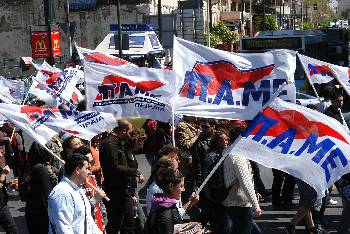 |
| Beware of Stalinists bearing flags |
 |
| Rabid SYRIZA Members armed with deadly pickets |
The description of the Coalition of the Radical Left (SY.RIZ.A in Greek) again is, well, somewhat idiosyncratic. It is indeed a coalition, a block of left and green parties from left social-democracy to post-maoist groups. The three parties Michas chooses to enumerate are however not quite representative of the alliance. It is like saying that "the Italian peninsula is comprised among others of the Vatican and San Marino". The missing elephant, the core political and parliamentary entity around which the alliance was built, is the Coalition of the Left and Ecology (even the similar name sort of gives the deal away) a member of the Party of the European Left (along with Die Linke, Bloco, Sinn Fein, PCF etc.). Interestingly, despite Michas' claims regarding their dastardly final objectives, this party participated in two Greek governments in the late 80s early 90s (along with the Communists - with the Conservatives first and then in a emergency government): there were no gulags built. Kim Il Sung does not seem to feature among the guiding lights of either party... About "Anarchostalinism" I can only say that it is a term that has no proper place outside satire, so I'll leave it at that.
Those evil commies then, have activists who apparently "direct physical attacks primarily at politicians and journalists who support open societies and market economies". Now, the three "attacks" Michas mentions have indeed happened (as have many more like them); in fact politicians and establishment figures are currently feeling rather unsafe walking around in public without heavy escort. But that isn't because they are "for open societies and market economies" but rather because they are part of a corrupt and/or incompetent political two-party system that has thrown Greece into an unsustainable debt maelstorm, through cronyism, clientilism and theft. This opinion about the two governing parties is shared by a vast majority of the population - 93% of Greeks feel that corrupt politicians should go to jail. According to last year's Transparency International survey, Greeks were the people who ranked their political parties with the highest marks for corruption in the world. A recent poll shows that 40% of the population are for (and 56% against) violent heckling of governing politicians. As the Greek economy collapses even the "official" narrative for the crisis makes people who are facing destitution rather angry.
Even so, the conservative politician mentioned was most certainly not attacked by organized leftist activists (of any kind). Kostis Hatzidakis, MP and former transport minister, not involved in any personal scandals, was attacked by a couple of elderly men during a huge union demonstration, one carrying an umbrella which he used against the former minister, as other protesters from the crowd protected the MP.
 |
| Hadzidakis attacked |
 |
| Keratea burning |
 |
| Raw terror at the toll booths |
Then there is the Marfin Bank incident last May, where, in one of the largest union rallies ever in Athens, a group of hooded "anarchists" threw molotov cocktails inside a bank, a mind-bogglingly criminal act that resulted in the death of three bank employees, who were trapped inside. This was a depraved act, no doubt about it, but the fire-bombers, who were possibly not aware of the fact that there were people inside the shuttered bank, were a small group (3-4 people strong) acting around the main demo, with no connection to Michas' "hard left" at all. Michas' claim, that activists of the main parliamentary leftist parties go after "people who refuse to participate in strikes and demonstrations" stating that: "In May 2010 three employees of the private bank Marfin suffocated to death when a hard-left mob fire-bombed their offices during a riot" is slanderous and dishonest.
The ghost of Greek liberals past
This tale of nefarious leftists firebombing villages and occupying banks or whatever, is of course par for the course for the socialist government and its supporters in the media as well as the ultra-right wing LAOS party.This is not the only policy area where the "serious" parties converge: This January the government, the conservative opposition and the extreme right were trying to outdo each other in anti-immigrant, xenophobic and racist rhetoric when 300 (mainly North African) "illegal" workers went on a hunger strike to demand that they have the opportunity to employ themselves legally. Seeing this as a rare opportunity to gain popular points, the government rode the xenophobic horse almost until the end when, faced with the prospect of dozens of dead hunger strikers, as one after the other were fading in critical condition in Greek hospitals, they accepted some sort of deal - which after the hunger strike was over they made sure to reinterpret. The compliant government-dependent media moguls and their TV stations went on what can only be described as a week of inciting racist hatred: the intensity of rhetoric was at KKK levels and it was truly scary to realize that one was witnessing what amounted to a immigrant hate-fest in the most mainstream of Greek TV news shows. This was unfolding in an already ominous context of sky-rocketing unemployment and Dublin II, an EU treaty on migration which guarantees that Greece is and will remain a massive EU immigrant detention camp for the forseeable future, with a desperate, unemployed and hopeless detainee population that is now dying to get out of the country on top of dying to get in... The Democratic Alliance, the party which Mr. Michas writes as a representative of in the WSJ article, was a very vocal part of that broad coalition of xenophobia. Note that as an independent journalist Michas showed a libertarian bend, and it is doubly astonishing to read such calls to authoritarianism by him especially...The immigrant hunger strike was the most obvious example of the "respectable" part of the political spectrum seeming to have decided that, in the face of mass popular delegitimization of the political system, the proper response is to move ever rightwards on social issues. This is some sort of a collective "Sarkozy strategy", which ignores, among other things, how this is currently playing out in France. The marriage of neoliberal economics with extreme conservative, nationalist and xenophobic currents, seems to be a viable vehicle for preserving elite privilege. This has the effect of further strengthening an already empowered extreme right: the Nazi party (not a metaphor - the actual Nazi party) is polling at 1,5% according to a recent poll, ten times its historical size, and the original xenophobic extreme right-wingers at LAOS have also shown signs of a significant rise in the polls. Since Michas' article, the Nazis and the mainstream apologists for xenophobia who have fanned the flames of the racism that feeds them, have gone on an anti-immigrant rampage, a pogrom of real and horrific criminal violence, illustrating where the danger of blind and mindless destruction and societal dissolution come from and where criminal intent really is indiscernible from the effects of a programmatically antidemocratic platform. These events happened a month after Michas' aricle in the WSJ, and the trend was visible well before then. Strangely Michas' libertarianism was blind to this actual rather than invented rise of political violence.
What is even more worrying is the fact that these pogroms happened under the indifferent eye of the police, and they were then only peripherally highlighted and lightly condemned by mainstream media. What is more: as the Minister of Public Protection mumbled a few words about dissolving the nuclei of neonazi sympathizers in the police force, "serious" newspapers, the conservative and far-right opposition, members of his own "socialist" party and pundits of every sort, actually protested against "starting witch hunts" in the police force and "hurting an already diminished morale". Thus it is plainly clear that the toleration of the far right is a reasoned choice for sections of the Greek elite.
This will not be the first time the Greek liberal right and center and the elites that run them, will have allied themselves with the extreme right: During the civil war in Greece the "traditional" parties allied themselves with Nazi collaborators, black-marketeers and goons, and proceeded to impose a national security state that, with varying ferocity, continued until 1974, after attempts at democratization were quashed by royalist parliamentary coups and then the brutal military junta of 1967-74. Thus it is truly ironic for Michas to dangle the spectre of an imaginary authoritarian left: in Greece it is the liberal and not too liberal center and conservative parties that have a history of violence, using the extreme right as their "muscle". The parties Michas slanders and their ideological forebears, have been fighting for more not less democracy in Greece over the last 60 years. Kim Il Sung would feel much more comfortable with the government's LAOS allies than he would with the independent (to say the least) minded members of the components of SYRIZA's coalition. much less of course an anarchist of any sort...
Societal Tensions
There are other things happening in Greek society, as well, other ways in which the current increasingly desperate situation expresses itself. Suicide rates have shot up in 2010, and continue unabated in 2011, a quarter of shops in downtown Athens are now empty, people are leaving Athens in panic to become farmers, organized crime is booming, while unemployment almost reached 16% this February, homelessness has become a visible issue, soup kitchens almost cannot serve all the needy...This collapse has created hopelessness, anger and violence. Criminal violence, racist and nazi violence, police violence and anarchist / protest violence. The events of the past weeks I have described elsewhere, but a day after the brutal and murderous police attack against peaceful demonstrators - a practice so entrenched and widespread that it suggests a permanent strategy of intimidation in order to "discourage" participation - a gang of anarchists attacked a central police station with molotov cocktails, running through a street market full of people. In the ensuing mess, three bystanders were burned by the fire bombs and one was until yesterday in serious condition, fighting for his life in a hospital...
So this explains somewhat the results that Public Issue, a polling company, published, of a survey that reported that:
- 62% of Greeks think that the memorandum with the troika has harmed the country and the same percentage is against it (13% it benefited the country - 15 support it),
- 16% think that there is no alternative (69% think there are alternatives).
- 77% do not trust the Prime Minister to manage the economy (22% trust him).
- 75% have a negative view of the IMF (69% last year), and 74% of DSK (49% last year).
- 69% believe that the IMF must leave Greece now (up 4% from 6 months ago).
- Only 52% have a negative view of the ECB (vs 33% positive) and 61% of Trichet. 59% have a positive view of the EU (up three points from 6 months ago).
- 53% want to bargain and default on at least a part of the public debt. 17% want to default completely and unilaterally.
- 33% think that the country needs a revolution and 56% deep changes.
- Greeks support strikes (74 - 20) and protests & marches (69 - 25) and are marginally not supportive of electoral abstention (45 - 54) and public deprecation and jeering of politicians (43 - 54)...
- 78% vs 21, believe that a social explosion is impending...
- 29% feel mainly angry, 18% dissapointed, 15% anxious, 11% shamed, 8% sadness and 13% all of the above.
Interestingly 48% believes that the stage is set for a successful far right party to emerge, versus 27% for a far left.
Thus contrary to Michas' assertions this is not about a leftist coup d' etat: The natives are restless and unhappy because of the, probably unprecedented during peacetime, drop of living standards they are suffering, with large swathes of the population being pushed to extremes of poverty that were unimaginable a few years ago, at the same time as prices rise, with incredibly high inflation due to a continuous barrage of indirect taxes and the backbone of state services and companies is being privatized in a gigantic sell out: Schools are being shut down, hospitals are in jeopardy (while corruption in and around them is still rife), as per yesterday the electric utility, the healthiest bank in the country, the state gambling and betting monopolies (very profitable), the power company (again profitable), petroleum, water services etc - are on sale, a true sell out that will happen at fire-sale prices (the depression has driven the Athens stock market at an all time low, it will be interesting in a morbid way to see how low will the sell out prices go). The sad thing about the left in these circumstances is not that it does to much. But that it is still doing too little to stop the asset stripping and the destruction of a whole generation of Greeks. If only they were as dangerous as Michas claims!
Yet this work of political fiction Michas has concocted must serve a purpose. I fear it is one of creating alibis. "If you see us rolling out the tanks, rescinding a few articles of the constitution, or if you see demonstrators being trampled, beaten like it's Mubarak's Tahrir Square, Manama, or Baniya, Syria", signals Michas to US and global elites, "it's OK": It's only communists and "anarchostalinists" who are being punished for their love of Kim Il Sung. Everybody else just loves being reduced to poverty and insecurity.
P.S: And so it was until the #spanishrevolution. There are as we speak twenty or more facebook groups planning #greekrevolution gatherings around the country, today 25/5/11. Let's see how succesful and how nonviolent these turn out to be. Unlike the #spanishrevolution however, everybody expects the #greekrevolution right now...


